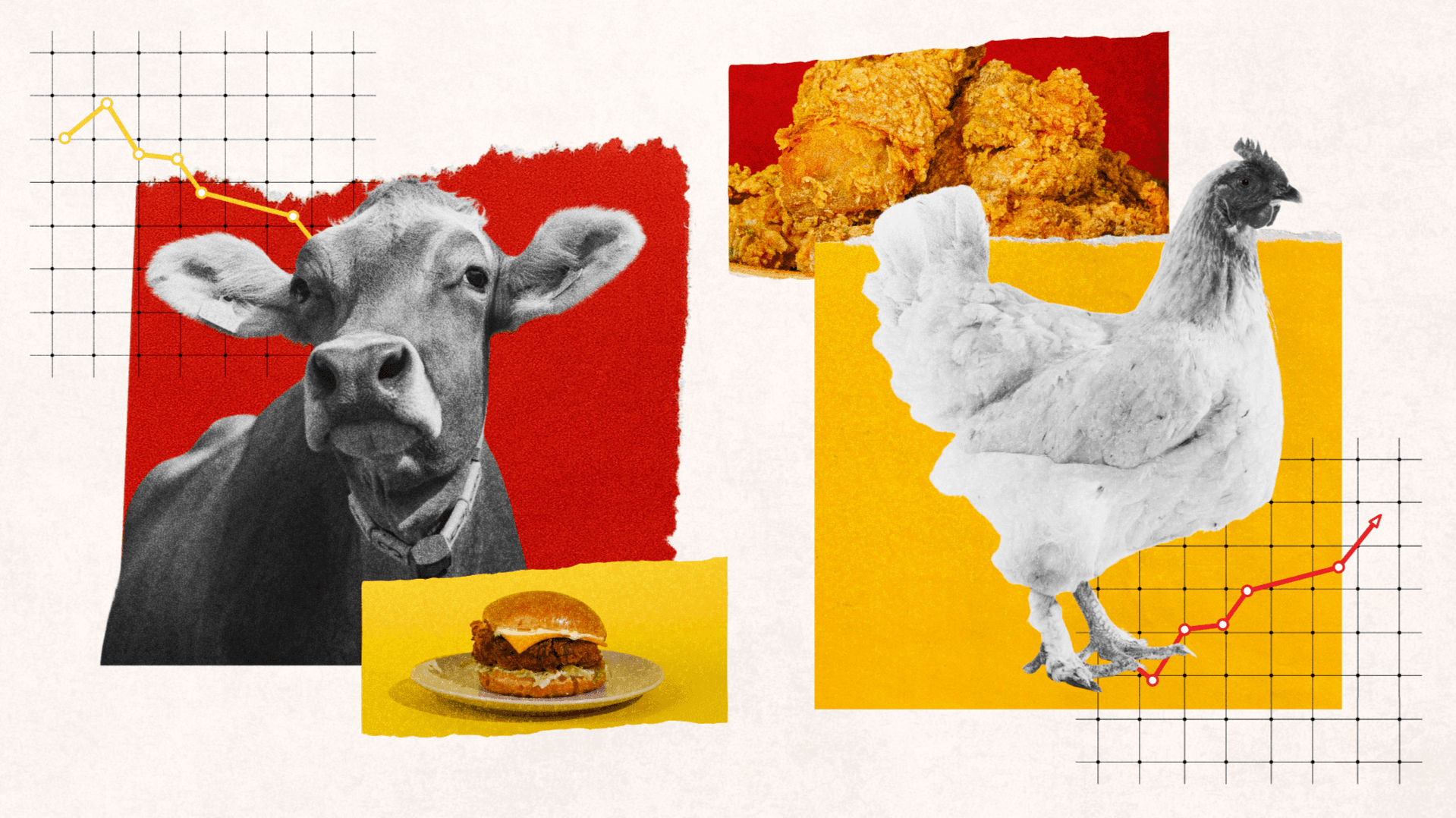
The price gap between beef and chicken sandwiches and wraps at quick-service restaurants has fallen from roughly 80 cents to 10 cents since 2023. Supermarket News reported new Numerator purchase data showing beef items up 28% over that period, compared with 12% for chicken.
Beef sandwiches and wraps now average $6.70 at quick-service restaurants, compared with $6.80 for chicken. The difference is now just 10 cents. In 2023, it was about 80 cents.
Average consumer spend per unit of beef reached nearly $14.70 in the 12 months ending July 31, up from $11.68 in 2023. Poultry rose 4% and pork 6% over the same period, and both remain under $10 per unit. Beef was up about 26%.
Beef now accounts for 56% of spending across fresh beef, poultry and pork, its highest share since 2019. That share increased 1 percentage point from a year earlier, a shift Numerator puts at roughly $1 billion. At the same time, beef's share of units purchased fell 0.8 percentage points, while poultry's increased by 1 percentage point.
USDA Economic Research Service data shows federally inspected beef production declined almost 5% in July. Wholesale prices remained at or above record levels for that point in the year, and tight cattle supplies are expected to keep second-half production below 2025 levels. ERS forecasts beef and veal prices to rise 9.8% for the full year, compared with 0.5% for poultry.
For burger franchisors, the change goes beyond a single quarter of higher costs. Beef has historically been the cheaper protein in many of these comparisons. That advantage has largely disappeared at the menu-item level. Franchisors may need to revisit value tiers and combo pricing using current beef costs rather than older cost assumptions. That pressure is already showing up at Burger King, which recently asked operators to absorb higher beef costs instead of raising menu prices.
Chicken-focused concepts now have a stronger cost story to make to prospective franchisees than they did three years ago. Development teams should be ready to back that argument with current food-cost data. Prospective franchisees comparing a burger concept with a chicken concept this fall should look at current food cost as a percentage of sales. They should also ask who absorbs commodity swings if the franchisor wants the system to hold menu prices.
Franchisors using old food-cost assumptions could have a tougher time making the case to new candidates.
Read the full article here.
Want to learn more about how 1851 helps franchisees find the right franchise opportunity? Visit www.1851growthclub.com and start your journey.