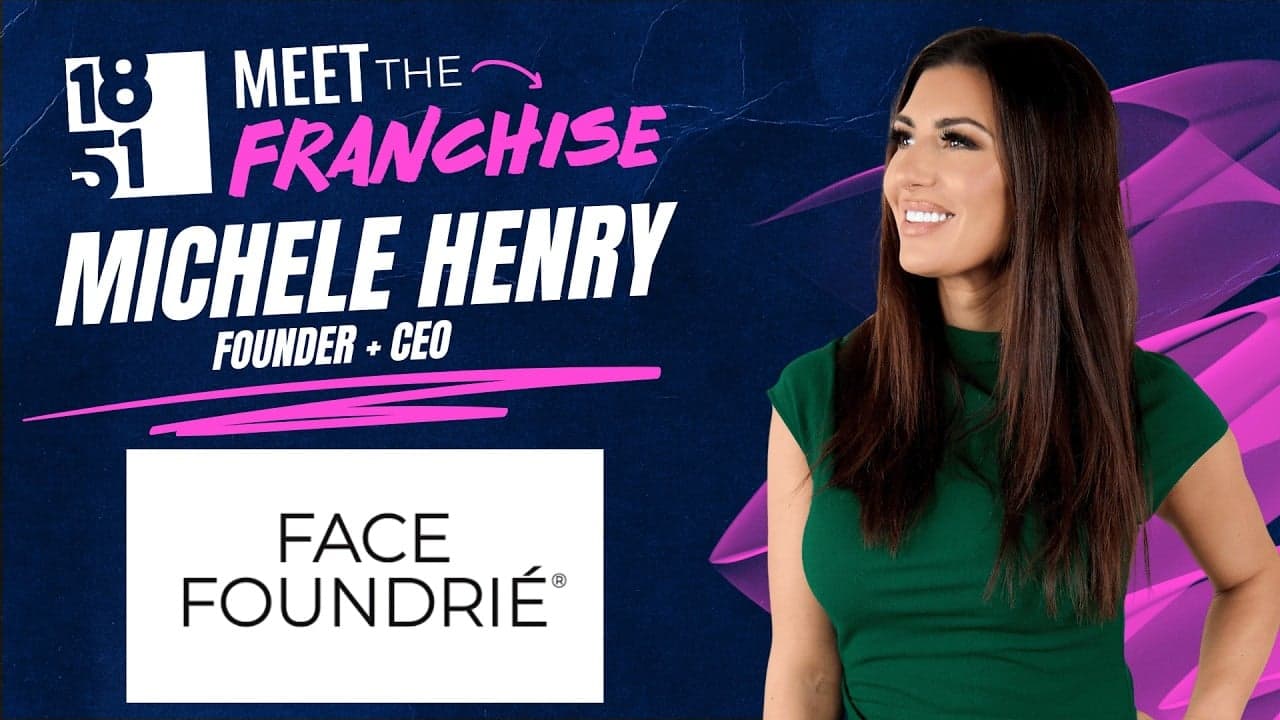
FACE FOUNDRIÉ is preparing to close out the year with 101 locations open, marking a major milestone for a brand that Michele Henry founded just seven years ago. The skincare franchise is also building its development pipeline, with new units planned in markets including Atlanta, Utah and California.
“I’m seven years in, and I wake up every day excited about this business,” Henry said. “I don’t think you hear that often from founders, but I’m feeling like I’m just hitting my stride at seven years.”
Henry said FACE FOUNDRIÉ has attracted franchisees from a range of backgrounds, including wellness, massage and boutique fitness, along with people leaving corporate careers to become business owners. While their experience varies, she said franchisees are drawn to both the business opportunity and the brand’s mission of helping people feel more confident through skincare.
“You can have a fantastic business idea all day long, but if you don’t have those numbers to back up that business and that concept, it’s not going to click,” Henry said. “I think they see the metrics in our FDD, but then they’re also very excited to help people be more confident through great skincare and through services and leading great teams.”
As the system has expanded, Henry has remained closely involved in decisions that can affect franchisee performance, particularly real estate. Rather than simply getting locations open, FACE FOUNDRIÉ looks for highly visible sites in strong retail areas with complementary co-tenants.
“Real estate is everything, and I am still so heavily involved in the real estate component, and I have been from day one,” Henry said. “We search out and find the absolute best real estate in a market.”
Henry joined 1851 Franchise Publisher Nick Powills on a recent episode of the “Meet the Franchise” podcast to discuss the brand’s growth, its approach to real estate and franchisee profitability and its relationships with franchise owners. A transcript of the interview has been provided below. It has been edited for brevity, clarity and style.
Nick Powills: How’s business going? What’s the good, the bad and the ugly?
Michele Henry: Business is great. I’m loving what we are building. We just closed quite a few units. We’ve got 10 going up in Atlanta, sold Utah. We’ve got a bunch in California. So it’s been a really busy year.
We’re going to close out the year with 101 units open, which is a big milestone for us. And we’ve got a lot of new innovation. I’m heading to Korea next week to go see what’s cooking in Seoul and meet with some manufacturers.
But it’s been so fun. I’m seven years in, and I wake up every day excited about this business. I don’t think you hear that often from founders, but I’m feeling like I’m just hitting my stride at seven years.
Powills: Where are these franchise owners coming from? Who are they? What are the backdrops?
Henry: People who align with wellness and our mission. Some come from other franchise concepts within the massage space or wellness space, fitness, boutique fitness. Some are corporate refugees. So it really is a nice mix, which is great because then we get a lot of diversity in helping build out our brand. It really isn’t just one specific personality or avatar.
Powills: Is it the brand that they’re buying into? Obviously, you can sell numbers, but are they buying into the brand and the mission? Is that part of the magic so that they are just as excited as you are when they’re getting into this, or are they buying into the business?
Henry: I think both, honestly. You can have a fantastic business idea all day long, but if you don’t have those numbers to back up that business and that concept, it’s not going to click. I think they see the metrics in our FDD, but then they’re also very excited to help people be more confident through great skincare and through services and leading great teams. So I think it’s a mixture of both.
Powills: If I take whatever your AUV is, let’s say for the first year it’s close to a million, a little bit less, I go a third brand, a third real estate and a third operator. If we miss on real estate, then say a $900,000 AUV turns into a $600,000 performance. That’s very tough to recover. If the brand is stable and we’ve hit the real estate, but we’ve missed on the operator, then there’s still a great asset that we can sell because we know if we put the right operator into that, even if we nail those first two. When I say that, how does that connect with the way that you would look at your business?
Henry: It’s so funny, Nick. You hit the nail on the head. Real estate is everything, and I am still so heavily involved in the real estate component, and I have been from day one. What’s different about our concept is we are literally going on Main and Main. We search out and find the absolute best real estate in a market and partner up and have great co-tenants because that’s half the battle. Whereas your traditional spa or facial bar, usually they’re going into a little bit of a secondary, off-main location, and that’s just not how our business model works.
I think about our first franchisee who ever signed on. Before she ever even signed her franchise agreement, I flew down to Chicago, and we did a huge site tour of all the sites and really distilled it down into what we were looking for and what we wanted to replicate before a franchise agreement was ever signed. It’s funny because I’ve been so involved from day one, and I love the real estate side, and I love the build-out side. I don’t think that’ll ever change. I love having my hand on that.
Powills: I think it’s so critical. My brain can instantly go to probably 10 [businesses] where I’m like, they were in the business of selling franchises. Yes, they’re in the business of getting franchisees open, but once they’ve sold a franchise, now they’re in the business of getting them open however they need to get open.
What’s fascinating to me is if you do the two things that you just said — I’m really focused on the real estate, and then I’m focused on protecting the brand — at the end of the day, that’s going to create more royalty for the franchise. It is what it is. Better real estate, better brand, better operator equals higher average.
But it’s fascinating because so many brands are looking at such a simple math equation, but they don’t protect the real estate and they don’t protect the brand. They’re just in the business of, how do we get these things open, whether the performance is below average or above average?
I think that’s the toughest thing in franchising for a franchise buyer. That same brand that’s going to have that behavior versus you, who’s going to go to Chicago, narrow down the units and say, “This is the right one.” You and them are selling the exact same thing.
That’s the toughest thing for a buyer because there’s no way, other than trusting your head, your heart and your gut, to say, “I landed with the right founder. I landed with the right CEO. I landed with the right brand.”
Henry: For sure. I think what’s powerful is we have so many multi-unit operators in our system. We just closed another deal last night, so I think we’re close to 97% multi-unit, and our franchisees keep reinvesting in the brand.
We went to a multi-unit show last year, and we brought our very first franchisee so she could speak to the brand and how we evolved. I think it’s such a critical part when you’re interested in a franchise brand. You have to connect with franchisees who are in the system, and most people overlook that because you’re just so enthralled with what the corporate team is telling you. Do your due diligence and talk to people who are actually part of the system and ask them, “Would you buy into this brand again if you had the opportunity?”
Powills: Yeah. When I’m talking with candidates, that’s the only question I tell them to ask: “Would you do this again?” If there’s any hesitation in their voice, it is so telling. I think there’s no real strong playbook in franchising because there are so many consultants and suppliers who say, “This is what you have to do.”
But in my opinion, it’s all about expectation setting. It’s not about average unit volume. If you engineer Item 7 to be very specific on what it’s going to cost — including what I think is the biggest miss of franchisors right now, which is that they’re not engineering the grand opening marketing fund properly — then if a franchisee is not performing well and you go back to them and say, “You’re going to have to spend more on marketing,” they’re like, “I’m not spending more on marketing.” It just won’t happen.
They haven’t engineered it based on what is the cost of user acquisition plus the value of that customer to say, “Let’s engineer a rush to break even.” If all this expectation setting is done properly for someone who, in many cases, is becoming a business owner for the first time, then what you just said happens. Franchisees continue to expand. If you miss it, then you see all these bad opens, and you have the hesitation when you say, “Would you do this again?”
Henry: Absolutely. And don’t get me wrong. We worked through things with our franchisees. I give them a ton of credit as we built this brand together. They were really receptive and gave great feedback on their communication style. We worked together really, really well because it wasn’t all rainbows and butterflies, Nick.
We worked through some times where we had these growing pains, where you jump from 20 units to 50 units and you’re trying to figure out, what is the grand opening strategy? What is working market to market? Sometimes it does differ. I feel like, really, in the last probably 12 months, we’ve hit our stride in figuring out exactly what that grand opening should look like. But they’ve been patient.
If there’s a franchise advisory council, call on that. We are coming off the heels of our franchise advisory council retreat, where we flew everybody up. We planned out all of 2027. We talked through everything and got them excited about what’s to come. But then they also got to give their feedback, and that is so important.
If you have a franchise advisory council that is strong and robust and works with the system, I can’t tell you how important that is as a franchisor. Calling on that as a potential franchisee in that system is also a huge area that people don’t tap into enough.
Powills: Think about it. If you were going to go through a traditional financial raise, you’re going to use investor money. Let’s just say all of your 101 locations were going to be corporate, and you went and raised the funds to do it. At the end of the day, you’re going to listen to your investors, and your investors are going to ask questions.
For some reason, in franchising, so many franchisors are like, “I want to rule with an iron fist because I’m in charge. I’m the franchisor.” I feel so bad for the franchisees who bought into that brand because these are your investors. They’re investing their life savings into the belief that they think this is going to build more generational wealth for them, right?
Henry: 100%. I think that is something that we have really tried hard to break the mold of traditional franchisor-franchisee relationships. You touched on it. That is exactly how it always has been in franchising, and for us, we’ve always asked ourselves, why? We want the feedback. We want to know what the client experience is, what the franchisee experience is, what the employee experience is and how we can make it better consistently because a high tide rises all ships.
They see it day in and day out. They are in the stores, and they understand the client experience we’re trying to deliver. Why wouldn’t we listen? I just don’t understand that mindset. It’s something we’re definitely trying to break the mold on, and I think we’ve done a great job doing that.
Powills: Now that you said that, I’m going to go unsolicited comment because I’m going to blow up your website in real time. I would say it says, “Your Franchise.” That’s anybody. Get rid of that. What you just said — “We’re breaking the mold of the franchisor-franchisee relationship” — and now the subhead turns into setting real expectations so that we can scale with our franchisees.
Did you know that X percent of our franchisees are multi-unit operators? Immediately underneath your fancy video, you have an empty building. I hate empty shots. Show me customers, but let’s push that all the way down.
The next thing I would do is say, “Meet our franchise advisory council,” because what you’re doing is you’re indicating, look at these people who are the voices of our business. You’ve now backed up what your word was, and you’re creating a point of differentiation in the marketplace.
Right now, you’re just selling a franchise in the way that you’re positioning it. Everything you’re talking about, including the way that you approach real estate as the founder and protecting these franchisees, is so powerful. But it’s not a part of your story.
Henry: That’s good feedback. I actually have been analyzing our website, so I’m going to Slack our team right now.
Powills: There you go. There’s the valuable takeaway from this. What keeps you up at night now? You’re so excited about it, but there have to be things where you’re like, “OK, how are we going to overcome this next hurdle?”
Henry: First, let’s back up. Going through ’23, ’24, what kept me up at night was, how are we going to build that generational wealth for our franchisees? Franchisees’ profitability is always top of mind. No matter what, it’ll never go away, and it shouldn’t go away as the CEO and as the founder.
For me, hitting this milestone at 100 units, now you really have a different battle, which is we don’t have a pipeline issue. We’ve got a ton of interest, a healthy pipeline, a lot of units we’re about to sell. Now it’s about maintaining that consistency because it really does fall on the franchisee, their staff, their estheticians, to make sure every single service is 100% top-notch.
Let’s face it. Everybody has a bad day, so you’re subject a little bit to folks and how they step in and how they show up. But it’s making sure that consistency and our client journey are followed every step of the way in every single store. It’s building our support team at HQ to make sure that is maintained as we scale.
Powills: How many hours in your onboarding training are customer service?
Henry: Nearly all of it. We’re talking about it at the bedside. You’re talking about how you’re walking them through their consultation, their entire service. It is every single touchpoint.
Powills: At least you’re setting the expectation properly because you’re right. As you continue to expand and add more different types of DNA to your system, it’s hard because a franchise buyer can tell you anything that you want to hear in the interview process. Then it comes to, OK, now we’re actually in business together. You’ve actually signed the check. Now what are your true colors?
The thing that you have to navigate, one, is their turbulence of stress because now there’s cash leaving their pocket, and there’s no cash coming in until the unit opens. You have to navigate that. Now that you’ve opened, you have to encourage them to press the pedal the right way.
But the magic in all this is get a customer in, meet and exceed their expectations, that customer comes back, and that customer tells another customer to come in. It’s not rocket science, but it’s all based on customer service, right?
Henry: It is. I’ll take you way back. In 2019, when I started FACE FOUNDRIÉ, we really didn’t have a marketing budget. It was all word of mouth. We positioned ourselves within the Galleria to be next to a Starbucks. We relied solely on word-of-mouth marketing and guerrilla marketing because we just didn’t have the means to invest in marketing at that moment. It really was what propelled us to launch store two and sign that lease within 30 days of opening our first store.
It really was this very viral moment locally with our community. You asked about some of our franchisees’ personality types, or who is this franchisee? The one common denominator through all of our franchisees is they are the mayor of their town when it comes to knowing who to partner with, knowing who their influencers are, knowing where they want their location to be because they shop, eat and live there.
That is one thing I will call out. That community aspect hasn’t left. We started with it with our first location, and it’s been consistent throughout. I think the brand seems to attract that type of person who really loves to immerse themselves in their community.
Powills: How do you vet that in the sales process?
Henry: Tell me where you’re going to go. Who are you going to partner with? At confirmation day, we’re asking all of those questions. What’s your strength? What’s your weakness? Where’s your area of opportunity? I want to know because our team can then better support you.
If you hate marketing, OK, that’s usually kind of a tell. That’s OK. We’ve got folks who don’t love it, but then they backfill it with someone who absolutely crushes it in marketing. We call it out right away. You have to know your strengths.
Powills: You’re hitting this milestone, and my number has always been, what, 1% of businesses make it to — 1% of franchises make it to 100 units? I actually think that number is far less. If you look at how many new brands come in and how many brands exit each year, I think it’s less than a percentage point. So you are now in the 1% of franchises.
Henry: Guess how many are women?
Powills: Maybe 0.01%.
Henry: Guess how many are still founder-owned without private equity?
Powills: Ooh, that’s a tough one. Very, very few.
Henry: It’s 0.003%. Crazy. That’s why I’m like, oh my gosh, I love women in franchising and not taking on any debt right now. We’re hitting a milestone that was what I dreamed about when we initially launched. This is such a big moment, but it’s definitely been a grind.
Powills: Go back to Michele at one unit, who’s decided to franchise her business. Now knowing what you know, what are you saying?
Henry: Keep your head down and keep going, and move faster. Don’t get distracted. Stay focused. When we launched initially, we had five beds, and then we had a juice bar because I thought, “Oh, people are going to want to stay. They’ll sip on juice.” It was more of this holistic approach all around.
Within 48 hours of opening, it was so glaringly obvious that the beds are where you’re going to make money. So we closed down, we repositioned the store, we scrapped the juice, and we added three more beds. Don’t be afraid to pivot, but move faster. I think I’m always a little hard on myself. We probably could move faster.
Powills: Yeah, that resonates with me. I think the way that I articulate it for myself, if I go backward, I’m like, play to win. I think sometimes, especially me as a business owner, I play not to lose.
Henry: Yeah.
Powills: In that scenario, I would protect the juice bar. I’d be like, “Well, but we invested in it. Let’s give it a shot.” That’s playing not to lose, right?
Henry: Totally. You’ve got sunk costs, and there’s that capital investment, but then the emotional investment because it’s tied to an idea that is yours. I 100% get that. But it’s not being afraid to shed things that aren’t working and recognize that quickly because I get why you want to hold on. There is an emotional tie there. But I take it very seriously when our franchisees are investing their life savings. You have to make sure that there is profitability at the end of the day, no matter what.
Powills: As an entrepreneur, at least from my viewpoint, at some point it’s not the money, it’s the scorecard. The dream never stops. There’s no ending to this, and there’s no ending to the scorecard.
I think about this constantly. We’ve done great in business. We’ve done some awesome things, but I want more, not for financial reasons, but because I feel like we can impact more people, or whatever mine is. What is your next dream, and how are you controlling your own mental scorecard?
Henry: It’s so funny because you’re probably pretty competitive. I certainly am, and I think about it often. There is nothing quite like the adrenaline rush that you get when you see a franchisee opening their business, and when you’re there and you see a dream fulfilled. That’s like my drug of choice, to be honest. I don’t drink. I work out and I pursue business. There’s just nothing quite like it.
You think about scorecards. I’m just constantly chasing that because it’s such a high and such a rush. I think that is really what I consistently think about. It’s not certain milestones in the end. It’s truly, how do I continue to be a dream builder, and what do we have to do to make sure we build more dreams and fulfill more people’s goals and wishes? To see them opening a concept that was just an idea in my head at one moment in time, it’s pretty surreal.
Powills: That’s crazy. You’re a fraction of a percent female founder who broke over 100 units in franchising who is not private equity-backed. There you go. That’s you. You are the dream.
Again, what I love about these conversations is, one, there’s no script. I don’t know where I’m going. But unpacking your psyche as a founder, which is happening through our conversation, then I go and keep looking over at your website on my right screen. I’m like, it’s pretty, but man, there’s such an emotional connection to you that if that gets lifted up as part of your why, it will capture more people’s attention because it’s so much deeper than a picture of beds.
Henry: I love that. It is so hard because we have people coming for confirmation day, and I swear, almost a 100% close rate. They will want to sign on if we’re going to award. But it’s my team. Honestly, my team is just as passionate as me. We would not be here without the team we have in place. They are so passionate. They are absolute warriors.
I love the team, and I love our franchisees. I think that’s really special. I don’t think a lot of people, especially seven years in, would be saying that. It’s like a marriage. You get into franchising, I think it’s like a marriage, and you better like the person that you are linking up with.
Powills: I think you’re doing a great job. Seven years to get to this number. You’ve done it the right way. You’re growing the right way. You’re learning the lessons. You’re cross-applying it back. Awesome story. Thank you so much for sharing some of it with me today.
Henry: Nick, really appreciate it. Thank you for what you’re building, and thanks for having me on.
Watch the full episode above or on YouTube.