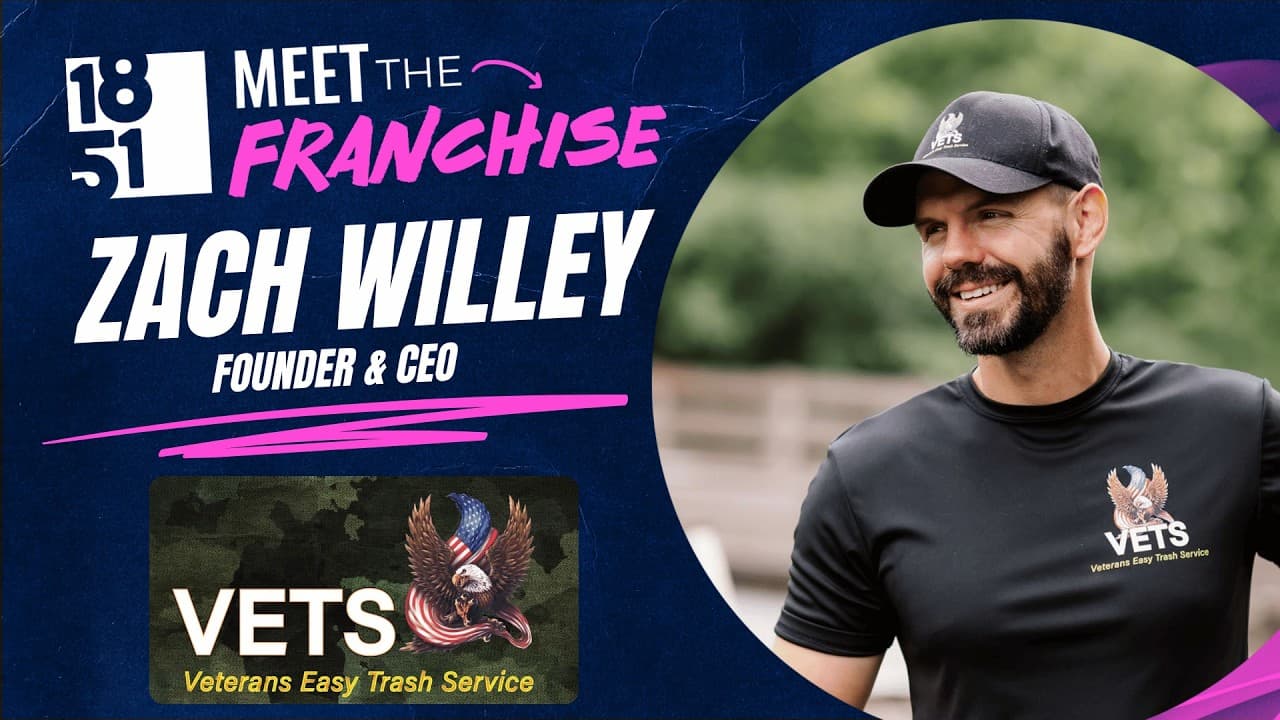
Zach Willey served as an assistant professor at West Point, a company commander managing more than $40 million in combat equipment, and an executive officer directing complex overseas logistics in Afghanistan. His leadership ability is unquestionable to most who know him. In a recent interview with 1851 Franchise publisher Nick Powills, we dove deeper into the humble beginnings of his journey from military leader to business owner and future franchisor of VETS Easy Trash.
After coming off of active duty in 2020, Willey had found himself, like most veterans, working inside a corporate environment. During COVID, the city decreased trash services near Willey, causing a bit of trouble while he moved into a new home and needed some items taken to the landfill. Without thinking much of it, Willey decided to do the “dirty job” himself.
"Strange as it may sound, I had the best time ever. I got a good workout in," Willey said. "I went right before sunrise, and as I'm unloading stuff out of my truck and trailer, I looked back at the landfill and the sun was coming over the landfill. That's how I stumbled into it."
From there, a business was born, and success quickly followed Willey. He was able to quit his corporate job just two years into business ownership, cementing his status as a powerful force in business, just as he had in the military. But like most owners, Willey discovered that the cost of owning a business was great.
"I have a wife and four little kids, and one reason I got out of the Army is I didn't want to be away," Willey said.
Franchising became the switch that VETS Easy Trash needed. It became a mission for Willey and his staff, not only to effectively haul trash and be the fastest, most efficient business in the region so they can increase clients, but to offer the operational game plan as a new service, as a franchisor.
"I just kind of thought, how cool would it be if I can solve this problem of our clients needing service, but then I can also give opportunities to veterans to build their own businesses," Willey said.
Willey joined 1851 Franchise Publisher Nick Powills on a recent episode of the “Meet the Franchise” podcast where they discussed the mindset shift from owner to franchisor and the unit economics that keeps veterans empowered. A transcript of his interview with Powills has been provided below. It has been edited for brevity, clarity and style.
Nick Powills: How did you accidentally fall into franchising? What's your franchise backstory?
Zach Willey: I truly fell into it. I got off active duty in the Army in 2020 and got a corporate job, as a lot of Army people do.
Right after moving before COVID, I had all this stuff that needed to go to the landfill, but the city wouldn't take it anymore because of COVID. So, I took it to the landfill myself. As strange as it may sound, I had the best time ever. I got a good workout in. I went right before sunrise. As I was unloading stuff out of my truck and trailer, I looked back at the landfill. The sun was coming over the landfill, and I could see the rays shining through the stink coming off of it.
That's how I stumbled into it. I was hooked. I went home and told my wife, "I'm going to start a junk removal company," and she thought I was crazy. But I started from there. I put together a website and started getting customers. I kept my corporate job, but after about two years of grinding, I was able to jump to that full-time.
We've been really fortunate with a good national accounts program, so I started getting requests in other cities and states. That's where we shifted some focus to franchising as an expansion plan. In mid-2022, we had our first franchise location in Savannah. Fast-forward four years: we have 15 franchisees now, a corporate store in Charlotte, and we are just continuing to grow.
Powills: So, you get the business going. How does franchising come into the discussion? Is it you proactively thinking, "I'm going to franchise this thing?" Because when you have that perfect moment as an entrepreneur, you're not thinking about it when you see the sun rise over the landfill dumpster. At what point does "All right, maybe I want to scale this in a different way," come to fruition?
Willey: I have a wife and four little kids, and one reason I got out of the Army is that I didn't want to be away.
The way we've been doing junk removal isn't rocket science, but I think we have a unique approach to it. We're very commercially focused with a good, recurring customer base. When I had important clients start reaching out and saying, "Hey, we need you in Savannah," or, "We need you down in Florida," I dipped my toes into doing it in-house, but I realized that wasn't for me.
I liked the idea of having an expansion model. Part of my mission and vision is my passion for the veteran community. There are a lot of issues and hurdles that the community faces coming off active duty. I thought, "How cool would it be if I can solve this problem of our clients needing service, while also giving opportunities to veterans to build their own business and do this?"
It evolved over time. First, I was solving my own problem of how to grow what I think is a unique, effective model without slaving away myself and giving up the reason I left the military, which was to focus on family.
Powills: Franchising a business can be expensive, and it's like you're starting up business number two. How are you feeling from a comfort zone standpoint when going through the process? How are you balancing where your dream of eventually helping vets get into business aligns with extending yourself to the second business model of a franchise?
Willey: It has not been easy. I'm not a business expert, and I don't know every industry. But we've been very fortunate. Junk removal is not super capital-intensive. It is more of a leadership and labor pool problem to solve. My military experience definitely helps with that.
Our corporate store that started this all has been profitable from the beginning with good cash flow, and I reinvested some of that money into starting up the franchise.
This is my first time being a franchisor, but I've heard that getting to the point where your royalties are sufficient to run the business is a big hurdle. We've been blessed; since day one, even with our first franchisee, we've been royalty-sufficient. We actually financed every franchise fee so far, so they pay it over time. That means the support we gave initially probably wasn't the greatest.I was the only person on the franchise staff at first. Since it's not rocket science, we were able to help our locations grow organically.
It's a big mindset shift going from a junk removal operator growing a company to being a franchisor. It is a very big mental shift with a different employee pool and different competencies.
There's a little bit of luck in there, but through a lot of hard work, we haven't needed funding. We've been relatively self-sufficient, and I have a great group of people around me. We continue to grow, add more staff, and provide more support. For us, it has just been hard, efficient work to make up for our size, age, and everything else.
Nick Powills: In today's world, you have to make a decision as a human to go protect our country and sign up for the military. When you get into the military, someone tells you to do something and you do it. Historically, why franchising loves a veteran is because someone who has gone through that training buys a franchise and can follow the system. That's all you ask them to do: go follow it every single day.
Where brands sometimes fail is when they say "follow the system," but it isn't really operationalized. They are taking someone who didn't necessarily come from a background of six different militaries before joining. To a franchisee, that gap is real.
The franchisor that wins is the one that truly operationalizes the business to say, "Now that we've identified you as an owner, we're going to put you to work." Where it fails is where it's vague, like, "Go knock on some doors." You have to be very specific and prescriptive.
Your story led to building your own business and bootstrapping. Then you hit a moment where commercial accounts wanted you in other markets, so you decided to franchise. Now you're going through that next hurdle.
The challenge for any franchisor is that it only yields $50,000 in royalties back to you. It's not like you get rich off that right away, because you have to hire support mechanisms and invest in technology and branding to support them. Getting to royalty sufficiency is the mission, but trekking through that mud is a process that is sometimes hard for franchisees to understand. You're going through a lot to give them everything you have.
Willey: Not all of our franchisees are veterans, but 12 of the 15 are. That mentality definitely helps. They're used to “prescribed uncertainty”, if that's how I could phrase it. You have a mission and a way to do things, but every day can be different, so that helps us.
I take that approach with our franchisees. Most of them have come from referrals or my own military network where we already had work lined up. I would ask, "Hey, do you want to give this a shot?"
We were very transparent in the early days with our first handful of franchisees: "There's money there waiting for you, but we don't have a ton of systems or support in place. Are you still interested or willing?" It was about the opportunity value of being the first ones in with no competing locations or territories. Fortunately, we found a really good group of people willing to take that risk with us.
We have done a lot of building in flight. For our first three franchisees, there was no LMS, it was just "call Zach about everything." Even our CRM was very basic. As we've grown, we find things that work, and then as we scale, we break them and have to reinvent them.
The way we've done it takes a lot of personal involvement. As the founder and CEO, I can't sit back and let my staff do everything; I have to be very involved day-to-day for probably the next year or two, and that's okay because I like doing that.
What else has helped us a lot is that our corporate store is the golden example. It's probably in the top 10% for junk companies as far as size and revenue for a single location. I have a full staff in place and spend maybe two hours a week on that location, so that provides a really good template for our franchisees to follow. We've proven it there, and it serves as a good training ground. We can bring franchisees out for a week to run through our positions in that company.
Having a corporate store as the template relieves some of the reliance on online systems. It's hard to learn junk removal online in an LMS. You can learn the business aspects, but the operational and networking pieces are hard to teach without doing it.
Powills: You're also teaching trust. If you can trust someone to operate your corporate unit where you only spend two hours on it, that's an exercise in scale, which is the magic. That's where any franchisee gets lost and fails to scale their business. You can make good money in a lot of different franchises, but you're not going to make generational wealth until you master the art of scale.
Franchisees might dream of making wealth that impacts their family, but they struggle to get to that same point of, "How do I learn from Zach, get it down to two hours on unit one, get unit two going, and put the other 38 hours against that?"
It's awesome that you've done that. What keeps you up at night right now?
Willey: Every day I'm learning more about being a franchisor. It's the 80/20 rule: 80% of them are going to be good, and 20% are going to be outstanding and need little guidance. But then you have the other 20% where no matter what you do, they seem to be struggling.
That's the main thing for me: I don't want any of ours to fail. No one is really close to failing, but we do have that 20% where I wonder, "Why is the playbook not working for you? Are you not capable of certain aspects, meaning we need to help you hire people to cover down on that?"
I hate seeing franchisees get into cash crunches. A lot of our clients are net 30, so you have to manage your cash. You do work, but you don't get paid until later on. I care a lot more about their locations than my corporate location, and I want to see them flourish. When they hit roadblocks, it keeps me up a bit.
Powills: What's your total investment at?
Willey: $39,000 to $59,000 for the franchise fee, and our FDD initial startup estimate is $68,000 to $179,000, so it's relatively low.
Powills: Looking at your story, I love it. At 15 locations, you're doing great, but eventually, you should go back to that franchise website and revamp it. If it were me, I would take clips from your opening statements and put them on your video.
Willey: It's funny you say that. After I attended FranCamp with you, my staff and I have been spending at least two hours a week working through that workbook. This week we finished going through it all to where we can start building our assets out. It has been super useful.
Having the story in my head and heart is one thing, but putting it on paper has been a big step. We had our customer-facing mission, but we didn't have an organizational or franchisee mission written out. When we wrote our organizational mission, it really pumped us all up. The end of our mission statement is: "We want vets to be positioned to be a pivotal member of a veteran coalition that impacts the veteran community nationwide." That resonates, especially since a lot of people on my team are veterans.
Regarding our "Why us? Why now?", our big three pillars are: high-growth revenue potential with a strong recurring customer base; lifestyle flexibility to impact your community or grow it and step back; and an awesome corporate store template to follow. You personally have helped us develop our story, and I'm super excited to operationalize it over the next month or two.
Powills: Let's close on this, Zach: if there's a buyer watching this right now, what else do you want them to know about the business?
Willey: Junk removal is a gritty but fun business with lots of personal fulfillment. There are lots of franchise opportunities out there, but ours resonates really well with the veteran community because we are doing real things in the real world, touching real people. As the world modernizes and AI rolls out, that hands-on reality becomes more rare. People often live in a bubble in a home office or store setting.
The coolest thing about this business is that I know every backstreet alley in Charlotte, North Carolina now. I've met so many people at their best and worst times, not only customers, but employees too.
I had never been a civilian employer before; I was a military officer, so I was a leader. I've hired veterans coming out of the military with PTSD who were broken and unsure of what to do with their lives. After spending a year or two with us, they go back to college, pursue their dreams, or stay with us to grow.
One of my first hires is now our tactical trainer for the franchise because he knows junk removal so well. He built a career out of starting as a junk guy. If you want to be out in the real world doing real things in a franchise system, we're definitely a fit.
From a financial investment standpoint, there is a very high ceiling and potential for generational wealth, but it takes a lot of sweat equity because it doesn't just happen behind a computer.
We've proven the model in our corporate store. It's giant and runs almost by itself. It serves as a proven location that everybody in the system can look up to and try to beat one day. Our franchisees in Atlanta tell me all the time, "We're going to beat you one day, Zach. We're going to be the gold standard, not the corporate store." I welcome that. That's what I would say to prospective buyers.
Powills: I would also tell prospective buyers to listen to your opening story about seeing the sun rise over the landfill. Everyone who gets into business has those moments, and it feels different when it's your own. You're able to teach them how to get there. You're just a little bit further ahead because you started working on this five years ago. Through that opening statement, they can see themselves owning something and seeing the same light you saw. That's a cool pathway and a great story.
Willey: And with a lot fewer hurdles than I had.
Powills: You managed the trash first.
Willey: Franchisees will call me freaking out about an issue, and I'll ask, "That's it?" And I'll tell them, "Okay, this is no problem." I've had plenty of times where I thought my business was over (equipment destroyed, people in accidents). We've ironed out those wrinkles so our franchisees generally don't go through the same setbacks we originally did.
Powills: I love it. Zach, thank you so much for sharing your story. Love what you're doing, keep up the good work, and keep us posted. I appreciate you doing this.
Willey: Awesome. Thanks, Nick. It was a pleasure.
Watch the full episode above or on YouTube.