
Home Halo
SPONSORED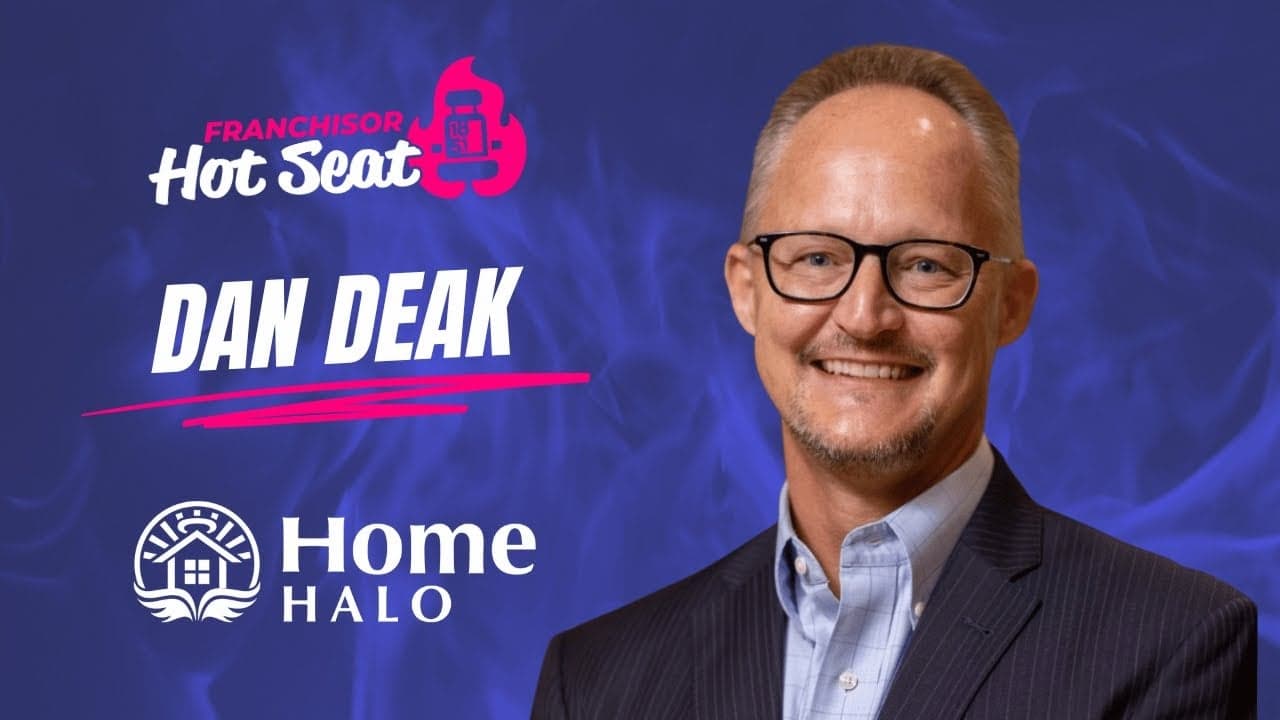
How Home Halo Is Shaping the Future of Senior Care Franchising
Home Halo offers a scalable senior care franchise model focused on caregiver retention, real-world support and meaningful impact in a growing, underserved industry.
Dan Deak, CEO and founder of Home Halo, recently appeared with 1851 Franchise’s Nick Powills on an episode of “Franchisor Hot Seat” to share his journey from hospice care and franchise operations to launching his own non-medical home care brand. With over a decade in the industry, Deak has seen the space from every angle — nonprofit hospice, franchisor, operator — and now, as the creator of a franchise model built to empower others.
“When I got into franchising, it just set my world on fire,” Deak said. “You could create a duplicable business process that almost anyone can follow and be successful in that business.”
Home Halo stands out in the crowded senior care industry, not just for its services but for the depth of its founder’s experience. Deak has launched offices across the country, both as a franchisor and as an owner, and now operates corporate-owned locations in six states. That experience translates into real-world support for franchisees.
“My differentiator is that I’ve done it myself. I’m still doing it,” he said. “Many home care franchisors don’t operate corporate-owned locations. I do — in six different states.”
Home Halo’s model is built around caregiver retention, one of the biggest barriers in the industry. Deak said most caregivers don’t leave for money, but for a lack of consistent hours. “We’ve developed a unique scheduling strategy that maximizes a caregiver’s available time. If they want to work eight hours, we give them eight hours.”
For Deak, the business is personal. “Two years into the business, my mom had a fall. She was perfectly fine one day and needed help getting dressed the next. It changed everything.”
While many franchise systems seek candidates with deep pockets or prior ownership experience, Deak is focused on something else. “What I’m looking for is their ‘why.’ That’s the first thing I ask every employee and franchise candidate.”
Ideal franchisees might be nurses, corporate professionals, veterans or former athletes — people who are comfortable with systems and passionate about helping others. “The goal should be to make yourself replaceable,” Deak said. “That’s how you scale.”
Home Halo offers franchisees a clear path to do meaningful work, build wealth and maintain control of their time — all with a system backed by someone who’s walked the walk.
A transcript of Deak’s interview with Powills has been provided below. It has been edited for brevity, clarity and style.
Nick Powills: All right, Dan, this one's slightly different because you and I have a friendship and I know most of the story, but I'm still going to ask you the same question I ask everybody. How did you accidentally fall into franchising? What's your franchise backstory?
Dan Deak: Yeah, so my business, Home Halo, is a non-medical home care franchise. I've been in the home care space for about 10 years. The first agencies I started up were not-for-profit hospices. Then I had the opportunity to work for a franchisor in the home care space.
I did that for about four years. I've always had a love for business and business models. I think even as far back as I can remember, I pretended to have businesses. It’s something that’s always been in my blood.
When I got into franchising, it just set my world on fire. You could create a duplicable business process that most anyone can follow and be successful in that business.
Powills: I want to dive into part of the story. You were working for another franchisor. Your backdrop is a little different than someone going from corporate America to franchising. Did you contemplate becoming a franchisee? Did you go down that pathway and not find anything that aligned, which made you become a franchisor? What was going through your head?
Deak: I worked for a home care franchisor and had some great experiences. I met some incredible people. My job was to launch new offices all throughout the country. We put together a rock-solid launch plan, which I’ve added to since. That experience in franchising really hit home — it felt like a comfort zone for me.
I never really considered getting into any other type of franchise or becoming a franchisee. When I left the franchisor, my plan was to create my own little home care empire—own offices throughout the country, almost like a Chipotle model, where it’s corporate-owned versus franchise-owned. I had really good success with those businesses, but I felt like something was missing.
I enjoyed coaching people who were looking to realize their goals and dreams through building a business — those people who had been in the corporate world for decades and were always looking for a way out. From the time I graduated college, I always felt like a square peg in a round hole. I never felt comfortable in that corporate space. I always felt like I was capable of more but wasn’t necessarily given the opportunities.
Even as an employee, I treated it like it was my own business. That’s what made me successful in those roles. But the ownership aspect — being able to chart my own course — wasn’t available to me in the corporate space. That’s why I’ve been drawn to franchising. I get such personal gratification from investing in people and helping them accomplish things they never even thought possible.
My dad is a Hall of Fame high school baseball coach. He’s actually getting honored again in August. I saw him take average athletes and pour into them, teach them fundamentals and strategy, and turn them into Division I athletes. I get that same kind of satisfaction through coaching franchisees.
Powills: So you’re building what you call your empire, planning to go the corporate route. Do you remember how fast the dial changed to “I’m missing something”? Was it immediate? Or after you started making money?
Deak: I think it was after I started making money. At first, you’re just in action mode — pouring all your energy into building something new. Then I started making really good money and I still wasn’t satisfied. That wasn’t what was filling my cup. Helping others was. With franchising, I can fill my cup while pouring into other people.
Powills: Here's the Hot Seat question. The senior care space has massive demand. But most of the logos on the door offer the same core caregiving services. Often the only differentiator is whether a brand has territory left. Occasionally, a franchisee will say support and culture pushed them over the edge. How have you established a point of differentiation for your brand?
Deak: Great points. The senior care space is very crowded. In any city in the U.S., you can probably find 50 to 100 different home care brands.
Powills: And often the caregiver could work for multiple ones.
Deak: Exactly. There are 65 to 70 senior care brands out there. If you look at the top 15 to 20 and combine all their revenue, they still don’t even hold 10 percent of the market share. That means 90 percent of care is still provided by mom-and-pops or smaller regional companies.
I don’t consider other brands my competition. My competition is the lack of awareness about the impact senior care can have.
From the franchisor standpoint, my differentiator is that I’ve done it myself. I’m still doing it. I know what challenges franchisees will face because I’ve faced them myself. Many home care franchisors don’t operate corporate-owned locations. I do — in six different states. That’s a big differentiator.
From the consumer standpoint, yes, we all provide help with ADLs [activities of daily living] and IADLs [instrumental activities of daily living]. But the biggest barrier to growth is caregiver retention. I don’t have trouble finding caregivers — the key is keeping them.
They usually don’t leave for money. They leave because they aren’t getting the hours they want, when they want them. We’ve developed a unique scheduling strategy that maximizes a caregiver’s available time. If they want to work eight hours, we give them eight hours. That reduces caregiver turnover, which improves client retention.
Powills: So with all this — large multi-unit operator, deep passion, proven systems — aren’t other big players knocking on your door to buy you?
Deak: I’ve had people reach out wanting to get involved, but not necessarily competitors. Honestly, I have a personal reason for doing this. Two years into the business, my mom had a fall. She was perfectly fine one day and needed help getting dressed the next. It changed everything.
That’s what so many families go through, and I want to help them. That’s why I do what I do.
Powills: That’s a powerful story. Most franchisees in this space have a moment — an aging parent, a realization that life can change instantly. That lights the fire.
If someone had caught you early, they could’ve partnered with you instead of competing against you. I say all the time: catch the entrepreneur before they catch you. In your case, you built your own way, and now others will follow.
Deak: I’ve become better at identifying talent because of my own corporate experiences. And like my dad did with baseball players, I try to find people capable of more than they realize.
Whether they got great care for a parent and want to give back, or they got terrible care and want to do better, both motivations work. What I’m looking for is their “why.” That’s the first thing I ask every employee and franchise candidate.
The vision for the brand is to keep growing, both through new franchisees and corporate-owned offices that we can eventually sell as turnkey businesses. I see what I want it to look like in 10 years. The path to get there is still unfolding.
Powills: You mentioned nurses are great fits. Who else do you see as strong franchisee candidates?
Deak: Nurses, definitely. They bring empathy, assessment skills and clinical judgment. But you don’t need a healthcare background. A lot of my most successful franchisees come from corporate roles. Athletes and veterans also do really well. They’re used to systems, fundamentals and following a game plan — all essential to franchising.
Powills: If you weren’t managing a franchise, just your own operations, how many hours would you work per week?
Deak: I love to work. But I also love having the flexibility to work when I want. That’s special. I might go for a two-hour run in the morning and work later. That autonomy is everything.
The goal should be to make yourself replaceable. I want people who know the business as well as I do running it, so I can guide the ship without micromanaging. That’s how you scale.
Powills: How many corporate-owned locations do you have?
Deak: We operate in six states: New Mexico, Iowa, Colorado, Wisconsin, Texas and Florida.
Powills: And if they were franchises, how many territories would that be?
Deak: It’s hard to say exactly. Some of our offices serve very large, rural areas, especially through VA contracts. Franchise territories usually cover about 250,000 people, mostly in metro areas. But rural areas are underserved, and there are a lot of veterans out there who need care, too.
Powills: You're a top-tier multi-unit operator, no question. And you’ve built this while maintaining work-life balance. If I’m a buyer, that matters. They’ll be in the trenches at first, but you’re showing how to build a replicable system and eventually step back.
Deak: I haven’t personally provided a minute of care in 10 years. It’s about hiring and training great people and giving them the tools to succeed. That’s how you build something sustainable.
Powills: Final thought. Most franchisors say they want multi-unit operators. But you’re saying: give me someone coachable, with a big “why,” and I’ll show them how to scale. That’s rare — and powerful.
Deak: Absolutely. Thanks, Nick. It’s an honor to be in the Hot Seat.
Powills: For Dan, I’m Nick. This was another episode of “Franchisor Hot Seat.”
Watch the full interview above or on YouTube.
To find out more information on costs to buy this franchise, please visit https://1851franchise.com/home-halo.
Home Halo
SPONSOREDHome Halo offers a scalable senior care franchise model focused on caregiver retention, real-world support and meaningful impact in a growing, underserved industry.
Dan Deak, CEO and founder of Home Halo, recently appeared with 1851 Franchise’s Nick Powills on an episode of “Franchisor Hot Seat” to share his journey from hospice care and franchise operations to launching his own non-medical home care brand. With over a decade in the industry, Deak has seen the space from every angle — nonprofit hospice, franchisor, operator — and now, as the creator of a franchise model built to empower others.
“When I got into franchising, it just set my world on fire,” Deak said. “You could create a duplicable business process that almost anyone can follow and be successful in that business.”
Home Halo stands out in the crowded senior care industry, not just for its services but for the depth of its founder’s experience. Deak has launched offices across the country, both as a franchisor and as an owner, and now operates corporate-owned locations in six states. That experience translates into real-world support for franchisees.
“My differentiator is that I’ve done it myself. I’m still doing it,” he said. “Many home care franchisors don’t operate corporate-owned locations. I do — in six different states.”
Home Halo’s model is built around caregiver retention, one of the biggest barriers in the industry. Deak said most caregivers don’t leave for money, but for a lack of consistent hours. “We’ve developed a unique scheduling strategy that maximizes a caregiver’s available time. If they want to work eight hours, we give them eight hours.”
For Deak, the business is personal. “Two years into the business, my mom had a fall. She was perfectly fine one day and needed help getting dressed the next. It changed everything.”
While many franchise systems seek candidates with deep pockets or prior ownership experience, Deak is focused on something else. “What I’m looking for is their ‘why.’ That’s the first thing I ask every employee and franchise candidate.”
Ideal franchisees might be nurses, corporate professionals, veterans or former athletes — people who are comfortable with systems and passionate about helping others. “The goal should be to make yourself replaceable,” Deak said. “That’s how you scale.”
Home Halo offers franchisees a clear path to do meaningful work, build wealth and maintain control of their time — all with a system backed by someone who’s walked the walk.
A transcript of Deak’s interview with Powills has been provided below. It has been edited for brevity, clarity and style.
Nick Powills: All right, Dan, this one's slightly different because you and I have a friendship and I know most of the story, but I'm still going to ask you the same question I ask everybody. How did you accidentally fall into franchising? What's your franchise backstory?
Dan Deak: Yeah, so my business, Home Halo, is a non-medical home care franchise. I've been in the home care space for about 10 years. The first agencies I started up were not-for-profit hospices. Then I had the opportunity to work for a franchisor in the home care space.
I did that for about four years. I've always had a love for business and business models. I think even as far back as I can remember, I pretended to have businesses. It’s something that’s always been in my blood.
When I got into franchising, it just set my world on fire. You could create a duplicable business process that most anyone can follow and be successful in that business.
Powills: I want to dive into part of the story. You were working for another franchisor. Your backdrop is a little different than someone going from corporate America to franchising. Did you contemplate becoming a franchisee? Did you go down that pathway and not find anything that aligned, which made you become a franchisor? What was going through your head?
Deak: I worked for a home care franchisor and had some great experiences. I met some incredible people. My job was to launch new offices all throughout the country. We put together a rock-solid launch plan, which I’ve added to since. That experience in franchising really hit home — it felt like a comfort zone for me.
I never really considered getting into any other type of franchise or becoming a franchisee. When I left the franchisor, my plan was to create my own little home care empire—own offices throughout the country, almost like a Chipotle model, where it’s corporate-owned versus franchise-owned. I had really good success with those businesses, but I felt like something was missing.
I enjoyed coaching people who were looking to realize their goals and dreams through building a business — those people who had been in the corporate world for decades and were always looking for a way out. From the time I graduated college, I always felt like a square peg in a round hole. I never felt comfortable in that corporate space. I always felt like I was capable of more but wasn’t necessarily given the opportunities.
Even as an employee, I treated it like it was my own business. That’s what made me successful in those roles. But the ownership aspect — being able to chart my own course — wasn’t available to me in the corporate space. That’s why I’ve been drawn to franchising. I get such personal gratification from investing in people and helping them accomplish things they never even thought possible.
My dad is a Hall of Fame high school baseball coach. He’s actually getting honored again in August. I saw him take average athletes and pour into them, teach them fundamentals and strategy, and turn them into Division I athletes. I get that same kind of satisfaction through coaching franchisees.
Powills: So you’re building what you call your empire, planning to go the corporate route. Do you remember how fast the dial changed to “I’m missing something”? Was it immediate? Or after you started making money?
Deak: I think it was after I started making money. At first, you’re just in action mode — pouring all your energy into building something new. Then I started making really good money and I still wasn’t satisfied. That wasn’t what was filling my cup. Helping others was. With franchising, I can fill my cup while pouring into other people.
Powills: Here's the Hot Seat question. The senior care space has massive demand. But most of the logos on the door offer the same core caregiving services. Often the only differentiator is whether a brand has territory left. Occasionally, a franchisee will say support and culture pushed them over the edge. How have you established a point of differentiation for your brand?
Deak: Great points. The senior care space is very crowded. In any city in the U.S., you can probably find 50 to 100 different home care brands.
Powills: And often the caregiver could work for multiple ones.
Deak: Exactly. There are 65 to 70 senior care brands out there. If you look at the top 15 to 20 and combine all their revenue, they still don’t even hold 10 percent of the market share. That means 90 percent of care is still provided by mom-and-pops or smaller regional companies.
I don’t consider other brands my competition. My competition is the lack of awareness about the impact senior care can have.
From the franchisor standpoint, my differentiator is that I’ve done it myself. I’m still doing it. I know what challenges franchisees will face because I’ve faced them myself. Many home care franchisors don’t operate corporate-owned locations. I do — in six different states. That’s a big differentiator.
From the consumer standpoint, yes, we all provide help with ADLs [activities of daily living] and IADLs [instrumental activities of daily living]. But the biggest barrier to growth is caregiver retention. I don’t have trouble finding caregivers — the key is keeping them.
They usually don’t leave for money. They leave because they aren’t getting the hours they want, when they want them. We’ve developed a unique scheduling strategy that maximizes a caregiver’s available time. If they want to work eight hours, we give them eight hours. That reduces caregiver turnover, which improves client retention.
Powills: So with all this — large multi-unit operator, deep passion, proven systems — aren’t other big players knocking on your door to buy you?
Deak: I’ve had people reach out wanting to get involved, but not necessarily competitors. Honestly, I have a personal reason for doing this. Two years into the business, my mom had a fall. She was perfectly fine one day and needed help getting dressed the next. It changed everything.
That’s what so many families go through, and I want to help them. That’s why I do what I do.
Powills: That’s a powerful story. Most franchisees in this space have a moment — an aging parent, a realization that life can change instantly. That lights the fire.
If someone had caught you early, they could’ve partnered with you instead of competing against you. I say all the time: catch the entrepreneur before they catch you. In your case, you built your own way, and now others will follow.
Deak: I’ve become better at identifying talent because of my own corporate experiences. And like my dad did with baseball players, I try to find people capable of more than they realize.
Whether they got great care for a parent and want to give back, or they got terrible care and want to do better, both motivations work. What I’m looking for is their “why.” That’s the first thing I ask every employee and franchise candidate.
The vision for the brand is to keep growing, both through new franchisees and corporate-owned offices that we can eventually sell as turnkey businesses. I see what I want it to look like in 10 years. The path to get there is still unfolding.
Powills: You mentioned nurses are great fits. Who else do you see as strong franchisee candidates?
Deak: Nurses, definitely. They bring empathy, assessment skills and clinical judgment. But you don’t need a healthcare background. A lot of my most successful franchisees come from corporate roles. Athletes and veterans also do really well. They’re used to systems, fundamentals and following a game plan — all essential to franchising.
Powills: If you weren’t managing a franchise, just your own operations, how many hours would you work per week?
Deak: I love to work. But I also love having the flexibility to work when I want. That’s special. I might go for a two-hour run in the morning and work later. That autonomy is everything.
The goal should be to make yourself replaceable. I want people who know the business as well as I do running it, so I can guide the ship without micromanaging. That’s how you scale.
Powills: How many corporate-owned locations do you have?
Deak: We operate in six states: New Mexico, Iowa, Colorado, Wisconsin, Texas and Florida.
Powills: And if they were franchises, how many territories would that be?
Deak: It’s hard to say exactly. Some of our offices serve very large, rural areas, especially through VA contracts. Franchise territories usually cover about 250,000 people, mostly in metro areas. But rural areas are underserved, and there are a lot of veterans out there who need care, too.
Powills: You're a top-tier multi-unit operator, no question. And you’ve built this while maintaining work-life balance. If I’m a buyer, that matters. They’ll be in the trenches at first, but you’re showing how to build a replicable system and eventually step back.
Deak: I haven’t personally provided a minute of care in 10 years. It’s about hiring and training great people and giving them the tools to succeed. That’s how you build something sustainable.
Powills: Final thought. Most franchisors say they want multi-unit operators. But you’re saying: give me someone coachable, with a big “why,” and I’ll show them how to scale. That’s rare — and powerful.
Deak: Absolutely. Thanks, Nick. It’s an honor to be in the Hot Seat.
Powills: For Dan, I’m Nick. This was another episode of “Franchisor Hot Seat.”
Watch the full interview above or on YouTube.
To find out more information on costs to buy this franchise, please visit https://1851franchise.com/home-halo.
Sign up for the 1851 Franchise newsletter to get our biggest stories before everyone else
By signing up, you agree to our user agreement (including class action waiver and arbitration provisions), and acknowledge our privacy policy.
No related articles found