Franchisor Stories
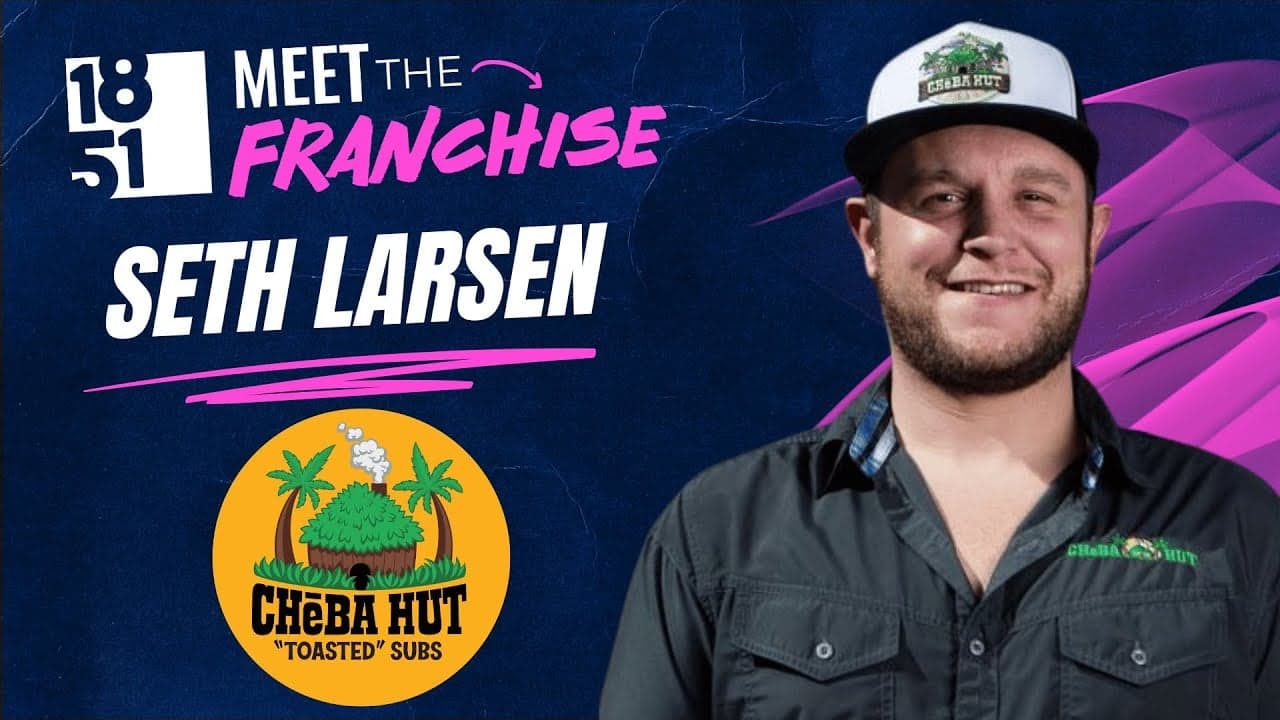
How Seth Larsen Turned His Fandom Into an Entrepreneurship Career With Cheba Hut
Larsen went from devoted customer to franchisee and executive, turning persistence and a belief in the brand into a 20-year career.
Franchisor Stories
Larsen went from devoted customer to franchisee and executive, turning persistence and a belief in the brand into a 20-year career.
Seth Larsen, born and raised in the northwest suburbs of Chicago, has always had a love for the restaurant industry. A dream to move to Colorado led him to Colorado State University following high school where he discovered Cheba Hut, the cannabis-themed sandwich shop, for the first time.
Those visits quickly turned into fandom of the brand, and after graduating from college, Larsen remained persistent in reaching out to the Cheba Hut team while figuring out his next steps.
“When I went to school here, I went to the first 420 party and was like, ‘Man, this is something I want to be a part of,’” Larsen said. “I didn’t have any money. I didn’t have any real restaurant experience. But Scott [Jennings], our founder, did reach back out and said, ‘Just come on back and we’ll figure it out.’”
That persistence led to opportunity. Larsen went on to open and manage stores before eventually purchasing a location himself. His passion led him to joining the corporate team roughly 12 years ago, where he has taken part in everything from operations to supply chain to marketing to legal, now overseeing the development team, franchise sales, real estate and construction.
“I love the look and feel of restaurants, the heart and soul of restaurants, the people,” Larsen said. “It was really my calling. The only thing I've done in my professional career is here at Cheba Hut and I'm really proud of that.”
What he fell in love with about the brand remains true to this day. It’s the brand's commitment to culture that has fueled his continued fire with Cheba Hut. Whether it’s a tight-knit franchise system or personalizing each restaurant with a hand-painted mural dedicated to that market or the authentic interactions with guests, it all hits home with Larsen.
“We’ve always focused on the X’s and O’s of authentic interactions, hospitality and incredible food, then letting it lay where it does,” Larsen said. “Trying to still provide as much value as we can to our customers, doing things the right way and zigging when others zag has served us really well. We’re going to continue that as we continue to grow.”
Franchisees echo that same mindset, with current operators continuing to grow into multi-unit owners. Existing franchisees have added roughly 50 new units this year alone. It comes down to living the core values. When that happens, things work out.
“The number one validator for us is that our franchisees are committed to opening additional units,” Larsen said. “It doesn’t mean we’re not selling new franchise partners and onboarding new franchisees, but we can be far more selective. It really is asking yourself the question, who do you want in that class picture next year?”
While Cheba Hut is the only company Larsen has known professionally, he has turned that passion into a successful career. To him, it does business the right way and has proven financially lucrative for franchisees, while still giving them room to have fun and stay true to what makes Cheba Hut different.
Larsen joined 1851 Franchise Publisher Nick Powills on a recent episode of the “Meet the Franchisee” podcast. A transcript of Larsen’s interview with Powills has been provided below. It has been edited for brevity, clarity and style.
Nick Powills: All right, Seth, first you, then the brand. But let me be clear, your last name is not Cheba. So, even though it’s appearing that way, it would be cool if you were Seth Cheba, unless you change your name for some branding exercise.
Seth Larsen: I didn’t know that was going to be my title on the podcast. I love it. Seth Cheba. Most people know me like that. That’s good.
Powills: So, the question is: Tell me how you accidentally fell into franchising. Give me your franchise backstory, because it’s definitely an accident.
Larsen: Absolutely. I’ve been with Cheba for 20 years. I was a long-running multiunit franchisee with a few locations and have been a partner at the headquarters office for about the last 12 or 13 years. So, it’s been a long road.
I’ve done a lot of things in the business, from running supply chain to assisting on the marketing side, operations and the legal side. I currently oversee the development team, franchise sales, real estate and construction.
I love restaurants in particular. I do enjoy franchising. I love guiding our franchisees on their business and entrepreneurial journey, and Cheba Hut and franchising have really given me that opportunity.
Powills: First, are you still a franchisee?
Larsen: I’m not a franchisee. I’m just a partner at the headquarters office in Fort Collins, Colorado.
Powills: OK, so go back to becoming a franchisee. Obviously, at that point, you don’t really understand what franchising is. You’re buying into this business. Walk me through that. What made you even believe in this brand from the get-go?
Larsen: Great question. I grew up in the northwest suburbs of the Chicagoland area. When I graduated high school, I came out to Fort Collins, Colorado, to go to school at Colorado State University. I didn’t know anybody and didn’t really know what I was doing, but it was the dream of every Midwesterner to go to Colorado back then, or Pepperdine in Malibu.
I ended up at Colorado State, and that’s where I found Cheba Hut. Cheba Hut started in 1998 in Tempe, Arizona. Our founder, Scott, opened the first location here in 2002. I was here from 2000 to the summer of 2004 in Fort Collins going to school. That’s how I got introduced to the brand.
After I graduated with a business marketing degree and a minor in environmental affairs, I was trying to figure out what I was going to do. I headed back home to live for about six months while I figured it out. In that time, I reached out to Cheba Hut constantly. I became a fan of the brand.
When I went to school here, I went to the first 420 party and was like, “Man, this is something I want to be a part of.” I didn’t have any money. I didn’t have any real restaurant experience. But Scott, our founder, did reach back out and said, “Just come on back and we’ll figure it out.”
I had an opportunity to open a store and manage that store. I had an opportunity to manage a couple of other stores over the course of about a year, then had an opportunity to buy a store that Scott had opened down in Boulder.
I really just fell into it. I love hospitality. I love food. I love the look and feel of restaurants, the heart and soul of restaurants, the people. It was really my calling. The only thing I’ve done in my professional career is here at Cheba Hut, and I’m really proud of that.
Powills: If Scott doesn’t take a swing at you, do you ever find your way into franchising, or did you need someone to believe in you and give you that chance?
Larsen: I don’t know. I think I probably find my way into it. Maybe I would have found success a little bit quicker, but Cheba Hut is always a long play, and we’re proud of that.
I do think I eventually would have found that I was very entrepreneurial. I still am. I still love taking chances and doing some things in the business world. I do think eventually I would have found franchising, but certainly not on the path that I made it.
When I first started working with Scott, I was probably working 60 hours a week, as you do as a young buck, and made $420 a week. It’s an awesome way to start out.
Here at Cheba Hut, we still have a lot of homegrown talent. Our CEO and my partner, Mark, just celebrated his 21-year Cheba Hut anniversary. It’s pretty rare to find that. We’ve certainly made a ton of mistakes over the years, but we’ve also found a lot of success. That homegrown talent and the cultural capital we’ve built is pretty undeniable.
Powills: Staying on the cultural capital for a second, if you open up in a new market now, it’s OK for a pop culture restaurant to exist because the world has come around. In the early stages, you were a pioneer.
Are you disappointed when you open now and don’t get the credit you deserve for being a pioneer? And two, how much pain did you have to trek through to build up the security of a community embracing you?
Larsen: It’s a good question. I’m never a sour grapes guy. We don’t operate like that. We have been doing this for 28 years now, so we are the OGs. Really, the way we gauge success is by way of our franchisees.
There’s no doubt that when Scott started in 1998, the landscape looked a lot different. Cannabis culture is very acceptable now across the board. The way we’ve always built our business is off the best subs that I think are in the country and genuine hospitality.
There’s no doubt that if your food sucks and your service is no good, no one’s coming back, no matter how good the theme is. We’ve always focused on those X’s and O’s of authentic interactions, hospitality and incredible food, and then letting it lay where it does.
Our average unit volumes are $2.3 million. We had 17 stores that did over $3 million last year, so we don’t need any of the bullshit awards, I guess, or the recognition.
Our success is found in the way of new store openings and doing things the right way. Our busiest stores these days, of course, we love our core markets and we still love the college markets, but our busiest stores these days are in the suburbs.
I think we’ve really created that lane that we absolutely own, where you get a decent level of hospitality and awesome food, but it’s at a price point where you can come multiple times a week.
I just ordered, and I’ll drop the name, Cava, the other day online. I ordered a single bowl, no changes or anything. I did get a cookie because I wanted to try the cookie, and it was $35. I was blown away.
Trying to still provide as much value as we can to our customers, doing things the right way and zigging when others zag has served us really well. We’re going to continue that as we continue to grow.
Powills: It’s interesting. Every brand struggles to find a point of differentiation, and you’ve embraced it. I’m going to give a real example because I know it.
Very early on in our business, we were working for a long time with a brand called Toppers Pizza. In my opinion, the pizza was good, but it didn’t game-change me. What was great was they put “We come fast, no apologies” in their windows. They embraced that cultural side.
As the CEO and founder got older, he was like, “Well, maybe we shouldn’t do that.” They turned into, at that point, pushing the message, “Never settle.” All of a sudden, their sales had this dip because they didn’t embrace cultural currency versus you.
There are a few elements that you just talked about, including the price point. You’re not going to get gouged like you are at other places. It’s accessible at the price point. There’s a cultural element of the look, feel and experience, and something that can connect with you and probably bring happiness or make you smile as a part of the way you’re presenting it.
Then there’s the good, solid hospitality and solid product. If you erased that middle part, which Toppers did, I would imagine the AUVs would decrease significantly. If you just said, “We’re going to own good products and good hospitality,” it wouldn’t be the same.
How important do you think each of those legs of the stool are to the success of having the AUVs that you have?
Larsen: I think it’s really important. I’ll give a specific example. We do hand-painted murals in all of our restaurants. They’re all different. They’re all tied to the history of whatever market they’re doing business in and what’s passionate to the owner.
It’s a really expensive undertaking. It’s tough to get what you want out of an artist without crushing their creative soul, but also keeping it on budget and on a timeline. That whole process is doing things the hard way, but there’s nothing worse than a wallpaper mural that’s been mass-produced and is in every store.
We’re committed to doing stuff the hard way and the right way, and it’s most often the hard way. The mural is just a tiny microcosm of that.
The explanation I use is flexibility within a framework. We certainly operate in some markets where we’re a little more cannabis-forward, and it’s completely acceptable. We operate in other markets where we don’t bastardize the brand at all, but it’s different at San Diego State than it is in Mansfield, Texas.
We want to make sure we can operate in both of those markets without bastardizing the brand. I think we’ve done a really good job of that. We don’t cookie-cutter this brand. We still leave some opportunity for our operators to put their stamp on it, and I think that’s really important.
Our aspiration is not to be the next Firehouse Subs. We want to continue to grow our AUV. We want to keep our franchise community tight, all multiunit operators, and really keep it cool.
I think as the leaders of this company, myself, Mark, Jimmy, our CFO, and Scott, our founder, our duty is to still keep it cool. I think we’ve done a pretty good job of that. It’s never a dull day, and it’s always a challenge, but we’ve worked really hard to get to this point, and we don’t want to mess that up.
Powills: How do you protect your own ego or your own mentality of what winning is? If you guys had just said, “Hey, screw it, we’re going to sell this to some private equity fund,” first of all, there are buyers. They would swallow you up in two seconds.
But if you did that, then everything you’re talking about leaves culturally. Is it because you feel a duty to protect the franchisees who invested their life savings into this thing? Is that what keeps an ego in check? Outside of you’re just a good dude, is that the magic?
Larsen: I think that’s certainly part of it. We have roughly 35 franchise partners currently. I still want to get Christmas cards from those folks, and I want to send them Christmas cards. I want to ask about their families and stay up to date.
When you’ve been with a brand for 20-plus years, like one of our larger franchisees in Arizona, it’s generational. We started doing business with the dad, and now it’s down to the kids. That’s pretty cool.
There are certainly different paths that you can take there, and sometimes it works out and sometimes it doesn’t. We want to be in control of our own growth and our own destiny. In most cases, on the private equity front, when they make those investments, they want to 4X their investment in eight years. To do that, you’ve got to make some pretty challenging decisions.
For us, it just never made sense, and it doesn’t fit the mold of what we’re trying to do. Again, we want to be in charge of our own destiny, and I think we’ve done a pretty good job of that.
As long as you live the Cheba Hut values that are sitting behind me, things tend to work out, whether we’re dealing with new vendors, new potential franchise partners, current franchise partners or employees here at HQ. As long as it’s not just wallpaper, the core values, and you’re living those core values, things tend to work out pretty well.
Powills: I would imagine you, as a leader, have an inside trigger that’s telling you, as long as you feel good about what you’re doing and you’re enjoying what you’re doing, then you keep doing it.
I’m sure you watch that voice to say, “OK, this is no longer fun,” and if it turns into that, then obviously you have to change. But the fact that you have 35 multiunit partners and you’ve kept it really tight-knit, the numbers alone could have you sell franchises all day long.
But you’ve really held true to the core of your own personal mission statement and who you’re letting into the club, and that’s part of that magic too.
Larsen: The number one validator for us is that our franchisees are committed to opening additional units. If the numbers aren’t working, they’re not making money, the build-outs are too expensive and we don’t do what we say we’re going to do, no one’s going to double down or triple down or quadruple down.
That’s the number one validation that we have. Just this year alone, we’ve added roughly 50 new units with our existing franchise partners. When we do that, we don’t need to bring on additional franchisees. It doesn’t mean we’re not selling new franchise partners and onboarding new franchisees, but we can be far more selective.
It really is asking yourself the question, who do you want in that class picture next year? We do two large events every year where we get all of our owners and their key people together. We’ve done that for a lot of years, and we have these awesome photos and these awesome events.
Who do you want in those pictures? That’s a good spot to be in, and we feel good about it.
Powills: I will never forget that I was the last keynote speaker for Cheba Hut before COVID. I get to write that down there, right?
Larsen: Absolutely, man. I definitely read your book. I mentioned I’m from the northwest suburbs of Chicago. I know you had a stint at the Northwest Herald. That was the paper that got delivered at my house to my parents for 30 years. It all comes full circle.
Powills: I love it. All right, last question. A long time ago, we were talking about Rice Krispies making their way to Austin. Are you going to send one to Mars now? Is there going to be a Rice Krispie rocket that goes into space?
Larsen: We’ll see. There are pros and cons to having a visionary founder. Some of the ideas are incredible and very impactful, and other ones are terribly distracting, really expensive and have no return to the bottom line.
We’re always pushing the limits and are going to continue to do that. Sometimes the things we do don’t quite pencil financially, but they do build the legend, and that’s important too.
Powills: I’m going to close by saying this. I think cannabis culture has probably had a stigma attached to it for a long time. If you extract that and try to change your perspective, or really think about the perspective on cannabis culture, it’s just good people really enjoying life.
Now that those two intersections, culture doesn’t matter on cannabis for most cities. Just looking at really good human beings trying to do really cool things, that’s always been my view on you guys.
At the end of the day, you bet on the jockey, not on the horse. The horse is Cheba Hut, but you look at the people around. You just said, “Me and my partner have been in this business for north of 20 years and didn’t make a jump.” That says a ton.
Not that you need to be in the business of selling franchises, but if someone’s watching this, it’s not hard to see that if culture is 50% and business execution is 50% of the currency, this is very intriguing to anybody who could be watching this.
Larsen: Absolutely. I think Cheba Hut, the way we do business and certainly the financial aspect of our business, is very lucrative. There’s no doubt about it.
But I think you can do those things. You can be incredibly successful and have a fun time while you’re doing it. That’s what we’ve created here, and that’s what we’re going to continue to do. We feel really good about that.
Powills: Seth, always good seeing you. Thanks for doing this. For Seth, I’m Nick. This is another episode of “Meet the Franchise.”
Watch the interview above or on YouTube.
Sign up for the 1851 Franchise newsletter to get our biggest stories before everyone else
By signing up, you agree to our user agreement (including class action waiver and arbitration provisions), and acknowledge our privacy policy.