
Mathnasium
SPONSORED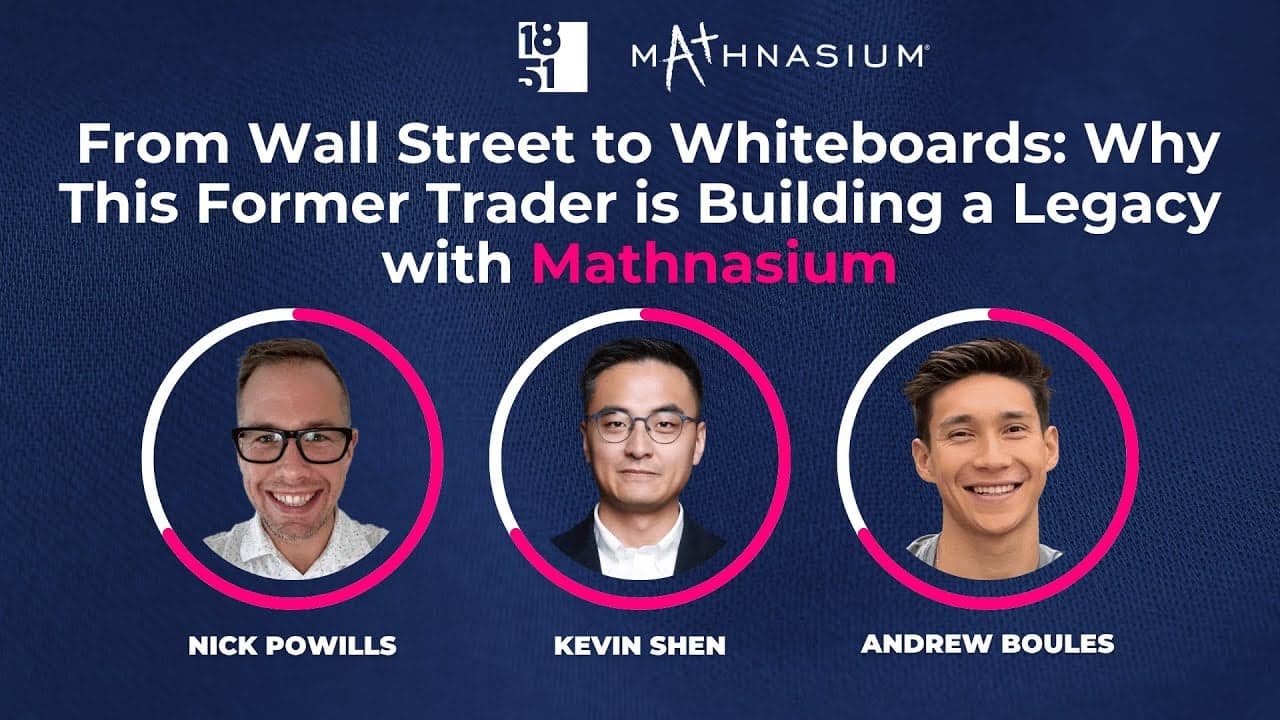
How Andrew Boules Built a Six-Unit Mathnasium Franchise
The former finance and tech professional shares how he combined business acumen with a passion for education to build a thriving, purpose-driven franchise portfolio.
In less than two years, Andrew Boules went from analyzing markets in high-frequency trading and venture capital to operating six Mathnasium Learning Centers across Southern California.
“I knew from the beginning that the end goal wasn’t going to be running just one center,” Boules told 1851 Franchise Publisher Nick Powills on a recent episode of his “Meet the Franchise” webinar. “I’m not a hobbyist or an educator in the traditional sense — being in the classroom every day wasn’t my long-term plan. But I also didn’t have a fully formed ambition to scale as far as possible from day one. I figured I’d take it one step at a time.”
After a career in finance and tech, Boules began searching for a business model that was both profitable and purposeful. A recommendation from a friend in private equity led him to Mathnasium. The brand’s mission to help students build confidence in math, coupled with a proven operational playbook, made it the right fit.
“The people attracted to Mathnasium generally aren’t looking to sell burgers or manage the supply chain for a food concept — they want to make an impact through education,” Kevin Shen, Mathnasium’s chief development officer, told Powills in the interview.
Boules started small, taking on every role in his first location for six months to understand the business from the inside out. With advice from other multi-unit operators, he focused early on building systems, hiring strong leaders and putting infrastructure in place to support growth.
Today, Boules’ six learning centers not only serve hundreds of students but also provide career opportunities for instructors, many of whom advance from part-time to full-time roles. “Being able to create opportunities for people who might not have had them otherwise — that’s what keeps me excited,” he said.
From Boules’ perspective, the keys to rapid, sustainable growth in franchising are following the system, aligning strengths with the right roles and hiring for the rest. Shen agrees, noting that the most successful franchisees “know what they’re good at and outsource or hire for everything else.”
As Boules looks ahead, the goal isn’t just more units — it’s continuing to build a portfolio that combines financial strength with meaningful local impact. For him, the return is about more than numbers; it’s about the students and families whose lives change when math finally clicks.
A transcript of Boules and Shen’s interview with Powills has been provided below. It has been edited for brevity, clarity and style.
Nick Powills: Kevin, I’m going to start with you so we can get a “state of the union” on what’s going on with Magnesium — how things are going — and then we’ll dive into Andrew’s story.
Kevin Shen: The brand is doing great. We’ve hit a lot of big milestones over the past couple of months. Year-to-date, we’ve had strong financial performance and strong franchise development performance. We signed 51 new franchise agreements in the first half of 2025 and opened 42 new centers globally — 31 in North America and 11 internationally.
We celebrated our 100th international center in Hammersmith, U.K., making the U.K. our largest market outside of the U.S. with 37 locations. We also launched in Romania with their first center now open. Elsewhere in the business, everything’s strong. We’re investing across the board in technology, expansion and customer experience.
Powills: That’s great to hear. There’s always a reason behind choosing a brand, so I like framing it this way. Andrew, I want to turn it over to you. How did you “accidentally” fall into franchising? What’s your backstory?
Andrew Boules: I actually started my career in high school, and by my last year of college — five to seven years post-high school — I had studied math and astronomy at Harvard in New Hampshire. I’m originally from Los Angeles, so I’d always wanted to come back to LA. I eventually moved back to be closer to family.
What really piqued my interest wasn’t just math and astronomy, but businesses that have a positive community impact, are easy to scale and operate, and can provide a good living while doing something positive. After spending time in tech and more traditional finance, I wanted something that checked all those boxes. For me, this franchise did exactly that. It offered something new, something I had only heard about before — and it felt like the right move.
Powills: So you’re heading into your second year with the franchise. Take us back to that decision-making process. You were working in tech and finance, and franchising started to seem attractive. You’ve said you weren’t necessarily looking at Mathnasium specifically — you were more focused on where you wanted to go. How did you land on Mathnasium, and why did it rise to the top of your list?
Boules: If I take a step back, my goal has always been to be an entrepreneur and do something on my own. Having worked for a few different companies, I always thought, “This is really cool, but wouldn’t it be even better if the work I do was directly tied to my ownership of the business?”
I wanted to find something like that. Unfortunately, I don’t think I’m smart enough to build a product from scratch. I come from more of a zero-to-one background, and as I looked at different businesses, I thought, “What about one to ten?” That’s where franchising came into the picture. Here’s something that has been done well before, where we know the curriculum works and the model is proven.
When I started looking at franchises, it didn’t begin with Mathnasium. I actually came to it through a private equity group, where a friend told me about their position and the work they were doing in the space. These were people who had looked at a lot of market opportunities and invested in companies with strong growth potential. My friend suggested I check out Mathnasium. For me, math and economics have always been passions. I’ve wanted to work with them my whole life, and my background gives me some added perspective. From there, everything came together — and here we are today.
Powills: When you see someone like Andrew come into the mix, it’s a different persona than some of the other franchisees. What’s appealing about that, and how does it align with where you want to take the business?
Shen: Both personas can be successful in our system, whether it’s someone with an education background or someone from the business and finance world. On the corporate and finance side, these folks still have a passion for education and understand the mission of helping kids change their lives through math.
But they approach it from a different angle — focusing on key operating metrics and driving operational excellence. They take the playbook Mathnasium has developed and push it even further. That’s where Andrew really shines.
What makes someone like Andrew so appealing from the franchisor’s perspective is that they may not be focused on the pedagogy of delivering education, but they can bring tremendous value in other ways — spotting opportunities the franchisee or franchisor may not have considered, thinking about the path from one unit to two, or from two units to five. They know how to think about scaling, infrastructure and hiring, and they make the playbook their own in a way that’s scalable. It’s just a different set of challenges we’re solving for, but it’s great to partner with franchisees like Andrew who bring that kind of background.
Powills: What I’m hearing is that passion for the product or service absolutely has to be there. You’re not going to buy into a business if you don’t have it. But, Andrew, you’re also coming into this with a business mindset. Your friend from work tells you to look at Mathnasium, you land on Mathnasium, and I imagine you’re building your business plan differently than maybe an entry-level franchisee. You’re thinking about scale from the start. Once you signed on with Mathnasium, what was the dream? What was the outlook you wanted to achieve?
Boules: When I started, I wasn’t looking much further ahead than I deserved to. I just thought, “Let’s try this out.” First, to see if I could do it, and second, to kick the tires because it seemed like a fun idea.
I knew from the beginning that the end goal wasn’t going to be running just one center. I’m not a hobbyist or an educator in the traditional sense — being in the classroom every day wasn’t my long-term plan. But I also didn’t have a fully formed ambition to scale as far as possible from day one. I figured I’d take it one step at a time.
I got great advice from another operator — not in Mathnasium, but in another system — who told me, “If you plan on scaling, build a business around you. Make sure you’re putting the right people in place from the start.” You can do fine as the person in the center every day, but if you want to grow, you need systems, the right hires and early investments to give yourself the option to scale later. That’s what I’ve been working toward. Whether or not I choose to take it as far as possible, I want to have the option.
Powills: I think about some of the smartest franchisees I’ve met and there’s a consistency in their approach. In your story, Andrew, I hear that you take the emotional highs and lows out of the equation, at least from a business perspective. You still care deeply about the impact you’re making, but you focus on building the right infrastructure so each unit can operate independently. That’s the same playbook multi-location businesses outside of franchising follow: set up the structure, then scale.
What also stands out is that you’ve said you don’t have to be the educator. A lot of franchisees start out doing the hands-on work to save money in the short term, but your approach — removing yourself from day-to-day instruction — puts you on a path to scale. Yes, you might have to be involved for a while to reach that point, but the long-term vision is there.
When you were evaluating the opportunity, were there hurdles to getting to “yes,” or was it more of an eyes-wide-open moment where you knew this was what you wanted to do?
Boules: It all happened so fast. On the emotional piece, I’ll admit I was very hands-on at first. For the first six months, I was in the center every day. I wanted to know exactly what it felt like to run it before I hired people to take over those roles.
I started as a tutor. On day one, the first four kids came in, and I was the instructor. From there, I became an assistant center director. I did that for six months, and those months are something I’ll always remember. I had a lot of fun, I connected with students and families, and I learned the business from the inside out. That experience wasn’t negotiable for me. I wanted to truly understand the work before stepping back. And there was a part of me that thought, “This is actually a really great lifestyle.”
Shen: That’s a perfectly good way to scale and build a single business. But if you’re looking to grow, can you identify even one characteristic you can build upon to create a sustainable, profitable business?
To your second question, franchising is a tried-and-true model. Everyone should do their own due diligence, but we talk to people every day who are tired of working for someone else, tired of the corporate grind or tired of climbing the ladder. Mathnasium makes sense for many of them because, first, it’s mission-driven. The people attracted to Mathnasium generally aren’t looking to sell burgers or manage the supply chain for a food concept — they want to make an impact through education.
Second, the unit economics are appealing. We have a robust Item 19, and we’re transparent about our financial model. Once prospects review the FDD and compare the opportunity to their current income and lifestyle, they can decide whether to take the next step. For those who say yes, we convert a high percentage at Discovery Day. It comes down to doing the research and determining whether the opportunity is truly compelling for you.
Powills: One more follow-up. Someone like Andrew is now mastering scale — you’re opening 50 units, you’re growing in the U.K., things are going well. But I could also see potential supply-and-demand concerns — the idea that market availability might be tightening. How important is urgency right now for someone looking to get into Mathnasium and build a scalable business?
Shen: Honestly, for our model, that’s a bit of a misconception. We’re a service-based franchise, so success isn’t purely about locking in an “A-plus” territory. In fact, the vast majority of success in our system comes down to the operator.
You can run the numbers — real estate quality, the number of children in the area, income levels, demographics — and all of that explains only about 20% to 25% of the variance in success. The other 75% comes from the operator’s efforts. Our top-performing centers aren’t all in major cities; some are in towns most people have never heard of. Those franchisees know their communities, and their communities know them. They build strong relationships and make Mathnasium a visible, trusted resource.
There are still hundreds of available territories in the U.S., Canada and internationally. There is urgency in the sense that you should talk to us early if you want your preferred area — we generally don’t encourage opening a center an hour away from where you live. But from an availability standpoint, we are nowhere near saturation.
Powills: This is more of a philosophical take, and Kevin, you can respond however you’d like. My kids go to private, for-profit schools about 25 minutes away, and those schools wouldn’t open another location anywhere near us. I’d love to have one closer. I understand why franchisees want protected territories, but in my opinion, Mathnasium could almost be as common as the “15-minute city” concept — one every couple of miles so it’s always close to families.
Shen: I think that’s a reasonable argument. We’ve always taken the view that we should be fairly conservative in how we draw territories so franchisees have ample room to scale — not just to a profitable business, but a very profitable one. Our protected territories have grown fairly large, and we see that as mutually beneficial.
That said, I agree with you. Families today are more time-starved than ever. If you have to take your child to Mathnasium, then to soccer, and then to another activity, traveling an hour back and forth for something that lasts only an hour is not the best use of time. Drive time is an increasingly important factor.
Powills: Andrew, back to you. What’s the dream now?
Boules: That’s a good question — one I should reflect on more often. Something I’ve really enjoyed is working with staff, instructors and employees and providing opportunities for them. We often hire part-time instructors and help them grow into full-time roles. I think that’s unique, especially for college students or people just starting their careers.
What excites me is being able to create opportunities for people who otherwise wouldn’t have them. A lot of talented individuals work in public education, but the system doesn’t always give them the roles they deserve. If I can offer those opportunities and help them apply their skills, that’s incredibly rewarding. That’s become a new part of my dream.
Powills: When I think about you as a younger franchise owner, the early dream might have been like graduating college — a long road from zero to 22. But when you look at what you’ve accomplished in the past seven to nine years, it’s remarkable. You’ve touched so many different things in your career, and now you own a business. If I’m counting correctly, you have six Mathnasium locations now?
Boules: I don’t think I’ve done anything extraordinary. Grit is probably the most important factor — just showing up consistently. Effort compounds when it’s focused on something you own. In past jobs, I might compound for two years and then move on to a new challenge. But now, when you stay focused, you start to see exponential results — especially when your team compounds their own efforts alongside yours. That’s the most humbling part: seeing what a group of committed people can achieve together.
Powills: Now that you’re beyond the five-unit mark, at six locations, is there anything you’ve learned at this stage that you wish you had known at the beginning? Something that would help a prospective franchisee who might be watching this?
Boules: Yes. You might have heard the phrase “increasing the surface area” of your team — bringing in people who are really good at the things you’re not. When I started, I was willing to wear all the hats. That’s what we have to do in the beginning, but it’s not always the best long-term decision.
As I’ve scaled, I’ve realized there are people far better than me at certain verticals. While I started as a jack-of-all-trades, knowing what I know now, I would have focused more on what I do best and built around that. For me, that means concentrating more on the education side, because that’s what ultimately matters most.
Powills: Kevin, you’ve probably seen this across many franchises. As we said at the beginning, those who can remove the emotional side, understand their role and expertise, and build around that are often the ones who scale beyond the five-unit mark. That’s a very small percentage of franchisees. Any other comments on what makes an “Andrew” — or the next Andrew — possible?
Shen: From my perspective, there are a few key factors that help predict success in a franchising model. The first is adherence to the proven business model. With more than 1,200 locations, we like to think we know what we’re doing. When franchisees lean in, follow the playbook and trust the process, they usually find success.
I can’t remember which franchisee said it, but the “secret sauce” to franchising is following what’s already in place. The second factor is effective team building and delegation, especially for multi-unit operators. As Andrew mentioned, building a strong leadership team is critical. That means hiring center directors or assistant center directors to handle daily operations so the owner can focus on growth and community engagement. Andrew does this very well.
The third point ties into Andrew’s comments about aligning strengths and outsourcing weaknesses. The best franchisees know what they’re good at and hire for the rest. Becky McDaniel, one of our franchisees in Florida, often says that if you’re not strong in education but like the business model, focus on the business side and hire great educators. Or, if you’re uncomfortable greeting kids and parents, hire someone more extroverted to be the face of the center. We cover all of this in our training and onboarding, and those who apply it are well-positioned for success.
Powills: Andrew, your story is great to see. Scaling from one to six units in just over two years is impressive. The long-term return will come — eventually, unit one will produce the cash you want, then unit two, and so on. It can be tight from a capital standpoint when you’re reinvesting into growth, but that’s how you reach the return stage.
A lot of franchisees understand “return on investment,” but fewer understand “investment on return.” You can’t get to the return without first making the investment. I appreciate the business approach you’ve taken. I also value the single-unit owners who invest their life savings into their location, but it’s inspiring to hear from someone who’s been fearless and taken a big leap. You may not take all the credit I’m giving you, but your story is worth celebrating.
Boules: I’m humbled by that, and I’m definitely feeling it right now. You’ve been doing this a long time, so you can see the forest for the trees. For me, it’s still very much about making payroll every month.
The good thing is I don’t need much to live on. My fiancée and I rent our apartment and keep our expenses low, so everything I make goes back into the business. I recognize the privilege in that — being young, having time on my side, a low cost of living and the drive to grow the business. That combination lets me reinvest heavily.
I haven’t felt the return yet, but I appreciate your perspective. It’s also making me think I wish this path were more common for younger people, because the earlier you start, the more you can put back into the business and compound the results.
Powills: You said something beautiful about the return, and you might not take the time to give yourself credit for it. As Kevin pointed out, some people go into industries like burgers or chicken. Those can make an impact in their own way, but not the same kind of impact you’re having.
When you zoom out and see the lives you’ve touched — all the students whose futures you’ve helped — and also see the business portfolio you’ve built, the combination is powerful. Aligning purpose and impact with financial results makes the return feel more meaningful. It’s not just about money; it’s about the economies of scale in both business growth and human impact.
Whether that makes it easier to sleep at night, I can’t say, but my perception is that it does. And again, I’m grateful for this conversation.
Watch the full episode above or on YouTube.
The initial investment required to begin the operation of a Mathnasium franchise is $112,860-$149,155. To find out more information on costs to buy this franchise, please visit 1851franchise.com/mathnasium/info.
Mathnasium
SPONSOREDThe former finance and tech professional shares how he combined business acumen with a passion for education to build a thriving, purpose-driven franchise portfolio.
In less than two years, Andrew Boules went from analyzing markets in high-frequency trading and venture capital to operating six Mathnasium Learning Centers across Southern California.
“I knew from the beginning that the end goal wasn’t going to be running just one center,” Boules told 1851 Franchise Publisher Nick Powills on a recent episode of his “Meet the Franchise” webinar. “I’m not a hobbyist or an educator in the traditional sense — being in the classroom every day wasn’t my long-term plan. But I also didn’t have a fully formed ambition to scale as far as possible from day one. I figured I’d take it one step at a time.”
After a career in finance and tech, Boules began searching for a business model that was both profitable and purposeful. A recommendation from a friend in private equity led him to Mathnasium. The brand’s mission to help students build confidence in math, coupled with a proven operational playbook, made it the right fit.
“The people attracted to Mathnasium generally aren’t looking to sell burgers or manage the supply chain for a food concept — they want to make an impact through education,” Kevin Shen, Mathnasium’s chief development officer, told Powills in the interview.
Boules started small, taking on every role in his first location for six months to understand the business from the inside out. With advice from other multi-unit operators, he focused early on building systems, hiring strong leaders and putting infrastructure in place to support growth.
Today, Boules’ six learning centers not only serve hundreds of students but also provide career opportunities for instructors, many of whom advance from part-time to full-time roles. “Being able to create opportunities for people who might not have had them otherwise — that’s what keeps me excited,” he said.
From Boules’ perspective, the keys to rapid, sustainable growth in franchising are following the system, aligning strengths with the right roles and hiring for the rest. Shen agrees, noting that the most successful franchisees “know what they’re good at and outsource or hire for everything else.”
As Boules looks ahead, the goal isn’t just more units — it’s continuing to build a portfolio that combines financial strength with meaningful local impact. For him, the return is about more than numbers; it’s about the students and families whose lives change when math finally clicks.
A transcript of Boules and Shen’s interview with Powills has been provided below. It has been edited for brevity, clarity and style.
Nick Powills: Kevin, I’m going to start with you so we can get a “state of the union” on what’s going on with Magnesium — how things are going — and then we’ll dive into Andrew’s story.
Kevin Shen: The brand is doing great. We’ve hit a lot of big milestones over the past couple of months. Year-to-date, we’ve had strong financial performance and strong franchise development performance. We signed 51 new franchise agreements in the first half of 2025 and opened 42 new centers globally — 31 in North America and 11 internationally.
We celebrated our 100th international center in Hammersmith, U.K., making the U.K. our largest market outside of the U.S. with 37 locations. We also launched in Romania with their first center now open. Elsewhere in the business, everything’s strong. We’re investing across the board in technology, expansion and customer experience.
Powills: That’s great to hear. There’s always a reason behind choosing a brand, so I like framing it this way. Andrew, I want to turn it over to you. How did you “accidentally” fall into franchising? What’s your backstory?
Andrew Boules: I actually started my career in high school, and by my last year of college — five to seven years post-high school — I had studied math and astronomy at Harvard in New Hampshire. I’m originally from Los Angeles, so I’d always wanted to come back to LA. I eventually moved back to be closer to family.
What really piqued my interest wasn’t just math and astronomy, but businesses that have a positive community impact, are easy to scale and operate, and can provide a good living while doing something positive. After spending time in tech and more traditional finance, I wanted something that checked all those boxes. For me, this franchise did exactly that. It offered something new, something I had only heard about before — and it felt like the right move.
Powills: So you’re heading into your second year with the franchise. Take us back to that decision-making process. You were working in tech and finance, and franchising started to seem attractive. You’ve said you weren’t necessarily looking at Mathnasium specifically — you were more focused on where you wanted to go. How did you land on Mathnasium, and why did it rise to the top of your list?
Boules: If I take a step back, my goal has always been to be an entrepreneur and do something on my own. Having worked for a few different companies, I always thought, “This is really cool, but wouldn’t it be even better if the work I do was directly tied to my ownership of the business?”
I wanted to find something like that. Unfortunately, I don’t think I’m smart enough to build a product from scratch. I come from more of a zero-to-one background, and as I looked at different businesses, I thought, “What about one to ten?” That’s where franchising came into the picture. Here’s something that has been done well before, where we know the curriculum works and the model is proven.
When I started looking at franchises, it didn’t begin with Mathnasium. I actually came to it through a private equity group, where a friend told me about their position and the work they were doing in the space. These were people who had looked at a lot of market opportunities and invested in companies with strong growth potential. My friend suggested I check out Mathnasium. For me, math and economics have always been passions. I’ve wanted to work with them my whole life, and my background gives me some added perspective. From there, everything came together — and here we are today.
Powills: When you see someone like Andrew come into the mix, it’s a different persona than some of the other franchisees. What’s appealing about that, and how does it align with where you want to take the business?
Shen: Both personas can be successful in our system, whether it’s someone with an education background or someone from the business and finance world. On the corporate and finance side, these folks still have a passion for education and understand the mission of helping kids change their lives through math.
But they approach it from a different angle — focusing on key operating metrics and driving operational excellence. They take the playbook Mathnasium has developed and push it even further. That’s where Andrew really shines.
What makes someone like Andrew so appealing from the franchisor’s perspective is that they may not be focused on the pedagogy of delivering education, but they can bring tremendous value in other ways — spotting opportunities the franchisee or franchisor may not have considered, thinking about the path from one unit to two, or from two units to five. They know how to think about scaling, infrastructure and hiring, and they make the playbook their own in a way that’s scalable. It’s just a different set of challenges we’re solving for, but it’s great to partner with franchisees like Andrew who bring that kind of background.
Powills: What I’m hearing is that passion for the product or service absolutely has to be there. You’re not going to buy into a business if you don’t have it. But, Andrew, you’re also coming into this with a business mindset. Your friend from work tells you to look at Mathnasium, you land on Mathnasium, and I imagine you’re building your business plan differently than maybe an entry-level franchisee. You’re thinking about scale from the start. Once you signed on with Mathnasium, what was the dream? What was the outlook you wanted to achieve?
Boules: When I started, I wasn’t looking much further ahead than I deserved to. I just thought, “Let’s try this out.” First, to see if I could do it, and second, to kick the tires because it seemed like a fun idea.
I knew from the beginning that the end goal wasn’t going to be running just one center. I’m not a hobbyist or an educator in the traditional sense — being in the classroom every day wasn’t my long-term plan. But I also didn’t have a fully formed ambition to scale as far as possible from day one. I figured I’d take it one step at a time.
I got great advice from another operator — not in Mathnasium, but in another system — who told me, “If you plan on scaling, build a business around you. Make sure you’re putting the right people in place from the start.” You can do fine as the person in the center every day, but if you want to grow, you need systems, the right hires and early investments to give yourself the option to scale later. That’s what I’ve been working toward. Whether or not I choose to take it as far as possible, I want to have the option.
Powills: I think about some of the smartest franchisees I’ve met and there’s a consistency in their approach. In your story, Andrew, I hear that you take the emotional highs and lows out of the equation, at least from a business perspective. You still care deeply about the impact you’re making, but you focus on building the right infrastructure so each unit can operate independently. That’s the same playbook multi-location businesses outside of franchising follow: set up the structure, then scale.
What also stands out is that you’ve said you don’t have to be the educator. A lot of franchisees start out doing the hands-on work to save money in the short term, but your approach — removing yourself from day-to-day instruction — puts you on a path to scale. Yes, you might have to be involved for a while to reach that point, but the long-term vision is there.
When you were evaluating the opportunity, were there hurdles to getting to “yes,” or was it more of an eyes-wide-open moment where you knew this was what you wanted to do?
Boules: It all happened so fast. On the emotional piece, I’ll admit I was very hands-on at first. For the first six months, I was in the center every day. I wanted to know exactly what it felt like to run it before I hired people to take over those roles.
I started as a tutor. On day one, the first four kids came in, and I was the instructor. From there, I became an assistant center director. I did that for six months, and those months are something I’ll always remember. I had a lot of fun, I connected with students and families, and I learned the business from the inside out. That experience wasn’t negotiable for me. I wanted to truly understand the work before stepping back. And there was a part of me that thought, “This is actually a really great lifestyle.”
Shen: That’s a perfectly good way to scale and build a single business. But if you’re looking to grow, can you identify even one characteristic you can build upon to create a sustainable, profitable business?
To your second question, franchising is a tried-and-true model. Everyone should do their own due diligence, but we talk to people every day who are tired of working for someone else, tired of the corporate grind or tired of climbing the ladder. Mathnasium makes sense for many of them because, first, it’s mission-driven. The people attracted to Mathnasium generally aren’t looking to sell burgers or manage the supply chain for a food concept — they want to make an impact through education.
Second, the unit economics are appealing. We have a robust Item 19, and we’re transparent about our financial model. Once prospects review the FDD and compare the opportunity to their current income and lifestyle, they can decide whether to take the next step. For those who say yes, we convert a high percentage at Discovery Day. It comes down to doing the research and determining whether the opportunity is truly compelling for you.
Powills: One more follow-up. Someone like Andrew is now mastering scale — you’re opening 50 units, you’re growing in the U.K., things are going well. But I could also see potential supply-and-demand concerns — the idea that market availability might be tightening. How important is urgency right now for someone looking to get into Mathnasium and build a scalable business?
Shen: Honestly, for our model, that’s a bit of a misconception. We’re a service-based franchise, so success isn’t purely about locking in an “A-plus” territory. In fact, the vast majority of success in our system comes down to the operator.
You can run the numbers — real estate quality, the number of children in the area, income levels, demographics — and all of that explains only about 20% to 25% of the variance in success. The other 75% comes from the operator’s efforts. Our top-performing centers aren’t all in major cities; some are in towns most people have never heard of. Those franchisees know their communities, and their communities know them. They build strong relationships and make Mathnasium a visible, trusted resource.
There are still hundreds of available territories in the U.S., Canada and internationally. There is urgency in the sense that you should talk to us early if you want your preferred area — we generally don’t encourage opening a center an hour away from where you live. But from an availability standpoint, we are nowhere near saturation.
Powills: This is more of a philosophical take, and Kevin, you can respond however you’d like. My kids go to private, for-profit schools about 25 minutes away, and those schools wouldn’t open another location anywhere near us. I’d love to have one closer. I understand why franchisees want protected territories, but in my opinion, Mathnasium could almost be as common as the “15-minute city” concept — one every couple of miles so it’s always close to families.
Shen: I think that’s a reasonable argument. We’ve always taken the view that we should be fairly conservative in how we draw territories so franchisees have ample room to scale — not just to a profitable business, but a very profitable one. Our protected territories have grown fairly large, and we see that as mutually beneficial.
That said, I agree with you. Families today are more time-starved than ever. If you have to take your child to Mathnasium, then to soccer, and then to another activity, traveling an hour back and forth for something that lasts only an hour is not the best use of time. Drive time is an increasingly important factor.
Powills: Andrew, back to you. What’s the dream now?
Boules: That’s a good question — one I should reflect on more often. Something I’ve really enjoyed is working with staff, instructors and employees and providing opportunities for them. We often hire part-time instructors and help them grow into full-time roles. I think that’s unique, especially for college students or people just starting their careers.
What excites me is being able to create opportunities for people who otherwise wouldn’t have them. A lot of talented individuals work in public education, but the system doesn’t always give them the roles they deserve. If I can offer those opportunities and help them apply their skills, that’s incredibly rewarding. That’s become a new part of my dream.
Powills: When I think about you as a younger franchise owner, the early dream might have been like graduating college — a long road from zero to 22. But when you look at what you’ve accomplished in the past seven to nine years, it’s remarkable. You’ve touched so many different things in your career, and now you own a business. If I’m counting correctly, you have six Mathnasium locations now?
Boules: I don’t think I’ve done anything extraordinary. Grit is probably the most important factor — just showing up consistently. Effort compounds when it’s focused on something you own. In past jobs, I might compound for two years and then move on to a new challenge. But now, when you stay focused, you start to see exponential results — especially when your team compounds their own efforts alongside yours. That’s the most humbling part: seeing what a group of committed people can achieve together.
Powills: Now that you’re beyond the five-unit mark, at six locations, is there anything you’ve learned at this stage that you wish you had known at the beginning? Something that would help a prospective franchisee who might be watching this?
Boules: Yes. You might have heard the phrase “increasing the surface area” of your team — bringing in people who are really good at the things you’re not. When I started, I was willing to wear all the hats. That’s what we have to do in the beginning, but it’s not always the best long-term decision.
As I’ve scaled, I’ve realized there are people far better than me at certain verticals. While I started as a jack-of-all-trades, knowing what I know now, I would have focused more on what I do best and built around that. For me, that means concentrating more on the education side, because that’s what ultimately matters most.
Powills: Kevin, you’ve probably seen this across many franchises. As we said at the beginning, those who can remove the emotional side, understand their role and expertise, and build around that are often the ones who scale beyond the five-unit mark. That’s a very small percentage of franchisees. Any other comments on what makes an “Andrew” — or the next Andrew — possible?
Shen: From my perspective, there are a few key factors that help predict success in a franchising model. The first is adherence to the proven business model. With more than 1,200 locations, we like to think we know what we’re doing. When franchisees lean in, follow the playbook and trust the process, they usually find success.
I can’t remember which franchisee said it, but the “secret sauce” to franchising is following what’s already in place. The second factor is effective team building and delegation, especially for multi-unit operators. As Andrew mentioned, building a strong leadership team is critical. That means hiring center directors or assistant center directors to handle daily operations so the owner can focus on growth and community engagement. Andrew does this very well.
The third point ties into Andrew’s comments about aligning strengths and outsourcing weaknesses. The best franchisees know what they’re good at and hire for the rest. Becky McDaniel, one of our franchisees in Florida, often says that if you’re not strong in education but like the business model, focus on the business side and hire great educators. Or, if you’re uncomfortable greeting kids and parents, hire someone more extroverted to be the face of the center. We cover all of this in our training and onboarding, and those who apply it are well-positioned for success.
Powills: Andrew, your story is great to see. Scaling from one to six units in just over two years is impressive. The long-term return will come — eventually, unit one will produce the cash you want, then unit two, and so on. It can be tight from a capital standpoint when you’re reinvesting into growth, but that’s how you reach the return stage.
A lot of franchisees understand “return on investment,” but fewer understand “investment on return.” You can’t get to the return without first making the investment. I appreciate the business approach you’ve taken. I also value the single-unit owners who invest their life savings into their location, but it’s inspiring to hear from someone who’s been fearless and taken a big leap. You may not take all the credit I’m giving you, but your story is worth celebrating.
Boules: I’m humbled by that, and I’m definitely feeling it right now. You’ve been doing this a long time, so you can see the forest for the trees. For me, it’s still very much about making payroll every month.
The good thing is I don’t need much to live on. My fiancée and I rent our apartment and keep our expenses low, so everything I make goes back into the business. I recognize the privilege in that — being young, having time on my side, a low cost of living and the drive to grow the business. That combination lets me reinvest heavily.
I haven’t felt the return yet, but I appreciate your perspective. It’s also making me think I wish this path were more common for younger people, because the earlier you start, the more you can put back into the business and compound the results.
Powills: You said something beautiful about the return, and you might not take the time to give yourself credit for it. As Kevin pointed out, some people go into industries like burgers or chicken. Those can make an impact in their own way, but not the same kind of impact you’re having.
When you zoom out and see the lives you’ve touched — all the students whose futures you’ve helped — and also see the business portfolio you’ve built, the combination is powerful. Aligning purpose and impact with financial results makes the return feel more meaningful. It’s not just about money; it’s about the economies of scale in both business growth and human impact.
Whether that makes it easier to sleep at night, I can’t say, but my perception is that it does. And again, I’m grateful for this conversation.
Watch the full episode above or on YouTube.
The initial investment required to begin the operation of a Mathnasium franchise is $112,860-$149,155. To find out more information on costs to buy this franchise, please visit 1851franchise.com/mathnasium/info.
Sign up for the 1851 Franchise newsletter to get our biggest stories before everyone else
By signing up, you agree to our user agreement (including class action waiver and arbitration provisions), and acknowledge our privacy policy.
No related articles found