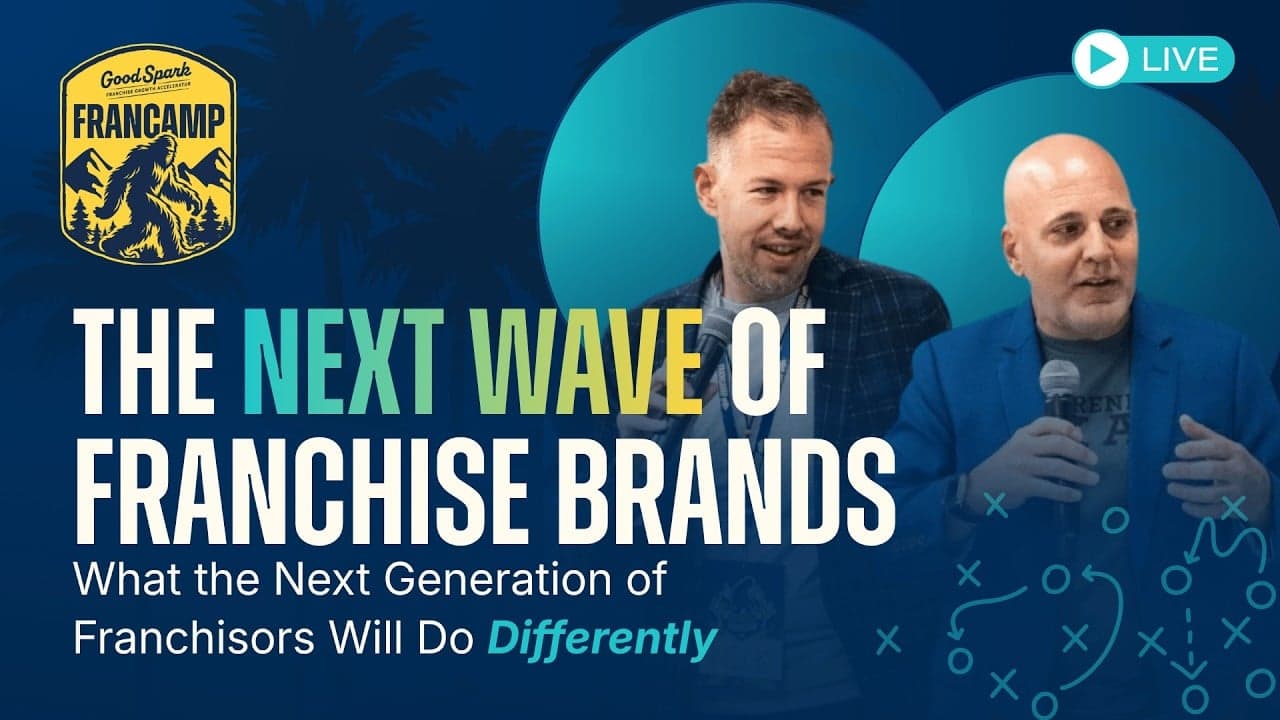
The franchise industry has no shortage of concepts looking to grow. The harder question is whether those businesses have built the foundation needed to support that growth. A business can become a franchise and sell agreements without necessarily proving that the model will work across dozens or hundreds of locations.
“It is going to become desperately important to have a definition of what you’re famous for,” Nick Powills, chief strategy officer for GoodSpark Franchise Growth Accelerator, said during a recent webinar. “If a brand cannot answer what they’re famous for, then the customer is not going to know what they’re famous for, and if there’s nothing that they’re famous for, then they’re just another business in the marketplace.”
Here are six areas emerging franchise brands should address before pushing for scale.
1. Define What Your Brand Is Famous For
A franchise brand should be able to explain why a customer chooses it instead of another business offering a similar product or service. That does not require inventing an entirely new category. It means giving customers something specific to associate with the brand.
Powills pointed to Crumbl as an example. Cookies existed long before the company, but Crumbl built a recognizable identity around its product, packaging and rotating menu. The same test can be applied to home services, fitness concepts and other franchise categories where competitors may offer similar services.
Powills suggested asking an AI tool what the brand is famous for as a starting point. Charles Internicola, CEO of GoodSpark, said the question should also prompt a larger discussion within the company.
“If you take that advice and question yourself, whether through ChatGPT or conversations with your team, that’s where the opportunity is,” he said. “What is your brand famous for?”
2. Get the Consumer Business Right Before Selling the Franchise
Before selling franchises, a brand needs to give customers a clear reason to choose it. A strong franchise opportunity starts with a business that has already established its identity and proven that it can attract consumers. Powills pointed to Crumbl and PopUp Bagels as examples of brands that built recognizable concepts in familiar categories.
“If you’re not famous for something, then you’re just another business in the marketplace,” Powills said. “You have to nail the B2C before you do the B2B.”
3. Build Around Brand, Real Estate and Operations
Powills uses three areas to evaluate the foundation of a franchise business: brand, real estate and operations. The brand gives customers a reason to choose the business, real estate puts it in a position to perform, and operations allow someone other than the founder to consistently deliver the product or service.
“If you break down a $900,000 AUV, you could attribute roughly a third to the brand, a third to real estate selection and a third to operations,” Powills said. “When brands get all three right, they put themselves in a position to succeed.”
One strong component cannot necessarily compensate for weaknesses elsewhere. Great branding cannot fix poor site selection, and a good location cannot make an unnecessarily complicated business easy to operate. A franchise model needs to work for operators who did not create the original business.
4. Make Sure the Unit Economics Work
Selling franchises is not the same as building a healthy franchise system. Before accelerating development, leadership needs to determine whether the economics give franchisees a realistic opportunity to recover their investment and build a sustainable business.
Powills uses a four-year payback period as his benchmark. While it is his framework rather than an industrywide standard, it forces franchisors to consider the relationship between the initial investment and what the business can reasonably produce.
“If you can pay off the initial investment by taking every penny out of your business and pay it off in four years or less, you’re a viable business,” Powills said. “North of four years, you’re a hobby business.”
Internicola pushed the discussion further by asking whether franchisee performance could itself become a differentiator.
“Do you need to be famous for something with consumers if you replace that with successful franchisees?” Internicola asked. “Our bagels are OK. They’re not the best in the world, but we have super well-performing franchisees because we’re operationally efficient.”
That question puts the emphasis on more than top-line sales. Average unit volume can demonstrate revenue potential, but it does not show what remains after labor, rent, supplies and other expenses.
5. Make Sure the Franchise Story Matches the Business
Franchise sales become problematic when candidates develop expectations the operating model cannot support. An AUV based largely on high-density locations, for example, may not represent what a franchisee should expect in a smaller market. The smaller location could still be successful if rent and other expenses are lower, but the franchisor needs to explain that difference.
That becomes particularly important with multi-unit agreements. If a franchisee buys several territories based on expectations that do not materialize at the first location, future development can stall.
“If you don’t have a compelling value proposition and a clear understanding of what you’re known for with consumers, you probably shouldn’t franchise,” Internicola said. “You also need to know how to communicate that value and whether your unit economics support the model.”
The goal shouldn't be just making the franchise attractive enough to sell. Candidates need to understand the business they will actually operate.
6. Keep the Business Simple Enough to Replicate
Adding more products, technology or processes does not necessarily make a business stronger. A complicated menu, difficult staffing model or overly involved operating process may work at a handful of company locations but become harder to control as the franchise system expands.
Powills pointed to McDonald’s early focus on burgers, fries and shakes as an example of how simplicity can make a business easier to execute.
“When you think about the foundations of great business, it’s not complexities. It’s actually simplicities,” Powills said. “Every good business, if you really examine it, stays in its lane. They keep things simple.”
Great branding can attract attention, and franchise sales can build a development pipeline, but neither guarantees that locations will open or perform. The next generation of franchise brands will need to prove the fundamentals first.
“If you want to become iconic, or break this 100-unit threshold — not sold, but open — I do think you absolutely need those three elements: great brand, great real estate and great operations,” Powills said. “And then you need your unit-level economics to perform.”
Once those pieces are working together, franchise development becomes an extension of a proven business rather than an attempt to create one.
Watch the webinar above or on YouTube.
For more information on GoodSpark and its services for developing franchises, visit https://www.goodsparkfranchise.com/.