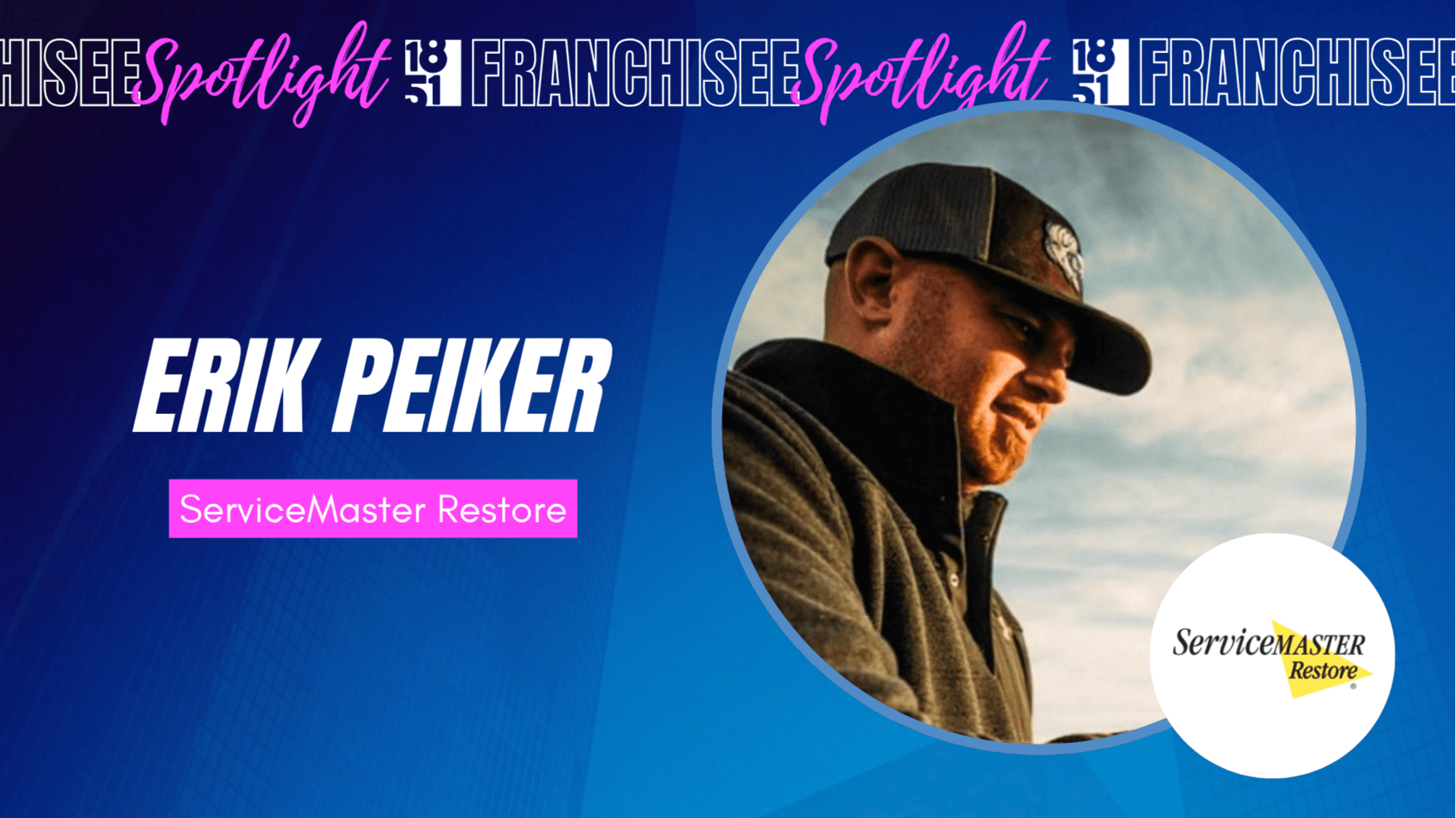
For Erik Peiker, working in construction has been a lifelong pursuit, starting at age 15 when he joined a roofing crew to earn extra money. After working his way up to a general manager role overseeing 12 states, Peiker launched his own independent construction business 13 years ago, eventually supplying labor for major catastrophe zones and completing high-end remodel projects for hit HGTV shows.
Despite his success, he recognized the limitations of operating independently and began exploring the franchise model to secure better infrastructure, support and access to capital. He discovered ServiceMaster Restore. Drawn to the brand's expansive territory sizes and the immense financial backing of a national network, Peiker converted his operations.
Today, Peiker owns nine ServiceMaster Restore licenses from the Northern Denver metro area to Southern Colorado Springs, with seven more pending. He said the move has nearly tripled his profit margins while giving him the support to build a stronger commercial team.
Peiker sat down with 1851 Franchise to discuss why he made the move to ServiceMaster Restore and how the decision has changed the way he runs his business. Here's what he had to say:
1851 Franchise: Frame your personal story for us. What do you want us to know?
Erik Peiker: I've owned a lot of businesses in a lot of different industries, but I've always been in the construction business. I think it started when I was probably 15 years old, trying to grow a crummy beard so I could be on a roofing crew to earn some extra money. I didn't grow up with a lot, so I worked pretty hard from a young age. I started in the roofing industry, moved my way up to a general manager overseeing crews in 12 different states for a pretty large roofing company, and then got pretty bored. I started my own construction business about 13 years ago.
1851: What did you do before franchising, and how did you decide franchising made sense for you?
Peiker: I've kind of worked for myself since I was in my early 20s. It's good, but when it's bad, it's real bad. We did reconstruction for a lot of different mitigation companies around the state of Colorado and surrounding states, and then we transitioned into supplying labor for big catastrophe zones like hurricanes and wildfires. We also had a fishing lure company, and we ended up selling that to Bass Pro Shop. I think that's when it kind of clicked for me. We had always done it on our own, but now that I had that partner in Bass Pro, we could use their infrastructure. It made me start thinking about the construction space and maybe a franchise does make sense. I looked for a franchise system that was very active with the franchisees and ended up landing on ServiceMaster.
1851: What was your perception of franchising prior to becoming a franchisee, and what do you want people to know about franchising now that you are in it?
Peiker: My perception was that it was a cash grab for people that had no business experience, especially in a market where they had the tools to learn. I was wrong. I think it's approachable. Before, my main concern was how much I’d have to spend, but there are a lot of really good financing options. The relationship with our bank grew exponentially just because ServiceMaster is on a lot of SBA-style lists. It's a lot easier when you have the infrastructure and backing of a national footprint. Cash flow was a huge one. I think it's probably the most overlooked factor in choosing a franchise.
1851: What made you pick this brand? What excites you most about this company?
Peiker: I was offered some territories through a competitor of ours, and I just liked ServiceMaster more. I felt there was more opportunity to grow here. The biggest factor was territory size. As an entrepreneur since I was young, it's like being caged into this little location like we see with our competitors. The territory and population size didn't leave me much room to go out and create a launchpad. It felt more like you were working for corporate than building a real business. I really like the territory size of ServiceMaster.
1851: What do you hope to achieve with your business? What are your plans for growth?
Peiker: Coming from the reconstruction side, I wanted to increase our margin. On a project, we'd be at 35% to 40%, and we'd clear 8% to 12% at the end of the year. Now our margins on that same volume have almost tripled. I wanted to increase our profitability because it's not what you make, it's what you keep, and that's what matters. I also want to develop a commercial team where we can consolidate some of the best talent with decades of experience and do larger commercial projects. My goal is to make it to the top, which is the SRM (ServiceMaster Restore Commercial) team. I wanted to be on it in two years; they thought I was crazy, but I'm halfway there.
1851: Is there anything else about your story you want us to know?
Peiker: I've helped a lot of people start businesses and invested in a lot of businesses. I've kind of done everything to see if there's a better market out there than construction. At least from what I found, no. It's fruitful and has staying power, especially the insurance world, which is basically recession-resistant. Beyond that, this has afforded me more time with my family because I have more backing. I used to work 14 hours a day, six to seven days a week, and now I have time to coach my kids' T-ball games because I have the infrastructure and a support system.
1851: What advice do you have for other people thinking about becoming franchise owners?
Peiker: Simply, I guess, just do it. If you're able to run a business on your own and you're wondering if a franchise is worth it, you will always do more in a franchise system simply because you have the support. You have better financial support from banks. It's a lot easier to get cash for lines of credit and loans, and you have really good support from regional, national, commercial and sales teams. If you're thinking about doing it, do it, because it would cost me millions every year to build out and have the same fighting chance that I get for a nominal fee by franchising.
ABOUT SERVICEMASTER RESTORE®:
With approximately 2,000 franchised and licensed locations around the world, ServiceMaster Restore and ServiceMaster Recovery Management (SRM) serve customers through a global network of franchises available 24/7/365 to provide residential and commercial restoration services resulting from damage caused by water, fire, smoke or mold. SRM is the large-scale commercial catastrophic disaster restoration unit of ServiceMaster Restore. ServiceMaster Restore is a business unit of Atlanta-based ServiceMaster® Brands, a leading franchise provider of needs-based residential and commercial services. More information can be found at servicemasterrestore.com and srmcat.com.
ABOUT SERVICEMASTER® BRANDS:
ServiceMaster® Brands is a leading franchisor of residential and commercial services in the restoration, cleaning, moving, junk removal, and bioremediation industries. Founded in 1929, the company is home to over 3,200 franchisees across 4,600+ locations serving over 1 million homes and businesses each year. ServiceMaster was founded with a deep commitment to its franchisees and has franchise opportunities available in ServiceMaster Restore®, ServiceMaster Clean®, Merry Maids®, TWO MEN AND A TRUCK*®, and TWO MEN AND A JUNK TRUCK®. Visit servicemaster.com/franchising to learn more.