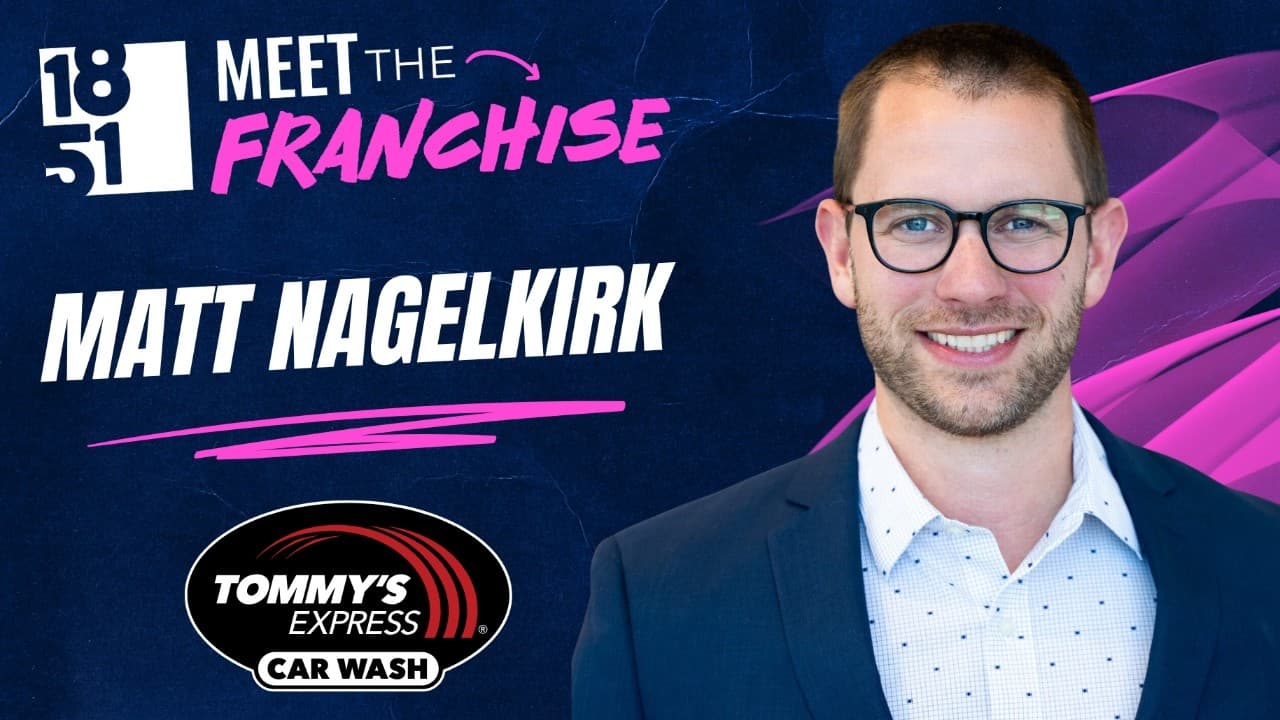
For Tommy’s Express Car Wash, the 250-plus-unit car wash franchise, success in the fragmented industry comes from a foundation of purpose and support. By prioritizing franchisee alignment in the selection process and consistent improvement on the brand side, Tommy’s has built a brand infrastructure meant to scale and drive long-term, systemwide success.
“Franchising is the basis of what we do here, but the root of it is helping people,” said Matt Nagelkirk, vice president of franchise development. “That's where our story begins almost 60 years ago with our first generation, Tom Essenburg, who is 94 and still in the office nearly every day and very involved. That's what gets all 650 of us excited: just helping people. We saw early on that the car wash industry was highly fragmented, and we still see it today. Regardless of franchising, whether it's Tommy’s Car Wash Systems or Tommy's Express, the supply chain side, purchasing or trying to grow the brand, we just want to help the car wash operator.”
By deploying a fully vertically integrated system that covers equipment manufacturing, custom consumer app development, and an internal 30-plus-member marketing agency, the brand supports its owners with a complete operational engine built to replace unpredictable mom-and-pop structures with true consistency.
“We are different from our competitors because we are fully integrated,” he said. “It’s one phone call to our team for everything.”
As Tommy’s Express grows, Nagelkirk remains deeply committed to finding the right people and supporting them in a model that provides a clear pathway to generational wealth. With a thoughtful selection process and a support team of over 600 people, Tommy’s Express proves that franchise success can start with putting people first and ensuring everyone is moving in the same direction together.
Nagelkirk joined 1851 Franchise Publisher Nick Powills to discuss the brand’s infrastructure, the value of vertical integration and what he looks for in Tommy’s Express franchisees. A transcript of Nagelkirk’s interview with Powills has been provided below. It has been edited for brevity, clarity and style.
Nick Powills: All right, Matt, first you, then the brand. One scripted question usually opens up a good story: How did you accidentally fall into franchising? What's your franchise backstory?
Matt Nagelkirk: It’s a great question, and my answer is probably different than what you typically get. I actually started with Tommy Car Wash Systems, which is our equipment and product line. We developed the franchise at about the same time that I started, so it just morphed into place and worked out. My background wasn't in franchising; I joined a retail brand selling car wash products, equipment and technology, which is the parent company of Tommy's Express, our franchise brand. I actually started on Tommy's Express a year ago, but before that, I was on the Tommy Car Wash side.
Powills: At what point did you understand how franchising worked, or how long did it take you to understand the structure of it?
Nagelkirk: It took a while. I've been with Tommy's for eight and a half years, and it probably took me a year to really understand what we were doing. Before I started on the franchise side of the business, I was in supply chain. I was helping ship products, installing equipment and managing some of our project management teams handling construction projects. I didn't really understand franchising and what we were trying to do for a while. Now I love it and can't imagine myself anywhere else.
Powills: If I go to your franchise site, it says "Own a Car Wash Franchise." To the buyer, regardless of their financial position, they go through the same thing. It takes a year for them to figure out what franchising is and why they should buy this brand. Franchise brands rarely look at their website as an educational guide for the buyer; it is simply a landing page to fill out a form.
The biggest positioning Tommy's currently has from a franchise standpoint is average gross sales, which is very loud and in your face. Those are great numbers, but what do they mean? That buyer then goes around the web to figure things out, which is the biggest threat to a brand like Tommy's, because they will look at other investments or use ChatGPT. I love your answer because it shows the gap for franchisors who put so much pressure on selling franchises. Because it's not overly challenging to close, they tend to ignore the truth: if all of us go back to the day before we were in franchising, we couldn't explain it either.
Nagelkirk: Yeah, I think we've done a great job internally. Franchising is the basis of what we do here, but the root of it is helping people. That's where our story begins almost 60 years ago with our first generation, Tom Essenburg, who is 94 and still in the office nearly every day and very involved. That's what gets all 650 of us excited: just helping people. We saw early on that the car wash industry was highly fragmented, and we still see it today. Regardless of franchising, whether it's Tommy Car Wash Systems or Tommy's Express, the supply chain side, purchasing or trying to grow the brand, we just want to help the car wash operator.
Powills: If I bought the total business today, what you just said is your "Why You, Why Now." What your franchise site currently says is "buy my franchise." Often when I'm having these discussions, I realize that the website doesn't explicitly state, "We are in the business of helping people." Instead, it says, "Look at all the money you can make." If someone listens to this and hears that there are 600 people working together to impact them, that's a real reason to buy.
Nagelkirk: We feel that is why people need to look at Tommy's. That is the difference. We are family-owned, third-generation and not private equity-backed.
Powills: I love the category. It's fascinating because I am dialed into highly fragmented industries where private equity or family offices come in to consolidate. They know that if they put the right operations and technology in place, there is a good business opportunity. The car wash category is there, and not many players own the franchise component of it. There are regional players, but nothing like you. What else are you seeing in the category, and what do you like about it?
Nagelkirk: We are different from our competitors because we are fully vertically integrated. It's one phone call to our team for everything. I could walk out back right now and see our equipment being built. I could walk past the developers managing our consumer app, or our facility where we blend our detergent. We have everything in-house, including a 30-plus member internal marketing team helping our franchisees. When people visit, they are blown away.
In the wider car wash space, consumers get confused because of the fragmentation. They go to a competitor's site, and the quality, language or building colors are different from the one down the street, even within the same brand. We are different because we are consistent. All our sites are built from the ground up. The consumer experience and consistency are critical.
Our competitors have been slow to adapt to that consumer consistency. If you go to a Chick-fil-A in San Antonio or Chicago and want a Number One, it better be the exact same everywhere or you're going to be confused. We preach that it's all about the guest, helping people and consistency.
Powills: In my own experience with car washes, convenience and proximity are number one. Traffic patterns are essential, very similar to fast-food restaurants. I also don't want the equipment to scratch my car, which is the biggest complaint with older mom-and-pop operations that don't replace their technology. It's not hard to win the customer here; it's just a matter of getting the right people in.
How many franchisees did you award last year, and what is your goal for this year?
Nagelkirk: Last year was in the teens, and we're right around there again this year, though we would love to hit 20. We are very picky. Leading the charge on development, it's my job to help be picky because I've seen it from the operations side. We will get a few thousand leads this year, but we only award about 1% of franchise agreements. It is very intentional. Next week, we will knock on the door of 279 or 280 stores, and we've only been doing this for 10 years. Building the brand responsibly is the goal. People will tell us a prospect has a hundred million dollars, but if they treated the waitress unfairly or were rude to the team, they are not a fit. We are not in the business of just getting people to sign franchise agreements.
Powills: After 10 years, how many multi-location franchisees do you have?
Nagelkirk: We have about 35 to 40 multi-unit franchisees. Corporately, we own about 15 or 16 locations, and I have a couple of franchisees with upwards of 30 units.
Powills: These are ground-up builds. Are the franchisees buying the land as well?
Nagelkirk: About 85% of them own the land. It’s roughly a $5.5 million to $6 million investment even without the land. For that type of investment, they want to own the real estate. About 15% lease, but most get into this to own the dirt.
Powills: What the industry doesn't talk about enough on higher-investment franchises is the "franchising of dirt." We do this to build generational wealth. The magic of a good model is that the business pays off the land, leaving you with options. You can pass it to the next generation, you can sell the franchise but keep the land and act as the landlord, or you can sell both. It's impossible to disclose that exact value in an Item 19, but you are buying an engine to build generational wealth.
Nagelkirk: You nailed it, and we see that all the time. We had a family group come in last week. This was the dad's way of building generational wealth. The son has wanted to get into the car wash industry for a long time, found us two years ago, and we just met with our franchise administration team to drop the franchise agreement for him. We see a lot of that, and we relate to those people well given our own family ties.
Powills: I assume your challenge in a multi-generational scenario is ensuring there isn't an entitlement issue — making sure the child is actually going to put in the work and doesn't think it's just magical, automatic money. The parents built the wealth and want to set the kids up for success, but the guardrails have to be up.
Nagelkirk: I hear you loud and clear, and it is a concern we discuss as part of our franchise partner approval committee. We look closely at whether the next generation is going to run it the way the parents historically ran their business. But because we're so picky, our vetting process is very thorough. We don't hold back. We make sure they go into multiple car washes during our discovery day to experience it firsthand.
Powills: If someone is watching this and intrigued, what else do you want them to know about the business opportunity?
Nagelkirk: The biggest thing to make clear is that we are just scratching the surface. We are in 38 states and two countries — the U.S. and Canada. You join Tommy's with almost 60 years of car wash experience, and we are fully vertically integrated. One prospect told us last week that we make it easy because we have the operational and marketing playbooks, the staff to support every aspect of the business and great training. You call us for everything, including our in-house technology.
On top of that, you're paying a 4% royalty for all of this infrastructure, which usually floors people. There are no perishables on our shelves, and it's low labor. We think we're the best opportunity out there right now.
Powills: At the end of the day, you shouldn't just look at similar investment amounts; you should look at what you are paying in a royalty in exchange for what you get. Some brands give you nothing for that royalty, while others have built tremendous infrastructure. You have built a support structure around the franchisee so they can focus on operations. You have strong support, a purpose rooted in helping people, a land and building investment that builds generational wealth, and a category ripe for consolidation. As long as someone is financially qualified, it’s an incredible model.
Nagelkirk: I'll end with our technology and automation. Seventy percent of our revenue comes through our consumer mobile app. There isn't a lot of contact at the window or dealing with cash. The automation keeps labor low. The equipment always shows up, it's always there when we open and close, it's never late, and it never complains. We feel like we're doing something special.
Powills: Love it. Well, Matt, thanks for doing your first podcast. For Matt, I'm Nick, and this was another episode of Meet the Franchise.
Watch the full interview above or on YouTube.