Franchise News
SPONSORED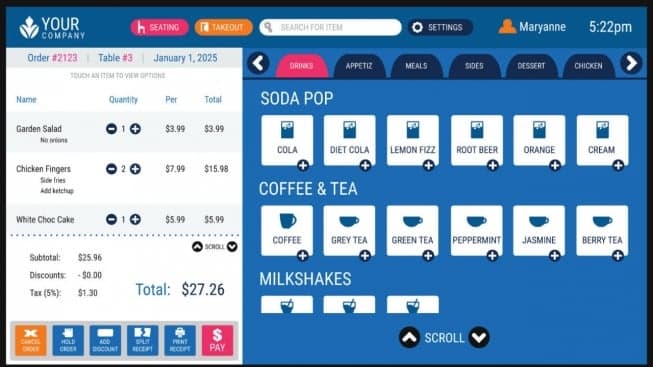
Five Must-Have Features for your quick-service POS Systems
Here’s how to make your technology work for you, not against you.
Franchise News
SPONSOREDHere’s how to make your technology work for you, not against you.
If you own a quick-service restaurant, you know how important it is that your technology works for you, not against you.
Your technology should have features that speed up your restaurant workflow, increase efficiency and boost restaurant sales. That’s why, when searching for a quick-service POS, there are a few features that should be non-negotiable. Check out our five must-haves of a quick-service POS system.
1. A quick-service POS should move guests through the line faster.
With technology that is easy to use, not encumbered by miscellaneous buttons and unnecessary touchpoints, table turn times can increase by 10 to 15 percent. The server just has to enter the item and fire the order off to the kitchen. The cook is then instantly updated on an organized ticket display screen.
Another option for speeding up long lines are handheld POS tablets. These devices can take more orders and get customers through the line faster, using the handheld to field orders and payments right in the line instead of at the counter.
2. A quick-service POS should provide accurate, real-time data.
As a QSR, making data-backed decisions about the future of your business is the key to success. How do you know which menu item is performing best? How do you gauge what times are busiest when scheduling employees?
Cloud-based restaurant technology can give restaurant owners access to real-time data about every facet of their business and the ability to view and make changes to their restaurant from anywhere, at any time. That way, they can better understand where to invest, what programs to grow, which employees to promote and how much you’re really spending on food.
3. A quick-service POS must offer gift cards and loyalty integration.
It’s all about getting your customers to come back for more. Incentives like gift cards and restaurant loyalty programs can help you build a powerful customer database, rewarding your best customers, creating new regulars and increasing visitation frequency and average check size. According to LevelUp, when customers redeem their loyalty reward, they spend 19 percent more on average.
4. A quick-service POS must allow affordable online ordering and delivery.
Online ordering is becoming more and more prevalent in this mobile-driven society, so if your restaurant doesn’t offer this option, you’re missing out on a valuable customer base.
The problem is, online ordering vendors like GrubHub usually charge a commission per order, costing restaurant owners a few dollars per order plus the initial spend of the service. That’s why, this service should be integrated into your quick-service POS system. Not only will your restaurant save money, but you can now entirely customize the experience, collect customer data, easily make modifications to your online menu and benefit from return customers.
5. A quick-service POS must give you insight into customers’ buying behavior.
A customer relationship management (CRM) system is crucial. It allows you to understand your customers, create powerful marketing campaigns and make data-based decisions according to your customers’ preferences. With a CRM, you can engage guests on digital receipts with personalized promos, or even ask for qualitative and quantitative feedback. It also creates a database detailing that specific guest's buying behavior.
Sign up for the 1851 Franchise newsletter to get our biggest stories before everyone else
By signing up, you agree to our user agreement (including class action waiver and arbitration provisions), and acknowledge our privacy policy.

About the Author
Nick Powills, CFE, founded No Limit Agency in 2008 and serves as Chief Brand Strategist for the Chicago-based firm. No Limit is a full-service communications agency that establishes and elevates brands by bridging Public Relations, Social Media, Marketing, Advertising, Digital, and a lot of creativity, to best strategize well-rounded and successful campaigns for 50+ global franchise brands. By presenting visionary ideas and building real relationships, No Limit is able to create effective media branding strategies to help companies grow. Nick currently leads a staff of writers, media strategists, designers, social media experts and digital producers in an office think-tank where brands are humanized for strong, compelling media stories. Prior to starting No Limit at the age of 27, Nick spent four years working at a franchise PR agency where he mastered the art of building rapport with media outlets and creating newsworthy pitches for earned media placements. He holds a Bachelor of Journalism from Drake University in Iowa.