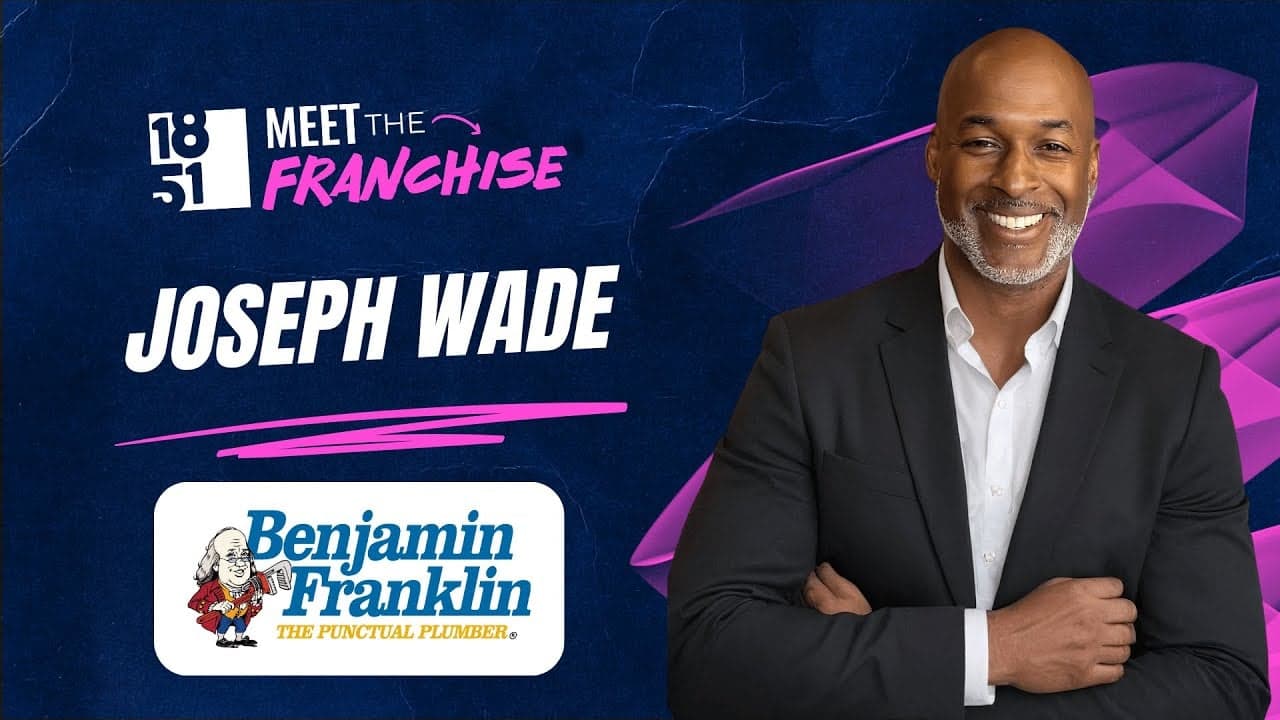
Joseph Wade didn’t come up through the trades. He came up through engineering.
Before he became vice president of operations for Benjamin Franklin Plumbing, Wade wrote software for aerospace programs tied to head-of-state aircraft and military platforms. Later, he ran a digital technology company that installed everything from access points to smart whiteboards for small and midsize businesses. That mix of technical rigor, customer communication and firsthand entrepreneurship now shapes how he talks about franchising in plumbing: as a disciplined, people-led business with steadier demand than most.
For franchise buyers, Wade’s clearest message is that plumbing is attractive because it is consistent. He describes the category as “recession resistant,” the kind of essential service that doesn’t depend on discretionary spending. In his view, that stability makes the opportunity work for owners who want a business they can build without having to guess where demand will be next quarter.
Just as important, Wade pushes back on the assumption that a buyer has to be a plumber. “You don’t have to be a plumber in order to run a plumbing business,” he said. After the purchase, “business is business,” and the owner’s job is leadership, execution and building a team.
That mindset is showing up in who enters the system. Wade said Benjamin Franklin Plumbing still sees independent operators join for brand power and structure, but he is also seeing more “investors” coming from tech, HR and real estate. What unites the strongest candidates is not a trade background, he said, but a willingness to commit. Owners have technicians “looking to you for leadership, for culture, for stability,” and that responsibility requires an “all in” approach.
Rather than positioning franchising’s advantage as brand recognition alone, Wade emphasized the importance of infrastructure that evolves alongside franchisee needs. As Benjamin Franklin Plumbing looks ahead to 2026, the brand has rolled out an updated operating platform across the network, leveraging the scale of its system to partner with ServiceTitan. The enhanced platform gives franchise owners a more efficient, unified engine to run their businesses, while also providing the franchisor with clearer insight into performance trends across regions and service lines. Wade noted that longtime operators have embraced the upgrade as a way to continue meeting rising demand and shifting customer expectations without losing operational consistency.
Technology is part of that demand. Wade pointed to the connected home, where smart fixtures and leak detection have changed expectations. “Even smart fixtures in homes is something that 10 years ago, plumbers didn’t have to deal with,” he said. He described leak detection that can alert a homeowner and, in some configurations, notify the local Benjamin Franklin Plumbing operation so the customer can book service immediately.
Still, Wade is careful not to sell a fantasy of automation. He said AI can streamline workflows, but “the only thing that doesn’t change is that technician with his hands on the equipment.” In other words, the work remains physical, skilled and increasingly valuable. Wade even referenced an article suggesting “the next round of millionaires” could be technicians, given tightening labor supply and rising pay.
That reality feeds back into why culture matters. Wade said transparency is a core value and that expectation-setting is part of protecting franchisee success. His mantra for 2026 is blunt: “Failure is not an option.” For him, that mindset pairs with systems, coaching and a franchise network where owners learn from one another and “expand at a much faster pace than if they had to do it on their own.”
On the customer side, Wade believes Benjamin Franklin Plumbing’s differentiation shows up at the front door. Clean uniforms. Shoe covers. Respect for the home. Punctuality. “We say we’re going to be there,” he said. “We’re going to be there on time.” In a service business where trust is fragile, Wade argues those basics are not small details. They are the product.
Wade joined 1851 Franchise Publisher Nick Powills on the “Meet the Franchise” podcast to discuss why plumbing’s recession-resistant demand continues to attract franchise buyers and how Benjamin Franklin Plumbing’s systems and service standards help owners scale. A transcript of the interview, edited for length and clarity, has been provided below.
Nick Powills: All right, Joseph — first you, then the business. Question one is very scripted and very easy: How did you accidentally fall into franchising? What’s your franchise backstory?
Joseph Wade: Kind of an interesting story. My background is engineering — I’m a software engineer.
I used to work in aerospace. I wrote code, developed programs and delivered governmental programs for head-of-state aircraft, as well as military aircraft — Navy and Air Force. I had grown in that industry about as far as I wanted to go. I was delivering programs that were $300 million, $400 million — 10-year programs, five-year programs.
Very intense, but very involved and very detail-oriented.
I transitioned from that and had my own company for a brief period. We were a digital technology company. Anything digital — from access points to smart whiteboards — we would install in small- to medium-sized businesses.
Small to medium-sized, generally about 500 users was the max. Even mom-and-pop businesses that just needed IT support — we would provide those things, as well as the security associated with it.
While I was doing that, a friend of mine reached out. He had been in franchising for decades. He said, “Hey, I just saw this job opening, and based on our conversations, I think you’d be a good pick. You were the first person I thought of when I saw the job.” I said, “OK, I’ll check it out.”
It turned out to be a franchise business consultant role for a restoration company. I looked into it and liked it because it fed two things for me. One was the analytical, technical and financial side of business.
But then it was the people part. One of the things I did in aerospace was communicate with customers and make sure they were good with where we were going with our programs. It piqued my curiosity.
I jumped in and honestly kind of fell in love. From there, I stayed with that company for about three years, and then I got recruited by Authority Brands to come over and be a part of Benjamin Franklin Plumbing.
Powills: I love that backdrop. A few things I want to unpack there. You’ve felt what it feels like to be an entrepreneur.
Wade: Oh, yeah.
Powills: How do you keep that energy silent? Obviously, the benefit is you can tell a franchisee, “I’ve walked a day in your shoes. I know what it feels like that all of my hard work is going to be the answer for how I feed my family.”
But how do you keep that silent and stay on more of the employee side, and how do you still access that entrepreneur side to help you coach through any of those situations?
Wade: Great question. I think the entrepreneurial — I’ll call it the entrepreneurial monster — needs to be fed. For me, it was more about, “How can I serve my community through something that I love and am passionate about and still make money for myself and for my family?”
It’s an interesting dynamic. You’re either really strong on one side — all I want to do is make money — or you’re on the other side — all I want to do is serve my community. I have a nice balance of the two, and an analytical approach to problem-solving, which serves both sides.
Also, people fascinate me. Human beings fascinate me.
Powills: You get to interact with so many people. The fundamentals are the same: Whether it’s you being an entrepreneur and deciding, “I’m no longer going to work for the man — I’m going to work for myself,” or a franchisee doing personal discovery and saying, “I believe in this brand, and I believe the scaffolding they’re going to give me will help me build something.”
It could be time — it doesn’t have to always be money — but it’s going to give me something back that I’m missing.
That relatability is hugely beneficial for you. I was looking at your LinkedIn before we got on — it’s probably the most interesting thing, to go from that into the business coach or business consultant.
I’d almost argue you, as a business consultant, are at the top of the line of impact because your ability to listen to the words of a franchisee — the struggles or the high points — and actually have a point of view. The natural progression back into business is automatically there in what you do today.
Wade: One hundred percent. I truly can, and I’m fortunate that I ran my own business first. I learned a lot.
I learned where my strengths were and where my weaknesses were with regard to running a business. I was able to sell my contracts and then go into franchising. But being able to impact someone in a way that, in my mind, you can’t do any other way —
Franchisees are all in. They are literally all in. So if I’m going to look myself in the mirror in the morning and say, “You know what? I’m just going to come and punch a clock and do whatever,” I can’t do that. I have to be all in — sometimes even more than them — in terms of being committed to their business and the success that follows.
Powills: If someone’s watching, I want them to listen to that. The reality is, when we’ve surveyed almost 5,000 franchisees and asked them what pushes them over the edge, it’s only two things. The words change, but the end result is usually the same: culture and business model.
That culture side — they’re the ones taking the risk and putting their life savings at risk. For a franchisor to say, “It’s our responsibility — my responsibility — to not clock in, clock out. I have to over-index what I’m going to give them from a support standpoint so they have the chance to succeed and scale and win,” is awesome.
Shift it over to the business. Give the state of what’s going on with Benjamin Franklin Plumbing. And if someone’s watching this, oversimplify why you’d want to buy in.
Wade: First and foremost, the plumbing industry. Based on my bio, I didn’t come from the plumbing industry. It is fascinating in and of itself.
The idea that it is recession-resistant — that alone should attract anyone who wants to run their own business. And you don’t necessarily have to be a plumber to do that.
After the transaction, business is business. It all runs the same way, give or take a few percentage points in particular areas.
Benjamin Franklin Plumbing coming out of 2025 — which we did very well — going into 2026, we’re excited. Under trade brands, we updated our operating system across the network.
Now, for our franchise owners, they have a more efficient engine to run their businesses. From the franchisor’s perspective, we now have an enterprise tool that gives us clear insight into performance — not just individual locations, but by region, by product line.
We’ve got reporting that provides an opportunity to make shifts and changes as we need to, on the fly. We’re excited about where we’re going.
Powills: Stay on that. If you go to an old-school plumbing business, the infrastructure you’ve built around the plumbing business doesn’t exist — and unless you’re a franchise brand, most don’t have that infrastructure.
That gives a huge advantage to an industry that’s seeing a tremendous uptick because fewer people want to do it. So the value of the service is increasing, and now you put the technology around it.
Do your franchisees — even older franchisees, older as in they’ve been in the system longer — respect this transformation? What has their feedback been?
Wade: Amazingly enough, our older or more senior franchisees embrace it because they see that the old-school infrastructure doesn’t allow them to scale and grow as quickly as the market is demanding.
Even smart fixtures in homes are something that 10 years ago, plumbers didn’t have to deal with. Now you have to keep up with technology.
Things like leak detection — being able to look on your phone and know that your house in Aspen is currently having a leak, and you can get somebody to take care of it relatively quickly. Those things didn’t exist not so long ago.
They’re excited about where we’re going from a technology standpoint, and from a resource and information standpoint that allows them to book a call.
Our leak detection will contact the owner and let them know you’ve got a leak. Depending on how we have it configured, it will contact the local Benjamin Franklin Plumbing and let them know as well. The customer can book the call right then and there.
Powills: You and I could probably spend a few hours talking about this. The connected home — in my opinion, the company category that’s going to be most excited about this is the insurance business.
If the insurance business can understand all the data you just spoke about — yes, the homeowner wants to know it — but it gives so much insight into how you address premiums and everything else. What you laid down is one category, but the connected home is going to dial in so much.
I also don’t want to over-index on spending time on this topic, but the trades categories are going to continue to build up as some of the most elite categories in business. I can read the data and give analytics to say, “OK, we see X, we’ve identified a leak.” But it’s not going to change having an expert go out there and fix it.
Wade: I’m glad you touched on that. AI is part of our infrastructure at this point, and it will continue to grow and become more and more a part of how we do business.
The best part is we’ve laid out a strategy where we’ve looked at where we can automate some of the business practices and the workflows.
In every model, the only thing that doesn’t change is that technician with his hands on the equipment — hands in the sink, under the counter, wherever else. You can’t automate that.
I read an article — it’s been some time now — but they talked about the next round of millionaires. The next round of millionaires won’t be the franchisees necessarily, although they’ll do very well. It will be the technicians. Interesting.
Powills: Yeah, because there’s going to be fewer. For now, there are fewer people.
Plumbing is seen as a dirty business — not that it’s a dirty business, but it’s literally a dirty business.
So whether it’s plumber jokes or garbage man jokes, all these trades that have a limited amount of humans who have wanted to do it — now, finally, we’re starting to pay those people what they truly deserve for the problems they can solve.
This transformation might not be tomorrow, but the CEO of tomorrow might be the technician who now has a skill set that puts them above so many other people.
Wade: Absolutely. Absolutely. And I don’t want to misspeak.
I have two sons, Elijah and Langston, and they’re fantastic kids, in spite of my parenting style. We talk about sports heroes and the contracts some of these sports heroes are making. They’ll say, “Man, it would be great to have that.”
Well, that’s the technician. But I reminded them: “You realize somebody’s writing that check for them — the franchise owner.”
So I don’t want to diminish the benefit that the franchise owner will make in all of this. Just showing some attention to the technician.
Powills: And for the owner, I’m aligned with you. The technician is going to be one of the highest-paid jobs that exists, across so many categories.
But for a franchisee, if they look at the business model of how do I surpass this, it’s going to be scale of ownership.
If you own multiple territories and build multiple businesses, you will be the highest earner. You’re not doing the work — you’re building the infrastructure and operations. You’re building the infrastructure to support it.
And then you’re going to have to pay this in order to be competitive on the level of service you want to get to your customers.
Wade: And the franchisor builds the culture and the mechanisms for your growth in that as well.
One of our favorite things about franchising is the network we build, where franchise owners can speak to other franchise owners within the brand and learn, grow and expand at a much faster pace than if they had to do it on their own.
Being part of a franchise is great. Being part of a franchise network is even better. And we have a strong network — strong, huge.
Powills: All right. Talk about the persona of the franchisee today. I’m going to lead the witness with this.
Wade: I know you know the answer already.
Powills: Some outsiders are like, “Well, I have to have grown up in plumbing.” Who is the owner today? Where are they coming from? Any characteristics you’re seeing in their backdrop that you want to call out?
Wade: We still have the mom-and-pops — I’ll use that term loosely. Independents is a better way to describe them — coming onto the franchise system because they see the benefit of the national brand.
They see the benefit of the systems — the things they may have been struggling with for growth and development that the franchise offers as part of the package. So we still see those conversions come in.
But we’re seeing more and more what we call investors. They invest in a company that is recession-resistant. I never say recession-proof, but a business they can grow.
They’re coming from tech, HR, real estate — they’re coming from all over. The benefit is you don’t have to be a plumber to run a plumbing business.
I mentioned before: After the transaction, the business runs the same way. It doesn’t matter what the business is.
Plumbing allows them — because it is consistent and steady. We don’t have huge ebbs and flows in volume. It’s attractive to a lot of different individuals who want to come in.
Now, I will say this: In the plumbing industry, you’ve got to be all in. You have a full team of technicians looking to you for leadership, for culture, for stability. As an owner, you have to have those things in place.
We provide those tools to our franchise owners, and we guide them through our franchise business consultants.
Powills: I couldn’t agree with you more. The culture that’s set at the top is the culture that’s going to show itself when they enter the most sacred thing that humans own, which is their home.
If you don’t hold that culture strong, the experience of the customer isn’t going to be good, which means they wouldn’t use you again. It’s straightforward business models — but that’s how you take care of your customers. Take care of your team, and take care of your customers.
Wade: I never say easy. I say straightforward, noncomplicated. I never use easy.
Powills: That’s good. In franchising, the difference between good and bad is expectation-setting.
When a franchisor swings heavily on selling a franchise, expectations tend to be misaligned, which creates validation issues.
So you saying, “Look, this isn’t an easy business. It’s a beautiful business. It’s not easy,” sets the expectation properly for the franchise buyer, too.
Wade: Absolutely. We do that all along.
One of our core values is transparency — being clear and open and honest about what we’re doing. If you go in with your eyes wide open, there are no surprises further down.
One of my mantras going into 2026 is, “Failure is not an option.” If you take that mentality, everything else we provide — tools, direction, focus, support — a lot of the problems go away.
Because you’ve already said quitting is not an option. “I’m not going to quit. I just need to figure out how to navigate my current challenge.”
Powills: Great message for the consumer, too, because you’re going to see some tough situations. I also have two boys — I’ve seen those tough situations.
Let’s end on this, Joseph. If there is a franchise buyer watching this, what else do you want them to know about the business opportunity before we go?
Wade: The business opportunity with trade brands — and specifically Benjamin Franklin Plumbing — is you get to be part of a community.
You get to be part of a business model that is committed to customer experience excellence. We are not the brand that is — and when I say cheap, I don’t mean by price. I mean how we deliver.
We show up in clean uniforms. We make sure our shoe covers are on before we go in because we respect the customer’s home.
It’s a business model that delivers top-quality service to our customers on a regular and consistent basis. And we’re punctual. We say we’re going to be there — we’re going to be there on time.
Powills: The professionalism you bring ends up being a point of differentiation.
I lucked out — this was not Benjamin Franklin Plumbing— but I used a company in Atlanta when we lived there. A moment that stuck out: We had to snake the toilet for the second time. The first time was like $130 — it was crazy.
The same technician came and said, “Let me show you what snake to buy on Amazon so you don’t have to pay this every single time. Call me when you have a bigger issue.”
It’s such a little moment, but it stuck with me. “I don’t need to take your money. I want to build transparency.”
What you talked about — the difference between a good franchisee and a great franchisee tends to be those that listen to your advice, listen to your mantra, listen to your experience in business. You’ve chosen to be a leader for an organization — no longer an entrepreneur at this stage.
There’s tremendous value in what you shared. I’m grateful you shared it with us today. I think it paints a nice picture for someone looking for a culture match in a business.
I don’t think many children grow up and say, “I want to be a plumber someday,” unless their dad is a plumber. But to say, “I want to have a tremendous career where I can make a difference and impact my community” — that’s what we just talked about. It wasn’t even the tactics of what plumbing is.
I’m grateful for our conversation, Joseph. Thanks for sharing your story with us today.
Wade: Nick, I appreciate the opportunity. This has been a blast, and I appreciate the opportunity to share our story.
Powills: I love it. For Joseph, I’m Nick. This was another episode of “Meet the Franchise.”
Watch the full interview here.