Franchisor Stories
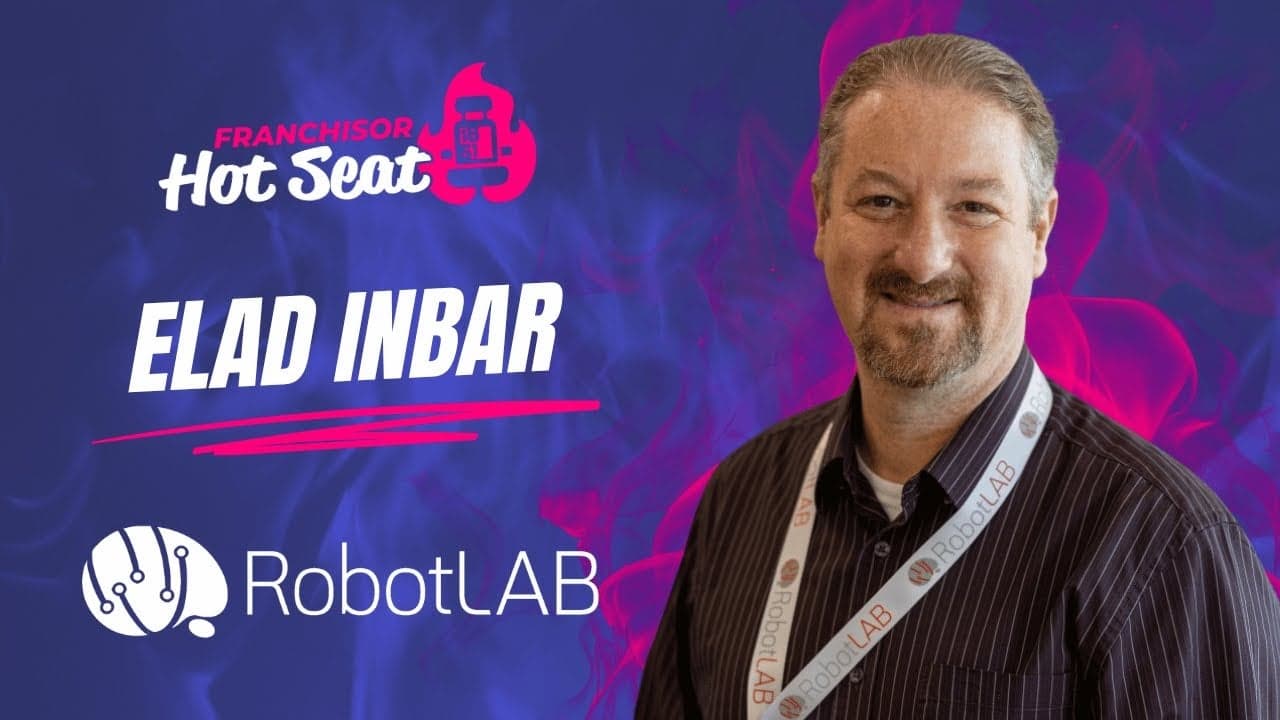
Bringing Robots to Main Street: How Elad Inbar’s RobotLAB Franchise Is Powering the Local AI Revolution
From Hilton Hotels to local schools, RobotLAB is putting robotics in the hands of business owners — and no PhD is required.
Franchisor Stories
From Hilton Hotels to local schools, RobotLAB is putting robotics in the hands of business owners — and no PhD is required.
With 36 franchise owners operating nearly 90 territories in under two years, RobotLAB CEO Elad Inbar is proving that the robotics revolution isn’t reserved for Silicon Valley — it’s coming to a neighborhood near you.
RobotLAB Inc., the global leader in commercial robotics and AI, began its franchise journey just over 18 months ago. After nearly two decades of direct-to-business sales to major brands like Hilton, Marriott and JP Morgan, Inbar saw franchising as the path to local scalability. Today, the brand equips everyday entrepreneurs with the tools, training and support needed to become robotics providers for local hotels, restaurants, schools and more.
“Just like when Henry Ford revolutionized car manufacturing — it wasn’t viable to send a car across the country for repairs,” Inbar told 1851 Franchise’s Nick Powills on a recent episode of “Franchisor Hot Seat,” a podcast that highlights the growth stories behind successful franchise brands. “You needed a local support system. That’s what we’re building with our franchise network — the last mile of robotics.”
Franchisees don’t need a technical background. Instead, they act as consultants and service providers for their territories, recommending the right solutions, conducting demos, handling deployment and providing ongoing support. RobotLAB even assigns national corporate accounts to local franchisees to service on the ground.
The investment starts at $278,000, which includes the $54,900 franchise fee, equipment, three months of operating expenses, and branded vans used to take robots directly to clients for onsite demonstrations. With average customer invoices of $26,000 and gross margins around 46%, the economics are promising — one franchisee even closed an $855,000 deal with a single Las Vegas hotel.
“I’ve been in this industry a long time, and for many years, progress was linear,” Inbar said. “But in the last three to four years, it’s exploded. We’re on a vertical takeoff now — a hockey-stick curve.”
A transcript of Inbar’s interview with Powills has been provided below. It has been edited for brevity, clarity and style.
Nick Powills: All right, we’ll start with the one scripted question, and then we’ll go off-script. How did you accidentally fall into franchising? What’s your franchise backstory?
Elad Inbar: That’s a great question. Thank you for having me, first of all. I started RobotLAB around 18 years ago, back in 2007. We were selling robots directly to customers — restaurants, hotels, assisted living facilities, schools, colleges and so on.
A couple of years ago, demand started growing so much that we couldn’t serve everyone, everywhere, whenever they needed it. So we looked at different growth strategies — opening our own teams or offices, getting private equity involved. And time and time again, the franchise model came up as the right path.
With franchising, we could rely on local business owners who are passionate about their markets and becoming leaders in their areas. So we started franchising about a year and a half ago. Today, we have 36 locations up and running — 36 different franchise owners — and we’re continuing to grow.
Powills: So 36 franchise owners. What’s that in terms of total units?
Inbar: We’re at around 90 units spread across those 36 owners.
Powills: You decided to go the franchising route — how have expectations held up? What did you expect, and what has actually happened?
Inbar: The growth opportunity has been phenomenal. One of the biggest benefits is being able to go to national brands like Hilton, Marriott or JP Morgan — some of our customers — and commit that we can be onsite at any of their locations today or tomorrow. That’s a huge value proposition, and we can do that because of our franchise system.
If we don’t have someone in that location, we ship products and send people from our headquarters, which is near Dallas — one of the best centralized locations in the country. But ideally, we rely on our franchise system as part of our team to service those locations.
Our goal is full national coverage — to be able to reach every business in the country within a few hours.
Powills: So what does a day in the life look like for a RobotLAB franchisee? Especially since they don’t need a PhD in robotics.
Inbar: Yeah, great question. We don’t have a single “ideal” profile yet. Our franchisees come from all kinds of backgrounds. Some are in sales, some are more technical. Some are corporate executives looking for something new. Others are younger and ready to take their territory by storm with robotics and AI.
What unites them is passion — they want to help business owners automate tasks people don’t want to do anymore. Nobody wants to push a vacuum for eight hours a day or bus tables. That’s the shared mindset.
In terms of their daily work — especially in their first year — it’s all about filling the top of the funnel. Nurturing leads, running demos, bringing robots to show potential clients. It’s classic sales cycle work.
We provide a lot of resources and support to help them succeed — lead generation, inbound inquiries, all of that. And we also assign them existing corporate accounts when available. So if we have a brand that has a property in Orlando, Vegas or Chicago, for example, we assign those service contracts to the local franchisee. They get paid directly for that work — whatever the customer pays us, we pay the franchisee.
Powills: So to simplify it, the franchisee is essentially buying a territory, and within that territory, they act as the salesperson and service provider — the go-between for getting the product into the marketplace. Do you train them on how to repair the robots?
Inbar: Yes. Our franchisees provide everything end-to-end — everything we offer to our customers, just localized. They handle sales, consultation, deployment and service. We’re not just selling robots; we partner with our customers. We act as consultants because there are so many different robots and applications out there, and the customer typically doesn’t know which solution is best for them.
There’s no one best robot — there’s only the best robot for that use case.
So we come in, identify their needs, recommend a solution, then go onsite and deploy it. Every robot needs to be mapped to its environment — like in a restaurant, the robot doesn’t know where table 14 is out of the box. So our franchisees create a digital map, define points of interest like the kitchen, dishwashing station and all tables.
After deployment, they continue servicing the customer. If there’s a failure or if the layout of the location changes — say, they move table 14 — the franchisee remaps the environment. They’re the local point of contact. We want the customer to think of it like a local RobotLAB office.
Just like a FedEx store — you don’t care if it’s a franchise. You know your package will get there. That’s the experience we’re aiming to create.
Powills: Does a franchisee need a brick-and-mortar location?
Inbar: Yes, but it's light industrial. Nothing fancy. A roll-up door in the back, maybe a couple of offices up front. No showroom, no prime retail. That’s because our clients don’t want to see the robots in a showroom — they want to see them on their floors.
So if you’re a hotel owner, you want to see a robot clean your carpet, with your dirt. Restaurant owners want to see robots deliver food to their tables with their crazy chef in the kitchen. That’s how they evaluate fit. So our franchisees load the robots into a branded van and run on-site demos.
Powills: What’s the cost to get started?
Inbar: The franchise fee is $54,900. That covers a territory of 8,000 relevant businesses — restaurants, hotels, assisted living, supermarkets and more. We don’t count irrelevant businesses — like pool cleaning companies, for example — in that calculation.
As for Item 7 in the FDD, the full startup investment is around $278,000 on the low end. That includes the franchise fee, equipment package, three months of office lease, van lease, salaries — everything needed to get started.
Powills: Are you making an earnings claim in Item 19?
Inbar: Yes, we have an Item 19. It’s not based on a full year of data since we’re still emerging, but it includes average invoice numbers and margin data. Our average invoice is around $26,000. The average gross margin is about 46%.
So you’re looking at $26,000 in revenue per customer, with nearly half of that as margin. Our highest single invoice so far was $855,000 — one hotel in Las Vegas bought 15 cleaning robots from our franchisee there.
Powills: That’s wild. So there’s clearly a path to recoup the investment quickly if you hustle. What’s your recommended grand opening marketing spend?
Inbar: We suggest budgeting around $15,000. But most of our franchisees don’t even hit that. It covers things like decorations, refreshments, or DJ and entertainment — it varies a lot by market.
We had one grand opening in South Florida with a DJ and open bar. In contrast, a Minnesota launch was much more reserved. But across the board, we help with press releases, connect with chambers of commerce, bring in local business owners, city leaders — even mayors show up.
Everyone wants to say, “I brought robots to my community.” There’s real excitement around that.
Powills: When we’re done, I want you to go back and listen to the 13-minute mark. That line — “I brought robots to my community” — that’s your “why now.” When someone visits your site, that should be the story. Right now, it just says “Franchise with RobotLAB,” which doesn’t say much.
Also, I love that you show a robot on your homepage, but you should also show a franchisee with the robot — someone leading this in their community.
Out of curiosity — since you’ve been doing this a while and technology moves fast — what’s the life span of one of these robots? How quickly does the tech become outdated?
Inbar: That’s a great question. Yes, the industry moves fast. New products launch every few months. Every couple of years, we see major shifts. It’s like our phones — every two to three years, we upgrade.
That said, just because something new comes out doesn’t mean the old version stops working or becomes obsolete. It’s still valuable.
Our customers typically pay 18% of the robot’s price annually to keep it under warranty. So after three or four years, instead of renewing the warranty, we’ll often suggest putting that 18% toward a new program.
At that point, there’s enough improvement — better battery life, smarter navigation, improved suspension — that the upgrade makes sense. We’ll take the old robot back, give them credit, and resell it as a certified refurbished unit — like the car industry.
Powills: Right. So you’re essentially creating a secondary market for used robots. Thinking back to that $855,000 sale in Vegas — 15 robots at around $50K each — how fast does the ROI happen from a labor perspective?
Inbar: First, let me say this: we don’t approach businesses and say, “Fire your team and get robots.” That’s not the message — and that’s not how the market sees it either.
The real issue today is labor shortage. Talk to any business owner about labor and you’ll get an eye roll and a rant. They simply can’t find people.
A single cleaning robot can replace about 1.5 full-time employees. For example, Hilton Atlanta runs our robots 14 hours a day. No one’s willing to work that much — and certainly not at the cost of the robot.
A robot that cleans 120,000 square feet a day costs $25 per day. You can’t hire someone to do that. Same with delivery robots — they run 10 to 12 hours on a charge and cost about $15 a day. You can’t hire a person for $15 an hour, let alone per day.
The economics make sense, but again — it's not about replacing people. It's about helping the few that do show up.
Powills: I agree. I love how you framed it as solving labor shortage, not labor replacement. That’s important. And if the demand is there — which it clearly is — then this is a real solution.
Let me shift gears again. Think about the 1980s, when robots were still science fiction. But between 2020 and 2025, things feel like they’ve accelerated dramatically. Would you say we’re hitting a new level now?
Inbar: Absolutely. I’ve been in this industry a long time, and for many years, progress was linear. But in the last three to four years, it’s exploded. We’re on a vertical takeoff now — a hockey-stick curve.
There are two main reasons. First is computing power. We’re getting exponentially more processing ability for a fraction of the cost.
Moore’s Law used to say that every 18 months, computing power doubles while cost stays the same. Now, according to Nvidia CEO Jensen Huang, the power is doubling every 18 months at the same cost — we’re on a vertical path.
Second is AI. With that computing power, AI has become more capable — and it’s no longer just in software like ChatGPT. It’s embedded in physical robots that navigate real-world environments.
Take a simple task like picking up a water bottle — it involves understanding transparency, weight, grip pressure. We take those for granted, but a robot has to compute all of that in real time. And now it can.
That unlocks a ton of new use cases — folding laundry, unloading dishwashers, cleaning floors. Until recently, we couldn’t do that with a robot. Now we can. What we’re seeing now is a huge expansion in what’s possible. In just the last six to eight months, we’ve onboarded more robots into our portfolio than ever before — robots for security, cooking, outdoor patrol, drones that wash windows, even firefighting robots.
These use cases weren’t possible a few years ago. Take firefighting — what is fire? How hot is it? Can a robot move through it safely and get out? That requires thermal imaging, real-time decision-making and advanced mapping — all onboard the robot.
With this increased computing power, we’re unlocking new capabilities at an incredible pace.
Powills: I love it. And honestly, what’s sitting behind you — the robot with a face — makes a big difference. Humans still want a “human touch.” Even though robotics is everywhere — autopilot on planes, self-driving cars, dishwashers — there’s comfort in seeing something with a personality.
That’s the next frontier: making robots feel more human and approachable.
Inbar: Absolutely. That’s what we call HRI — Human-Robot Interaction. It’s incredibly important. The robot behind me is a delivery robot for restaurants. It has a screen that tilts like a head, and as it moves down the aisle, it “looks” left and right.
When it turns left, it turns its head first — just like a person would. It creates a sense of familiarity. Customers feel more comfortable and know what to expect.
We’re not trying to create Terminators. We want robots to feel helpful and safe. If people feel threatened, they won’t engage with the technology. So we invest heavily in HRI to build acceptance.
Powills: Last question. I’m fascinated by this. If you think back to the space race — U.S. vs. Russia — is there a similar race happening in robotics? Or is this more collaborative globally?
Inbar: Great question. Right now, I don’t see much collaboration between countries. A few companies have R&D in one place and manufacturing in another, but in general, Asia is leading the robotics space.
Most robots come from China, Korea, Singapore, Japan. In the U.S., we have some activity — Tesla, Figure (the humanoid robot company) — but nothing at commercial scale yet. A few smaller players are working on robotic lawnmowers or similar tools, but they’re still early-stage.
A notable example of cross-border collaboration is LG’s acquisition of Bear Robotics. LG builds excellent hardware, and Bear has great software. They’re combining strengths. But Bear Robotics is already active in Korea, with offices and teams there, so it’s not necessarily bridging two countries.
Powills: Has anyone franchised something like RobotLAB in Asia? Or is franchising mostly a U.S. model?
Inbar: We started in the U.S. because this is our home base — it’s where we’ve operated for years. We also have an office in Bogotá, Colombia, and we’re planning to expand into Europe next year. We’ve already identified a partner there.
Eventually, we’ll enter Asia. But the problem we’re solving isn’t manufacturing — it’s the last mile of robotics. That’s where franchising works so well.
Products and manufacturers will come and go, but businesses — hotels, restaurants, schools — they’ll always need reliable, local service. If a hotel in Dallas has a problem with a robot, they can’t wait for someone to fly in from China or Michigan to fix it.
Just like when Henry Ford revolutionized car manufacturing — it wasn’t viable to send a car across the country for repairs. You needed a local support system. That’s what we’re building with our franchise network — the last mile of robotics.
Powills: That’s it — go back to the 30-minute mark and listen to what you just said. “We’re solving the last mile of robotics.” That should be front and center on your franchise site. It tells the story perfectly.
Well, I’ve really enjoyed this conversation. What a great story. Looking forward to seeing where you go next. Thanks for being here.
Inbar: Thank you for having me. I really appreciate it.
Watch the full podcast here.
Sign up for the 1851 Franchise newsletter to get our biggest stories before everyone else
By signing up, you agree to our user agreement (including class action waiver and arbitration provisions), and acknowledge our privacy policy.