The holidays are a time of joy and celebration for many families, but for their dogs, a constant stream of new people, smells and decorations can be overwhelming. This level of external input can be stressful for a dog, but with a bit of preparation through proper training, Christmas festivities can be safe and stress-free for everyone involved.

Dog Training Elite, one of the leading dog obedience and specialized training franchises in the country, provides guidance for pet parents preparing for the holiday season.

Get Started Early

Before the doorbell is ringing and the house is filling up, brush up on basic commands. Short practice sessions can keep dogs engaged and help maintain their obedience skills, which are crucial for stress-free holiday gatherings.

“Once the dog goes over their threshold, you’re just trying to stop the situation from getting out of hand,” said JB Pitsinger, owner of Dog Training Elite of Huntsville. “Be patient with them, let them learn and reward them when they do things correctly. It doesn’t have to be long, drawn-out exercises. We can get it done in 15 or 20 minutes per day — just some focused time with you and the dog.”

In these sessions, work on things from basic obedience to polite leash walking and the “leave it” command for food items dropped in the kitchen.

“Those 15 minutes really go a long way, and it increases the bond between you and the dog,” Pitsinger said. “Now, the dog will listen to you more easily, he’ll know what to expect from you, and he knows that he’s going to get rewarded when he does well and corrected when he does the wrong thing. Dogs like predictability, so keeping up those normal daily routines is key.”

The holidays also tend to increase the frequency of some stressors that would be intermittent on a “regular” day, like the doorbell. Preparing for these unusual stimuli is key.

“I’m not going to wait until my company is coming over and ringing my doorbell to start my training,” Pitsinger said. “I’m going to do things like record my doorbell on my phone and play that sound back through my Bluetooth speaker so I can imitate my doorbell. If I go ring my doorbell myself, the dog knows it’s me — they’re pretty smart!”

Making the doorbell “ring” unexpectedly through the speaker will give you an opportunity to teach the dog how to react to that sound, redirecting them and training them to respond to the doorbell ringing by going to their crates or place mats.

“When they know what to do and we’re confident that they know how to do it, we can easily redirect them in the moment and give them something else to do in that moment of stress or anxiety.”

Manage Guests and Greetings

As guests come into and move throughout the house, you’ll want your dog to behave politely. To avoid jumping, excessive excitement or otherwise improper greetings, establish a clear routine.

Chelsea Emery, owner of Dog Training Elite of Orlando, said that the “place” command is a game-changer in these scenarios.
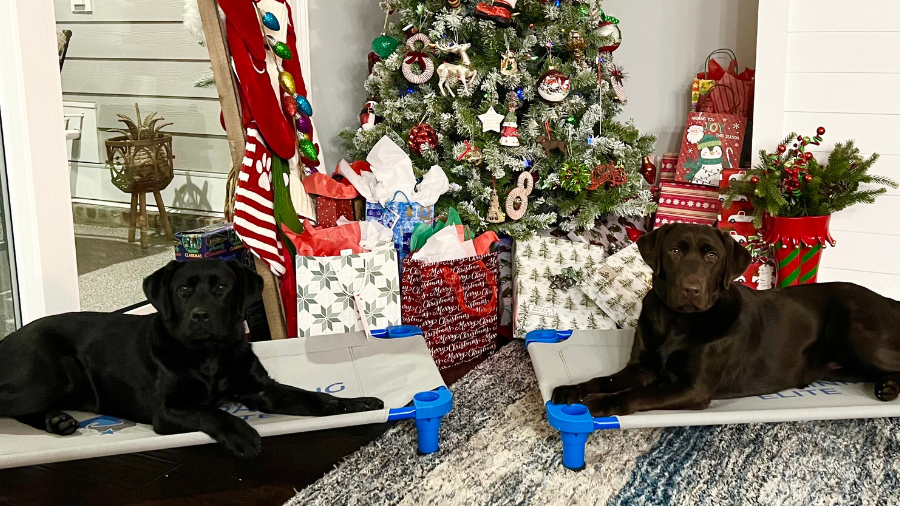

Emery’s young labs on their place cots for holiday festivities

“‘Place’ is a designated area that the dog will maintain while people are walking in and out of the door,” she said. “Another positive reason to do ‘place’ is because it not only keeps them in one area and doesn’t allow them to jump on people, but it also allows them to work on their impulse control — that’s where a lot of this comes from. ‘I want to say hi; let me jump!’ The ‘place’ command gives them an opportunity to settle as new people walk in the home, and whenever the owner feels the dog is nice and calm, they can release the dog to go say hi.”

Pitsinger explained that the “place” command also helps dogs who feel nervous about new people coming into their homes. By having a safe space that they know is theirs, dogs are able to “retreat” and feel more neutral about the situation. He also pointed out that it’s important to not only provide this resource to your dog but inform your guests of what it may mean to them. Letting everyone know that the dog is in their crate or on their “place” and should be left alone sets clear expectations that set the dog up for success.

Keep Food and Treats Safe

The holiday season is full of treats, but for dogs, many of these foods are dangerous. In addition to chocolate, which is bad for dogs, there are countless other items that can be problematic.

“Cat food is really not that good for dogs,” Pitsinger said. “Things like avocados, we don’t necessarily think that something like that could cause an issue with our dog, but they can. Most things with seeds in them, like grapes and apples, can also give dogs a problem.”

While maintaining awareness of which food items can be dangerous for dogs is a key step in protecting your pet, there are other precautions you can take, too.

Training the “leave it” command will ensure your dog will not pick up any food — safe or otherwise — that may be dropped by accident in the process of holiday cooking and snacking. And during the holiday meal, the “place” command can again be useful.

“Our first holiday with our dogs, I was a little nervous, but we brought their place cots,” Emery said. “We probably had 20 to 25 people in the house, but we told them ‘place,’ and we were able to sit down and eat. Our dogs don’t know human food, but still, if they hear a wrapper, they want to know what it is. So, we want to make sure that they’re under control and we can enjoy our dinner and not have to be helicopter parents with them.”

While the dog is in its designated space, providing something like a festive chew or lick mat is another way to keep them occupied and focused on their own food, not tempted to counter surf or search for crumbs.

Mind Your Holiday Decorations

Holiday decorations can make a home gorgeous, but they also pose notable safety hazards to pets. Whether it’s a glass ornament within reach, a train circling below the Christmas tree or an extension cord powering blow-up decorations outside, there are countless opportunities for dogs to get their mouths on things they shouldn’t.

The easiest way to prevent these challenges is to remove the risk entirely. Hang ornaments out of reach for the dog, place a gate or mini fence-type divider between the dog and the tree, and don’t leave a dog outside unsupervised.

However, you can also work to teach boundaries.

“If I do want to have these items out and teach the dog not to bother them, I have to make sure I’m supervising the situation,” Pitsinger said. “When they get near it, I can create that boundary space and teach the dog, ‘There’s no need for you to go over to that tree.’ Give them a little correction or redirect them away from the tree and back toward me or their place or bed.”

Practice Travel Etiquette Ahead of Time

If you’re traveling for the holidays, preparing ahead of time is essential.

If your dog gets nervous in the car, Emery suggests starting small and early to build confidence.

“Go for a five-minute drive and come back; the next day, go for a seven-minute drive and come back” she said. “It’s all about having a reward system in the car. If they’re being well-behaved and calm, just sitting there and looking out the window, reward it! ‘Yes! Good boy, good girl!’ Give them a treat. Dogs are very simple; you just have to be able to communicate with them in the right way.”

And, no matter how calm and secure your dog is in the car, Emery suggests crating them.

“We highly recommend putting your dog in a kennel in the car,” she said. “One, for safety reasons. Two, it allows them to have that space. Sometimes, when a dog is in a moving object, it makes them nervous. Being in a confined space where they don’t feel like they’re being tossed around, especially for nervous, anxious dogs, is a good thing. If you’re doing long hours of travel, that’s a good idea.”

Prioritize Mental and Physical Stimulation Ahead of Time

Many people will say that a tired dog is a good dog. When dogs have their physical and mental needs met, they may be tired, but they’re also able to unwind more easily. 

“Doing a 15 to 20-minute training session is more mentally stimulating and more exhausting to a dog than doing for a two-mile hike,” Emery said.

Doing this prior to a travel day, event or holiday gathering ensures the dog’s needs are met. It can mellow them out before the main event, but a similar attention to their needs can be carried through the day, too. Doing /enrichment activities like providing lick mats or feeding dinner in a puzzle feeder provides dogs with other outlets, ensuring they remain stimulated even if their people are busy with holiday activities.

Set Your Dog up for Success

The common thread through all preparation steps is to set your dog up for success. Whether you’re adjusting your ornament placement or advocating for your dog’s space with guests, it is your job, as their owner, to ensure they are not immediately positioned to fail.

“Don’t force your dog into any situation that they don’t want to be in,” Emery said. “A lot of people want their dogs to be involved in the holidays, get dressed up or be a part of the family pictures. And it’s nothing an owner has done, but some dogs just don’t want to do those things. Socialize and desensitize your dog as early as you can, but don’t throw them into a fire when they’re not ready to take it on.”

To find out more information, please visit https://1851franchise.com/dogtrainingelite/info

The holidays are a time of joy and celebration for many families, but for their dogs, a constant stream of new people, smells and decorations can be overwhelming. This level of external input can be stressful for a dog, but with a bit of preparation through proper training, Christmas festivities can be safe and stress-free for everyone involved.

Dog Training Elite, one of the leading dog obedience and specialized training franchises in the country, provides guidance for pet parents preparing for the holiday season.

Get Started Early

Before the doorbell is ringing and the house is filling up, brush up on basic commands. Short practice sessions can keep dogs engaged and help maintain their obedience skills, which are crucial for stress-free holiday gatherings.

“Once the dog goes over their threshold, you’re just trying to stop the situation from getting out of hand,” said JB Pitsinger, owner of Dog Training Elite of Huntsville. “Be patient with them, let them learn and reward them when they do things correctly. It doesn’t have to be long, drawn-out exercises. We can get it done in 15 or 20 minutes per day — just some focused time with you and the dog.”

In these sessions, work on things from basic obedience to polite leash walking and the “leave it” command for food items dropped in the kitchen.

“Those 15 minutes really go a long way, and it increases the bond between you and the dog,” Pitsinger said. “Now, the dog will listen to you more easily, he’ll know what to expect from you, and he knows that he’s going to get rewarded when he does well and corrected when he does the wrong thing. Dogs like predictability, so keeping up those normal daily routines is key.”

The holidays also tend to increase the frequency of some stressors that would be intermittent on a “regular” day, like the doorbell. Preparing for these unusual stimuli is key.

“I’m not going to wait until my company is coming over and ringing my doorbell to start my training,” Pitsinger said. “I’m going to do things like record my doorbell on my phone and play that sound back through my Bluetooth speaker so I can imitate my doorbell. If I go ring my doorbell myself, the dog knows it’s me — they’re pretty smart!”

Making the doorbell “ring” unexpectedly through the speaker will give you an opportunity to teach the dog how to react to that sound, redirecting them and training them to respond to the doorbell ringing by going to their crates or place mats.

“When they know what to do and we’re confident that they know how to do it, we can easily redirect them in the moment and give them something else to do in that moment of stress or anxiety.”

Manage Guests and Greetings

As guests come into and move throughout the house, you’ll want your dog to behave politely. To avoid jumping, excessive excitement or otherwise improper greetings, establish a clear routine.

Chelsea Emery, owner of Dog Training Elite of Orlando, said that the “place” command is a game-changer in these scenarios.


Emery’s young labs on their place cots for holiday festivities

“‘Place’ is a designated area that the dog will maintain while people are walking in and out of the door,” she said. “Another positive reason to do ‘place’ is because it not only keeps them in one area and doesn’t allow them to jump on people, but it also allows them to work on their impulse control — that’s where a lot of this comes from. ‘I want to say hi; let me jump!’ The ‘place’ command gives them an opportunity to settle as new people walk in the home, and whenever the owner feels the dog is nice and calm, they can release the dog to go say hi.”

Pitsinger explained that the “place” command also helps dogs who feel nervous about new people coming into their homes. By having a safe space that they know is theirs, dogs are able to “retreat” and feel more neutral about the situation. He also pointed out that it’s important to not only provide this resource to your dog but inform your guests of what it may mean to them. Letting everyone know that the dog is in their crate or on their “place” and should be left alone sets clear expectations that set the dog up for success.

Keep Food and Treats Safe

The holiday season is full of treats, but for dogs, many of these foods are dangerous. In addition to chocolate, which is bad for dogs, there are countless other items that can be problematic.

“Cat food is really not that good for dogs,” Pitsinger said. “Things like avocados, we don’t necessarily think that something like that could cause an issue with our dog, but they can. Most things with seeds in them, like grapes and apples, can also give dogs a problem.”

While maintaining awareness of which food items can be dangerous for dogs is a key step in protecting your pet, there are other precautions you can take, too.

Training the “leave it” command will ensure your dog will not pick up any food — safe or otherwise — that may be dropped by accident in the process of holiday cooking and snacking. And during the holiday meal, the “place” command can again be useful.

“Our first holiday with our dogs, I was a little nervous, but we brought their place cots,” Emery said. “We probably had 20 to 25 people in the house, but we told them ‘place,’ and we were able to sit down and eat. Our dogs don’t know human food, but still, if they hear a wrapper, they want to know what it is. So, we want to make sure that they’re under control and we can enjoy our dinner and not have to be helicopter parents with them.”

While the dog is in its designated space, providing something like a festive chew or lick mat is another way to keep them occupied and focused on their own food, not tempted to counter surf or search for crumbs.

Mind Your Holiday Decorations

Holiday decorations can make a home gorgeous, but they also pose notable safety hazards to pets. Whether it’s a glass ornament within reach, a train circling below the Christmas tree or an extension cord powering blow-up decorations outside, there are countless opportunities for dogs to get their mouths on things they shouldn’t.

The easiest way to prevent these challenges is to remove the risk entirely. Hang ornaments out of reach for the dog, place a gate or mini fence-type divider between the dog and the tree, and don’t leave a dog outside unsupervised.

However, you can also work to teach boundaries.

“If I do want to have these items out and teach the dog not to bother them, I have to make sure I’m supervising the situation,” Pitsinger said. “When they get near it, I can create that boundary space and teach the dog, ‘There’s no need for you to go over to that tree.’ Give them a little correction or redirect them away from the tree and back toward me or their place or bed.”

Practice Travel Etiquette Ahead of Time

If you’re traveling for the holidays, preparing ahead of time is essential.

If your dog gets nervous in the car, Emery suggests starting small and early to build confidence.

“Go for a five-minute drive and come back; the next day, go for a seven-minute drive and come back” she said. “It’s all about having a reward system in the car. If they’re being well-behaved and calm, just sitting there and looking out the window, reward it! ‘Yes! Good boy, good girl!’ Give them a treat. Dogs are very simple; you just have to be able to communicate with them in the right way.”

And, no matter how calm and secure your dog is in the car, Emery suggests crating them.

“We highly recommend putting your dog in a kennel in the car,” she said. “One, for safety reasons. Two, it allows them to have that space. Sometimes, when a dog is in a moving object, it makes them nervous. Being in a confined space where they don’t feel like they’re being tossed around, especially for nervous, anxious dogs, is a good thing. If you’re doing long hours of travel, that’s a good idea.”

Prioritize Mental and Physical Stimulation Ahead of Time

Many people will say that a tired dog is a good dog. When dogs have their physical and mental needs met, they may be tired, but they’re also able to unwind more easily. 

“Doing a 15 to 20-minute training session is more mentally stimulating and more exhausting to a dog than doing for a two-mile hike,” Emery said.

Doing this prior to a travel day, event or holiday gathering ensures the dog’s needs are met. It can mellow them out before the main event, but a similar attention to their needs can be carried through the day, too. Doing /enrichment activities like providing lick mats or feeding dinner in a puzzle feeder provides dogs with other outlets, ensuring they remain stimulated even if their people are busy with holiday activities.

Set Your Dog up for Success

The common thread through all preparation steps is to set your dog up for success. Whether you’re adjusting your ornament placement or advocating for your dog’s space with guests, it is your job, as their owner, to ensure they are not immediately positioned to fail.

“Don’t force your dog into any situation that they don’t want to be in,” Emery said. “A lot of people want their dogs to be involved in the holidays, get dressed up or be a part of the family pictures. And it’s nothing an owner has done, but some dogs just don’t want to do those things. Socialize and desensitize your dog as early as you can, but don’t throw them into a fire when they’re not ready to take it on.”

To find out more information, please visit https://1851franchise.com/dogtrainingelite/info

Don’t Miss the Next Big Franchise Story

Sign up for the 1851 Franchise newsletter to get our biggest stories before everyone else

By signing up, you agree to our user agreement (including class action waiver and arbitration provisions), and acknowledge our privacy policy.

Morgan Wood

About the Author

Morgan Wood

Follow

All Articles

No related articles found