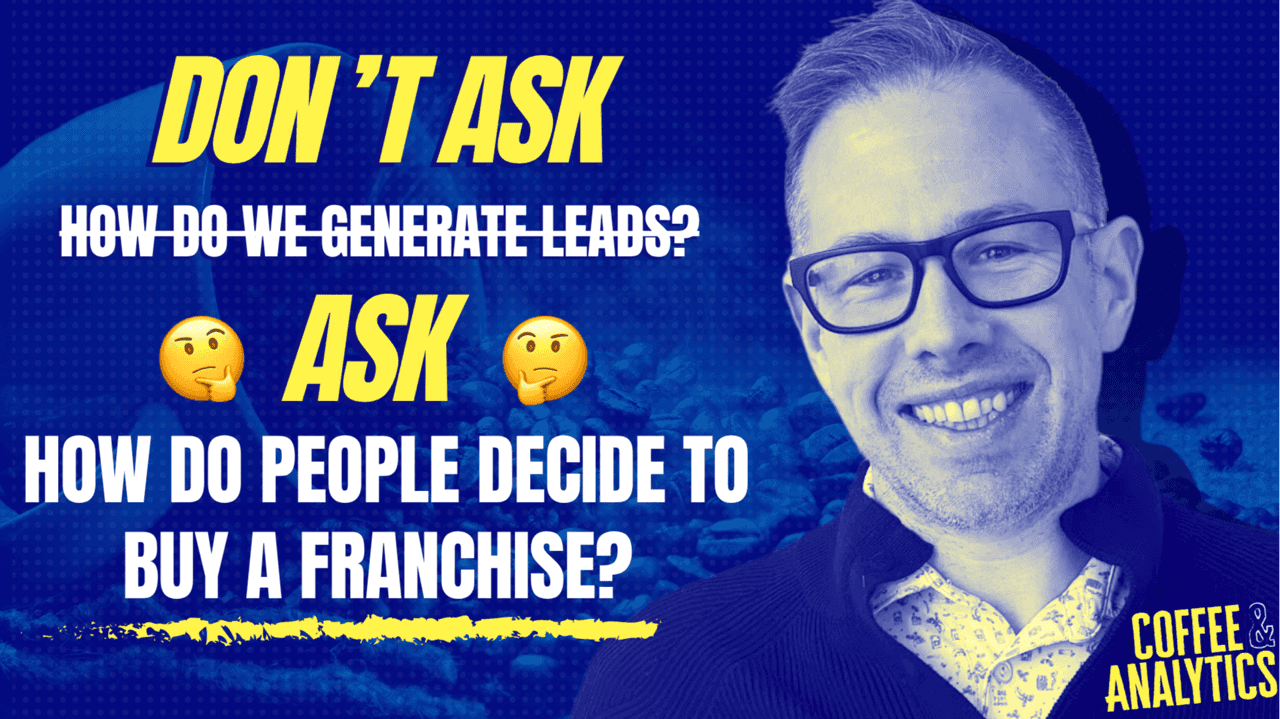
Franchise development has a measurement problem. Brands obsess over lead volume, cost per lead, and funnel conversion rates. Dashboards look clean. Campaigns look optimized. Reports show progress.
But behind those metrics is a harder truth: most franchisors are optimizing a system that doesn’t reflect how buyers actually behave.
We recently analyzed a dataset of real franchisees, their discovery paths, decision timelines, fears, and what ultimately pushed them to say yes. The findings are not subtle. They challenge some of the most common assumptions in franchise marketing.
In a recent episode of Coffee & Analytics, 1851 Franchise publisher Nick Powills shared 20 lessons every franchisor should internalize if they want to attract better operators and grow sustainably.
1. Discovery Is Often Accidental
Franchisees rarely follow a linear path into a brand. Many discover opportunities through travel, as customers, or through casual exposure. This means your brand is being evaluated long before a prospect ever fills out a form.
Takeaway: Your growth strategy should extend beyond lead generation. Discovery is happening whether you design for it or not.
2. The Physical Experience Still Wins
A consistent pattern emerged: prospects visited locations, tried the product, and evaluated the experience in person. That moment often carried more weight than anything digital.
Takeaway: Your units are your most important marketing asset. If they don’t convert customers into believers, nothing else will.
3. Brokers Still Matter
Despite the rise of digital channels, brokers remain a meaningful part of the early funnel for many buyers.
Takeaway: Ignoring broker relationships is not a strategy. It is a blind spot.
4. Buyers Consider a Small Set of Brands
Most franchisees evaluated between five and ten concepts, not dozens.
Takeaway: You are not competing in a broad market. You are competing in a tight, high-stakes consideration set.
5. Websites Validate, They Don’t Convert
Not one franchisee cited a website as the reason they chose a brand.
Takeaway: Your site’s role is credibility, not persuasion. If you expect it to close deals, you’re asking it to do the wrong job.
6. Financial Clarity Is the Biggest Gap
Franchisees repeatedly asked for clearer expectations around investment, returns, and what is actually included.
Takeaway: The issue is not the absence of data. It is the absence of storytelling around the data. If your Item 19 exists without context, it creates hesitation instead of confidence.
7. Timelines Are Consistently Underestimated
Many buyers entered the process without a clear understanding of how long it would take to open or reach profitability.
Takeaway: Overpromising speed or underexplaining process creates friction later. Transparency upfront builds trust.
8. “Support” Is Too Vague
Franchisees expect strong support, but often describe it as unclear or inconsistent.
Takeaway: If you cannot define support in concrete terms, your buyers will define it for you, and usually not in your favor.
9. Lifestyle Matters as Much as ROI
Freedom, flexibility, and building something personal in their community were common motivators.
Takeaway: Buyers are not spreadsheets. They are people making identity-driven decisions.
10. Fear Is Real and Predictable
Financial risk, wiring capital, and uncertainty surfaced repeatedly.
Takeaway: Every deal faces the same three barriers: funds, fads, and fear. The brands that win address all three directly.
11. Validation Drives Confidence
Conversations with existing franchisees were among the most influential parts of the process.
Takeaway: Your operators are your most credible sales force. Invest in them accordingly.
12. There Is No Standard Timeline
Some buyers inquired within a week of discovery. Others took nearly a year.
Takeaway: A rigid funnel ignores reality. You need systems that capture urgency and nurture patience.
13. High-Intent Buyers Move Fast
When the right buyer meets the right brand, decisions accelerate quickly.
Takeaway: Your process should not slow down serious operators.
14. Slow Buyers Need Long-Term Engagement
Many prospects require months of exposure and education.
Takeaway: Franchise development is not just acquisition. It is sustained relationship building.
15. Consumer Brand Strength Matters
Many buyers were already customers or fans of the concept.
Takeaway: Strong consumer brands create built-in franchise demand. Weak ones rely entirely on marketing.
16. Media Is Not a Primary Research Tool
Buyers relied more on search, lists, and peer input than traditional media coverage.
Takeaway: Awareness does not equal influence. Trust is built elsewhere.
17. Buyers Want Honesty, Not Perfection
Franchisees consistently indicated a desire for clearer, more realistic expectations.
Takeaway: The brands that stand out are the ones willing to say what is hard, not just what is attractive.
18. Not All Buyers Are the Same
Experienced operators evaluate differently than first-time franchisees.
Takeaway: One message cannot serve both audiences. Your strategy must segment accordingly.
19. Decisions Are Personal
Life stage, career transitions, and personal goals often triggered action.
Takeaway: The final decision is rarely made on logic alone. It is made when the opportunity aligns with a moment.
20. Marketing Channels Rarely Get Credit
Not a single franchisee pointed to ads or campaigns as the reason they chose a brand.
Takeaway: This does not mean marketing is irrelevant. It means its role is misunderstood.
The Bigger Problem
Franchise systems are built to optimize measurable inputs. Leads, clicks, conversions.
Buyers operate on something entirely different: experience, trust, validation, and timing.
When those two systems are misaligned, performance suffers. Not because the marketing is ineffective, but because it is aimed at the wrong target.
What Needs to Change
Franchisors who want to grow should rethink their approach in four ways:
- Design discovery, not just capture it
- Turn locations into conversion engines
- Build structured validation into the process
- Communicate financial reality with clarity and confidence
Growth is not about increasing activity. It is about aligning strategy with behavior.
The brands that win the next decade of franchise development will not be the ones with the most leads. They will be the ones that understand how decisions are actually made and build systems around that truth.
Because if your strategy does not match reality, it does not matter how well you execute it.
The truth is, all of the above can be overwhelming. In fact, when assessing brands, we deliver a playbook that reaches 100 pages. Franchisors look at it with blank stares and say, “Now what?” Millions of dollars takes millions of hours (or a lot of work). But, over the course of two years, if diligent and organized, a brand can leverage the above learnings to turn up the momentum.
Watch the full episode here.
Growing and selling franchises is difficult. Want to learn more about how 1851 helps franchisors grow their franchises with confidence? Visit www.1851growthclub.com and see what we can do for you.