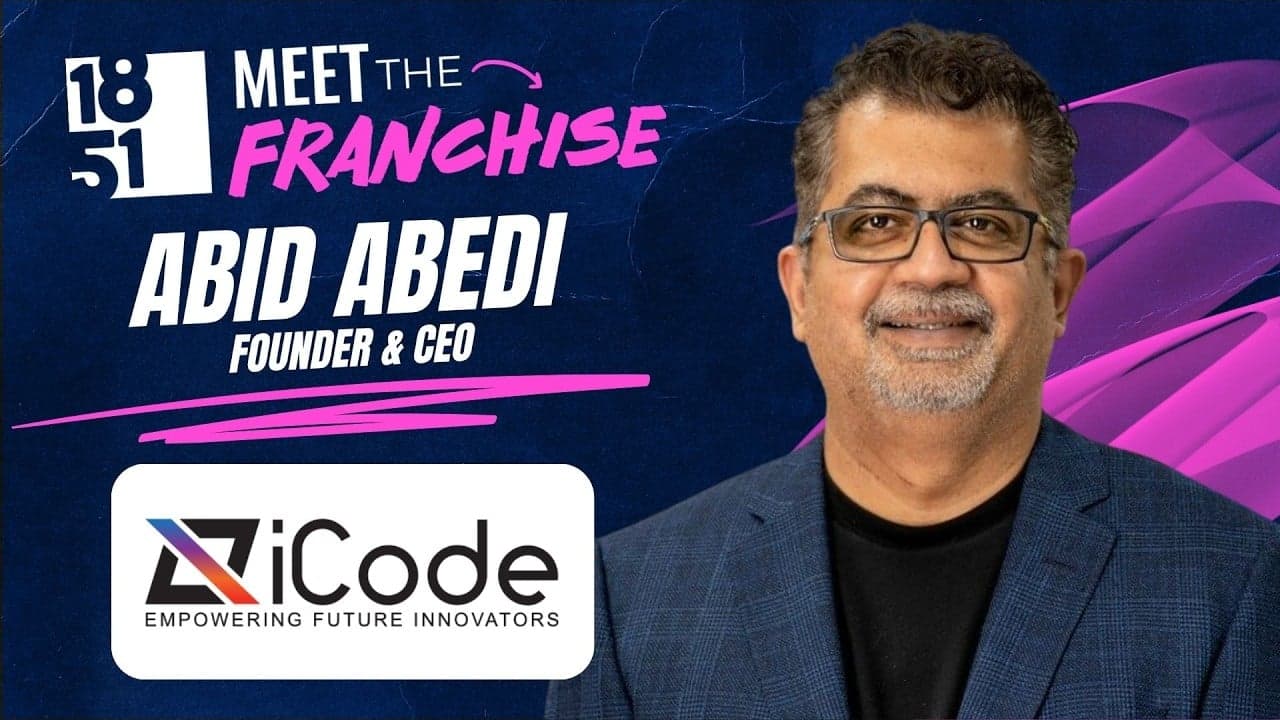
Founded in 2015, iCode School was created by founder and CEO Abed Adebi to fill an educational gap for engaging, future-focused computer science education for children. The start of iCode, as its name suggests, was focused primarily on weekly class and camp offerings in coding, using the message that learning coding languages was the key to unlocking a future that was more flexible and more rewarding, not just for that person but possibly for the world.
Now, the landscape is changing. Artificial intelligence and its many applications and avenues into nearly every industry have the momentum and curiosity that coding had as recently as five years ago. In an interview with 1851 Franchise publisher Nick Powills, Adebi discussed how iCode School is capitalizing on disruptive technology in a way that deepens its mission even further.
“It is a great time to be in this industry, because we are going through such a transformation, not only in our lives, but in the society we are about to create,” said Adebi. “I think it gives us an incredible opportunity to really train the folks that will be entering the workforce 5, 10, 15 years down the road."
iCode is now offering courses in both AI assistance and humanoid programming, two subjects Adebi is pioneering in the children’s education space. AI Studio, a program teaching kids how to learn a skill with the assistance of AI, is a particularly popular new addition. Partnering with Unitree, the largest manufacturer of humanoid robots, iCode now has R1EDU Smart humanoids in 18 of its campuses. Standing at 4 feet 3 inches tall, one of the first lessons includes programming the robot to recognize an open hand and respond with a high five. According to Adebi, this innovation is nothing new for iCode, which is accustomed to the rapid advancement of technology and whose culture thrives on experimentation.
“You have got to try,” Adebi said. “You cannot sit and wait for market validation before you do something. You have to have the ability and the mindset for innovation, and failure is just part of the journey.”
According to Adebi, coding laid the foundation of what iCode School is. On the physical side, the room is built with intellectualism in mind, rather than a day-care, and there is a focus on hardware resources being prominently available. On the mentality side, Adebi had the foresight from working with thousands of technical workers over his career to focus not only on technical ability, but on soft skills as the cornerstone of the classroom at iCode.
“iCode has never been focused on coding,” Adebi said. “What iCode has always been focused on is teaching kids the soft skills: collaboration, teamwork, problem-solving, critical thinking.”
Adebi joined 1851 Franchise Publisher Nick Powills on a recent episode of the “Meet the Franchise” podcast where they discussed how the brand has taken on new tech innovations in stride. A transcript of his interview with Powills has been provided below. It has been edited for brevity, clarity and style.
Nick Powills: I love that AI-powered and AI classes are starting to integrate into your business. We are in this world of the unknown right now, and you have an advantage as a franchisor to be in a space that can play in it, but at the same time, you are also in a space that is being disrupted by AI. How are you balancing opportunity and threat at the same time?
Abid Abedi: I always talk about the fact that when there is a disruption, there is an opportunity, you just need to find it. And actually, it is a great time to be in this industry, because we are going through such a transformation, not only in our lives, but in the society we are about to create. So I think it gives us an incredible opportunity to really train the folks that will be entering the workforce 5, 10, 15 years down the road.
Powills: Coding, if we flash-forward five years from now, it is going to just compound. It is going to change drastically. But what is not going to change drastically is the need for human beings to understand how these tools work, so you can actually put it to work in whatever career you are doing. My fear, and it is not just for franchising, is there is this lack of curiosity on how to use AI in a productive way, not to just do your job for you, but to actually make you be the superpower. And so this lack of curiosity is concerning, but the lack of curiosity will not exist, will not be missing with our children. Parents that invest in this now, their kids when they hit high school and whatever college is, when they go to college, are going to be better positioned.
Abedi: Yeah, if we think about it, Nick, coding laid the foundation, right? So that is what was the past, where I think coding laid the foundation. AI is the present, where we are today. The future, I think, has something to do with humanoids, as you see increasing use of it. And that is the reason why, not only that we have launched a couple of new programs. One is called AI Studio, which is teaching kids how to learn something with the assistance of an AI. If you think about it in our job today, you are using AI as an assistant in a variety of ways. If you are not, you are a dinosaur pretty much. I tell people, my nieces and nephews, that employers are going to only keep folks who are productive. The only way to be super productive is to use AI as an assistant. But nobody is teaching it, and that is why I took the initiative to really teach kids how to use an AI in the things they want to learn.
The other thing I thought about is when the kids in middle school and high school graduate and go to college and enter the workforce, they will be using some sort of humanoid, and yet there is nobody in the education field that is really teaching the kids how to program a humanoid. So we just partnered up with Unitree, which is out of China. They are the largest manufacturer of humanoid robots. And we are launching a youth innovation program and actually have humanoids in 18 of our campuses. We are doing a pilot starting this fall. We are actually teaching kids how to program a humanoid because that is what I think we are going to need in the future. So when you think about it, get all the noise out of it, and see where we are heading, then you are crystal clear. AI is the future, and humanoids are something that is around the corner. And I think getting the kids equipped with those two pieces of knowledge is critical to the success of anybody.
Powills: I am sure you have seen these. I have been at airports or malls, and I have seen coffee shops that are down to one employee, and the robots do everything else. So if I think about that space for, say, a franchisee of the past, if you are going to open up a coffee shop, you are thinking about how much labor you need to make the coffees, and now machine technology is probably going to make a better coffee, more consistent than your staff will. And so what I am hearing from you is, iCode has what the model was when you and I last talked in 2019, but that does not mean it has to stay forever, and if the franchisees listen to what you are saying, you are like, "I am evolving this thing so that I am actually protecting your business in more ways than a coffee shop could."
Abedi: Absolutely, and I talk about the fact that a franchise is a marriage, it is not a dating game, because you sign a 10-year deal, so it is from a long-term perspective. And anybody investing in any franchise, with iCode or otherwise, I think ought to look at the historical nature of that organization. Has it evolved over the period of time? If they have not, they could promise all they want that we are going to do this thing, but the track record does not speak for itself. Because change is a culture, it is in the DNA of an organization, right? And look at companies like Blockbuster, as you said, Sears and Robots, Montgomery Ward, Kodak. The list goes on and on about companies who do not innovate, do not demonstrate agility, do not stay relevant, do not exist very long. It is pretty clear, there is no doubt in my mind.
And yet, if you look at some of the companies in our space, they are still coding, they are teaching coding. iCode has never been focused on coding. What iCode has always been focused on is teaching kids the soft skills: collaboration, teamwork, problem-solving, critical thinking. How do you present? How do you build confidence? Because syntax changes over a period of time. That is not so important. What is important, I think, are the soft skills that are needed regardless, whether humanoid or without humanoid. I think the soft skills, if you ask the employers, I think 83% of them said the top skills they are looking for are communication, teamwork, collaboration, soft skills. So that is what the focus of iCode has been from the beginning.
iCode has also demonstrated that over the last 10 years it has been around, it has transformed itself tremendously to stay relevant. As I said, there is no other education franchise that I know of, or education business that I know of, that actually is teaching kids how to program a humanoid. We have R1EDU Smart humanoid from Unitree, which is about 4 feet 3 inches tall, 65 pounds, and we are the only company in the nation where kids can actually come in and learn how to program a humanoid.
Powills: Is it rotating to adults at all or are you just keeping children?
Abedi: If you look at how iCode is designed, it does not look like a daycare, which is a typical afterschool enrichment program that is one big room, small round tables, small round chairs, and kids come in and are treated like little kids. If you go to iCode, we have adult tables, adult chairs. We have four classrooms. It is all glass. We have all the hardware. So in the daytime, we definitely can teach adults the same thing we are teaching kids as far as the humanoid is concerned, or AI is concerned, for that matter, and that is something that we are thinking about because you can utilize the space during daytime, which none of our competitors can because they are not physically laid out in that fashion.
Powills: Yeah, that is where I think some of the moat that you are creating can be built. If you take today's cellphone and we get in a time machine and go back to, say, '96 and hand it to a 40-year-old and say, "Here you go," they would be like, "I do not know what to do with this." If you take a computer and go back to the '80s, today's computer, and say, "Here you go," they say, "I do not know what to do with this." And so the point that I am making is, as simple as a toaster oven, humanoids are where clearly we are figuring out, like, how does this make life easier? And so for an adult, there is going to be an intimidation factor with them as well. If I am thinking through where confidence comes from, confidence comes from "I am able to reset my computer," or "I am able to download an app on my phone." For someone that is not familiar with technology, confidence is going to be how do I use these tools that are making my life easier, right?
Abedi: Absolutely. That is the reason why iCode has 3D printing, Legos, E-sports machines, drones, and now humanoids. It is exactly what you said, confidence. You could write code all day long and see something on the computer, but when you write code and see how you can direct hardware to do certain things, that builds confidence in kids. That is why we have all the hardware that we have at iCode, for the exact simple reason you said, it builds kids' confidence. When they see how the code manifests into real life, into hardware, how when they are programming a humanoid, the humanoid actually does what you ask the humanoid to do through wire programming, that builds tremendous confidence. That is the reason why we have hardware at all our iCodes.
Powills: I am sure every franchisor has a franchisee that bought in with no passion for the brand. They just saw the dollars and they are like, "I want to be a franchisee." When you are saying this, does it blow your mind? For that franchisee, whoever that person is, for them not to listen to what you are saying, like you are giving more for their royalty than any other business, but they still look at it and say, "I am not making X." Is that the hardest part of what you have to do on a daily basis?
Abedi: It is. Our revenue was about 40% higher than our competitors in '25. In '26 it will be higher, 40% higher than our competitors. I am not happy. I want it to be double that of my competitors in my space. I am trying to be the leader, and I think with the humanoid, the youth innovation program that we are launching, and the AI Studio, which we already launched, I think we could double our revenue compared to our competitors.
As an entrepreneur, I tell people, an entrepreneur is never content, no matter what. How much growth he or she has done in the business, there is no contentment. And the franchisees share that. I think that is a good thing because that forces you, right? That forces the franchisor to find innovative ways to increase revenue, and you benefit as well.
If you have a personal trainer, why do you pay the personal trainer? To whip your ass in the gym. You are not paying the personal trainer to sit at the gym and drink coffee with you, right? So I look at my franchisees as my personal trainers. They force you, which is actually not pleasant - I am not going to be fake and say that it is a pleasant experience. But the way I look at it and the way I talk to my people internally is to thank them, because that is forcing us to be better, and there is nothing wrong with that.
Powills: Take that 40% higher than competition, that is a good metric. I actually think the runway is so long that if you build a group, a culture of franchise owners who understand impact in the community, and hopefully some sense of where the future is going, then they are playing for the runway. So this is all seed funds for where this business could potentially go. Per what I was saying with adults, I have seen some speakers speak about AI, and they are using pictures from 1994, and I am like, "You do not know what you are doing." And so the ownership of this space, even if the corporate division that gets created out of iCode is going to create so many revenue opportunities for those that embrace it, say, "Personal trainer, guide me," the runway is so big. And of course you are incentivized because you make more money if they make more money. It is very easy.
Abedi: I tell people, "Look, when you invest even in stock, what you are assuming is it is going to go up over a period of time, right?" The same way, when you invest in a business, look at it from a long-term perspective. Has the company demonstrated an ability for innovation, for agility, for staying relevant? Whether it is iCode or any other business you are investing in, you are investing where you think that when you exit down a few years, the company will be more valuable than what it is today.
If you look at the history of an organization and see whether they have changed, whether they have shown the ability to evolve and address the new emerging market needs, if that is the case, then obviously invest in it. If not, whether iCode or any other company, the fundamentals are the same for the business in any franchise that you open. But what is important is the culture of the company that has demonstrated an ability to change, an ability to innovate constantly.
Not everything we try works. Metaverse, I invested big into Metaverse. I created a whole iCode in the Metaverse. It did not work out, and that is fine. Every single time a quarterback throws a ball, it is not going to get caught. Every time a batter takes a swing, he is not going to hit a home run. But that does not mean that they do not swing, or that quarterback does not throw. The same analogy, right? You have got to try. You cannot sit and wait for market validation before you do something. You have to have the ability and the mindset for innovation, and failure is just part of the journey.
Powills: I think the metaverse is going to come back. The comparison I make, if you think of the takeout taxis back in the '90s that went to restaurants, they took all the menus and said, "Here, you could order." The timing was wrong. It is DoorDash and Grubhub future, they just could not... the timing was off, I think. What is interesting is you could see the way that kids are communicating. It is almost more okay to communicate in a metaverse than it was, say, 10 years ago. I think you are probably just early there.
On that note, I am curious, because I am going through this as a parent having a teenager who is a coder. He puts the middle finger up to AI all the time. He does not even understand what that means, but he is "F AI" all the time. Him and his friends are saying the same thing. I am like, "I think you are confused." But what they are doing is they look at coding and community and graphics as art. And so they are looking at this and saying, "Do not come and mess with my area." How do you feel about the audience that needs some convincing, which is the next wave of kids that will be franchisees someday?
Abedi: Kids want to learn. They are curious by nature. If you tell them from that perspective that AI is what you could use to answer some of the things that you do not know how to do, right? And that is why with AI Studio, you could learn anything. You could learn coding if that is what you want to learn, through the assistance of an AI.
In the workforce, especially for a teenager, I think you talk about the fact that the workforce of tomorrow pretty much will entail that you use AI as an assistant, not as a sort of doer, but as an assistant to improve your productivity. And employers are going to keep the employees who are productive, and the employees who are going to be productive are the ones that are using AI.
The other ethos of iCode is to make learning fun. If you talk to parents who bring their kids to iCode, they will tell you that this is the only program where the kids drag the parents to bring them to iCode, because what we have done is make learning fun. For instance, having all the hardware, having the environment where it is all glass, right? Adult tables, adult chairs, right? They feel at home. They feel empowered. They are working with other kids who have similar skills. So I think it is important that we create an environment for the kids where they think they are having fun, when in fact they are actually learning.
So the challenge to organizations in the education space is how do you make learning fun? That is the key, and that is the reason why iCode, not only from a programming perspective having all the hardware, but also the look and feel of iCode is very welcoming. It is very open. It is not a dungeon where you go at the back of the strip center and it is dark. There is nothing there and these small round tables, small round chairs. That is where I think iCode succeeds, not only with the multiple revenue streams that our franchisees have, but also the fact that we have made learning fun, which I think is an important distinction.
Powills: I just went to your franchise website when you said that. I go to franchise websites all the time, and they are all the same. It is blah, blah, blah, buy a franchise. I think what you just said is: make business ownership fun. You are not cleaning buildings; you are actually impacting humans, and you are part of a ship that is not saying, "The only way we make the Big Mac is this way, and this is the only way, do not even communicate." You are saying, "Let us build a culture of intelligence that is trying to work together to continue to crack a code on what we can do as a business."
Abedi: Selling Kentucky Fried Chicken is not a bad business to be in, right? Nothing wrong with it. If you are not passionate about it, do not do it. Life is too short. I tell people all the time, "If you are not passionate about this, then this industry or what iCode is doing, please don't. I do not want you." Because people succeed when they have fun with what they are doing. People do not succeed when it is just a job.
Powills: So now make the bold prediction: five years from now, where is iCode?
Abedi: I think the most innovative business model in the education space. I think that is what we will be. I think it is the most innovative business model that exists on the planet.
Powills: You have an advantage. Education franchises are hard to make real-time pivots with, either because of size or because of the Blockbuster mentality of "No, this is the way we have always done it, why would we stop doing this?" And you are in a place where the curriculum can move within the box that is created, and you have obviously already nailed the real estate selection. You know where the right people are, and now you are going to continue to find what the options are that make education fun and continue to make it innovative. I love what you are doing with the business, I love the potential, and I love seeing where innovation does not sleep in a business model. There are not many in franchising. Thanks for doing this, and thanks for sharing some of your story.
Abedi: Great, nice talking to you, Nick. Appreciate you getting me on the show again.
Watch the full episode above or on YouTube.