Reformer Pilates is having a moment, but inLIFE Wellness founder and CEO Scott Capelin has been in the fitness business long enough to know that chasing trends is not a sustainable growth strategy.
Instead, Capelin has spent more than 25 years learning what makes fitness businesses work, first as a personal trainer, then as a multi-unit franchisee and business owner, and eventually as a franchisor. When he founded inLIFE Wellness in Sydney in 2019, the goal was to take those lessons and create something deliberately simpler: an approachable fitness experience for members and a leaner, more scalable business for owners.
"I started my business ownership career as a franchisee, and it was one of the best things I could have done in terms of learning," Capelin said. "Now, coming full circle, I understand what I think makes a good franchisor, what makes a good franchisee and what makes a franchise an attractive investment for an owner-operator, owner-manager or owner-investor."
Today, inLIFE Wellness has grown to approximately 70 locations, most of them in Australia, and is building its footprint in the United States.
"We have 70 locations and we've done no franchise marketing," Capelin said. "What that tells me is that we've done a really good job with the culture and created something people want to be part of. Most of our studios have been opened by instructors and members. Now, we're looking to open that opportunity up to the wider community."
For prospective franchisees, that next chapter presents an opportunity to enter the $14.7 billion Pilates sector with a concept designed around lower startup costs, streamlined operations, recurring membership revenue, multi-unit scalability and a consumer experience built to welcome the people traditional fitness concepts often leave behind.
Built From 25 Years of Fitness Business Lessons
Capelin did not set out to become a franchisor. After leaving the corporate world for personal training in 1999, he joined a fitness company in the early stages of franchising and eventually became one of its first franchisees. He grew to five locations before selling the businesses in 2011, later moving into larger gyms and several other ventures.
That experience gave him a firsthand view of both sides of the franchise relationship. More importantly, it taught him how easily fitness businesses can become unnecessarily expensive and complicated.
When Capelin returned to the industry and opened the first inLIFE Wellness studio in Sydney in late 2019, he took the opposite approach. The model was built around smaller spaces, controlled occupancy costs, automated systems and limited management layers. The brand's prototype targets spaces that can be refreshed cosmetically rather than requiring major structural construction, helping reduce both build-out expense and opening complexity.
"Probably the biggest lesson I've learned is that you don't need to spend $500,000 to $1 million to open a studio," Capelin said. "I'm really passionate about return on investment. The lower we can bring that initial capital outlay, the quicker people have the opportunity to get their investment back. We don't have layers of management. If you're going to do a Pilates class, you walk in, check your name off on an iPad, put your keys away, take your shoes off and find a Pilates machine. You don't need two people sitting at the front desk. We're not cutting corners; we're stripping out costs that don't need to be there."
More Than Another Reformer Pilates Studio
The business model may be lean, but the consumer offering is intentionally broad.
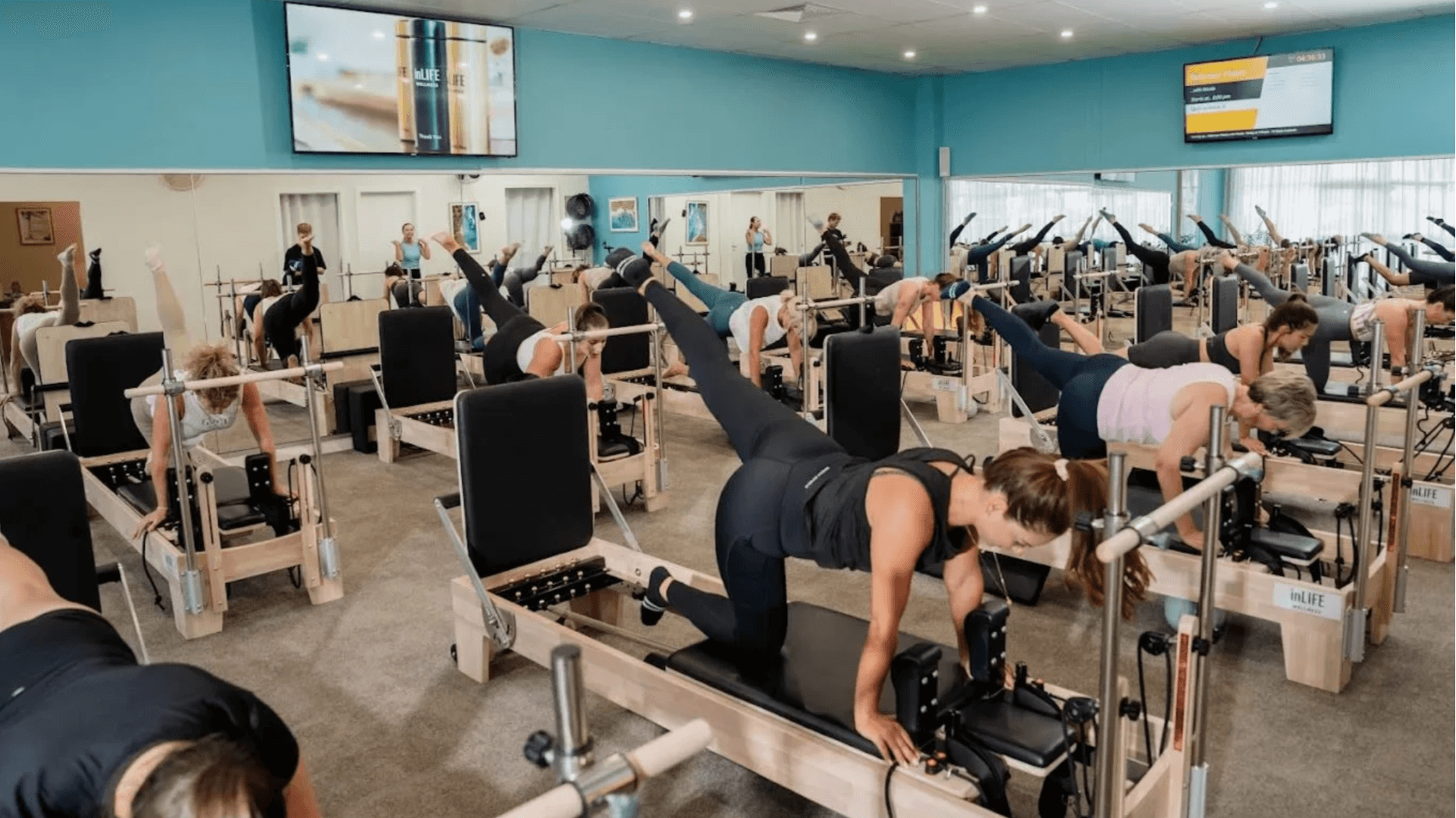
Reformer Pilates remains the foundation of inLIFE Wellness, but the concept incorporates elements of barre, strength training, functional fitness, cardio and stretching into a wider variety of class formats.
"People come to inLIFE Wellness for Reformer Pilates, and that's why they stay," Capelin said. “But we have this whole additional range of classes that are fresh, fun, unique and innovative. The big thing our members get is variety at a price point that's great value, with a really positive, warm, welcoming and inclusive studio culture.”
For Capelin, that final piece is just as important as the workouts themselves. Rather than designing inLIFE for the most experienced or athletic fitness consumer, the company has deliberately focused on people who may not traditionally see themselves as "gym people." The brand's research indicates roughly 70% of its members had never tried Reformer Pilates before.
"If you look on Instagram, you see skinny fitness influencers doing some pretty unachievable things on a Pilates machine," Capelin said. “But there are more unfit people in the community than fit people. We want to be a place where people feel comfortable coming. About 50% of people who come to us have never been to a gym or studio before.”
The strategy appears to translate into customer longevity as well. Capelin said inLIFE's average member lifespan is approximately 15 months, compared with the six-month industry benchmark he uses internally.
A Business Model Designed Around Keeping Costs Down
For franchisees, one of inLIFE Wellness' central differentiators is what the brand has deliberately removed from the traditional boutique fitness equation.
The concept generally operates in approximately 1,800-square-foot facilities, and the real estate strategy prioritizes functional, affordable spaces rather than trophy locations with expensive construction requirements. Capelin looks for sites where existing infrastructure can remain in place and the transformation can be accomplished primarily through flooring, paint, mirrors and lighting.
"It all comes down to site selection and finding the right space," Capelin said. "We want something that doesn't need structural work, just a cosmetic rejuvenation. We do carpet tiles, paint, mirrors and lighting. Nothing too fancy or costly. Keeping the fit-out low makes it easier to get approved by the city and means the build-out can take about four weeks. We're trying to be smart with every decision."
According to the brand's 2026 Franchise Disclosure Document, the total estimated initial investment for a single studio ranges from $238,280 to $452,670, including a $40,000 initial franchise fee. Item 19 provides 2025 financial results for the two U.S. studios that had been operating for a full calendar year: the company/affiliate-owned Addison, Texas, studio and the University Park franchise location. Addison reported $456,201 in gross profit and University Park reported $278,995 in gross profit.
"We've never had a studio close, and I'd like to think that's because the investment is low and the ongoing operational costs are also very low," he said.
Creating a Pipeline From Member to Instructor to Owner
inLIFE Wellness has also developed an internal ecosystem that addresses one of boutique fitness' most important operational challenges: finding instructors.
"Most of our instructors started off as members," Capelin said. “They become an instructor so they can ingrain themselves more in the culture and do something they enjoy.”
Many of inLIFE's first franchisees were not outside investors recruited through traditional franchise sales channels. They were people already inside the system who understood the experience and wanted to build a business around it.
For Capelin, seeing those individuals become entrepreneurs has become one of the most rewarding parts of building the company. "There are so many success stories of franchisees, and many of them are women who came out of corporate careers or were at a point where they were looking for something different," he said. "They've gone on to own a business with a proven model, ongoing support and a network around them. People going down that path to business ownership is a big responsibility on my end, but it's incredibly fulfilling."
A Model That Is Already Trending Toward Multi-Unit Ownership
As inLIFE expands in the United States, its early franchisees are also demonstrating another important characteristic of the model: the ability to scale beyond a single studio.
According to the brand's development team, every current U.S. franchisee either owns more than one location or is already progressing toward additional studios. The brand expects to approach 20 U.S. studios across just five owners as that development pipeline opens.
"Every single franchisee in the States has more than one location or is deep in the process of opening their second or third studio," said Brent Dowling, who is working with inLIFE on its franchise development strategy. “We're talking about multi-unit growth in the first year of ownership, not waiting five years to prove it out. I've rarely seen that kind of speed.”
The operating structure can support several ownership styles as the system grows. A Pilates instructor can be an owner-operator. A community-minded entrepreneur can function as an owner-manager. And with the right studio manager and team in place, Capelin believes the model can evolve into a semi-absentee structure for multi-unit investors.
"The right owner cares a lot about not just the business, but the people inside the business, which are the members and instructors," Capelin said. "As an owner who's not present, you can't personally deliver great customer service to 300 studio members, but you can look after one studio manager and a team of instructors. Make sure they're valued, appreciated, paid fairly and have opportunities to grow. Someone has to be the face of the business."
Support Starts Long Before Opening Day
Keeping the operation simple does not mean asking franchisees to figure it out themselves. inLIFE has built a support infrastructure covering franchise growth, operations, people, marketing, sales, social media and technology. The relationship begins months before opening, helping owners move through site selection, pre-opening marketing, staffing and the launch process.
One part of that support starts well before opening day. About 16 weeks out, inLIFE Wellness begins generating leads and working to convert prospective customers into founding members before the first class is held.
"It took me many years to figure out how to open a studio with hundreds of members on day one," Capelin said. “That ties directly back into our marketing and sales program. We're not asking someone to open the doors and then start figuring out where the customers are.”
Capelin said franchisee support remains one of his biggest priorities as the company accelerates its U.S. expansion. "The main thing that keeps me up at night is whether our studio owners are getting the support they need, whether they have the tools to be successful and whether they're happy," he said. "Happy owners open more than one location, my life is peaceful and the brand has a good reputation."
Why Now? A Proven Model With U.S. White Space Ahead
Six years after opening its first studio, inLIFE Wellness is entering a very different stage of growth.
The concept has already demonstrated that it can scale internationally, reaching approximately 70 locations largely through organic interest from within its own community. Now, the United States represents the company's primary expansion opportunity. Capelin said the brand has established its initial base in the Dallas market and has additional locations in development, while the team is also exploring expansion into new states and underserved growth markets, including Arizona, Minneapolis, California, North Carolina, South Carolina, and Florida, among others.
"Reformer Pilates has been around for almost 120 years," he said. “I say that because it's not a fad. It has stood the test of time. What's changed is that it has become much more commercial and mainstream.”
In its 2025 Look Back Report, ClassPass named Pilates the most-booked workout worldwide for the third consecutive year. Pilates reservations increased 66% year over year, while Reformer bookings in particular grew more than 70% annually.
For prospective franchisees, inLIFE Wellness offers a leaner way into a growing fitness category, with a smaller footprint, recurring memberships and a model that early U.S. owners are already expanding beyond one studio.
And while Capelin has ambitious ideas about how large the system could ultimately become, he is more focused on building a healthy franchise network than chasing an arbitrary unit count.
"I'm really confident in our ability to scale and build the infrastructure we need to support it," he said. "I don't want growth just for the sake of saying we have a certain number of locations. I want to enjoy the process, do work we're proud of and touch people's lives through business ownership and through the members who come into our studios."
For more information about franchising with inLIFE Wellness, visit https://www.1851franchise.com/inlife-wellness.