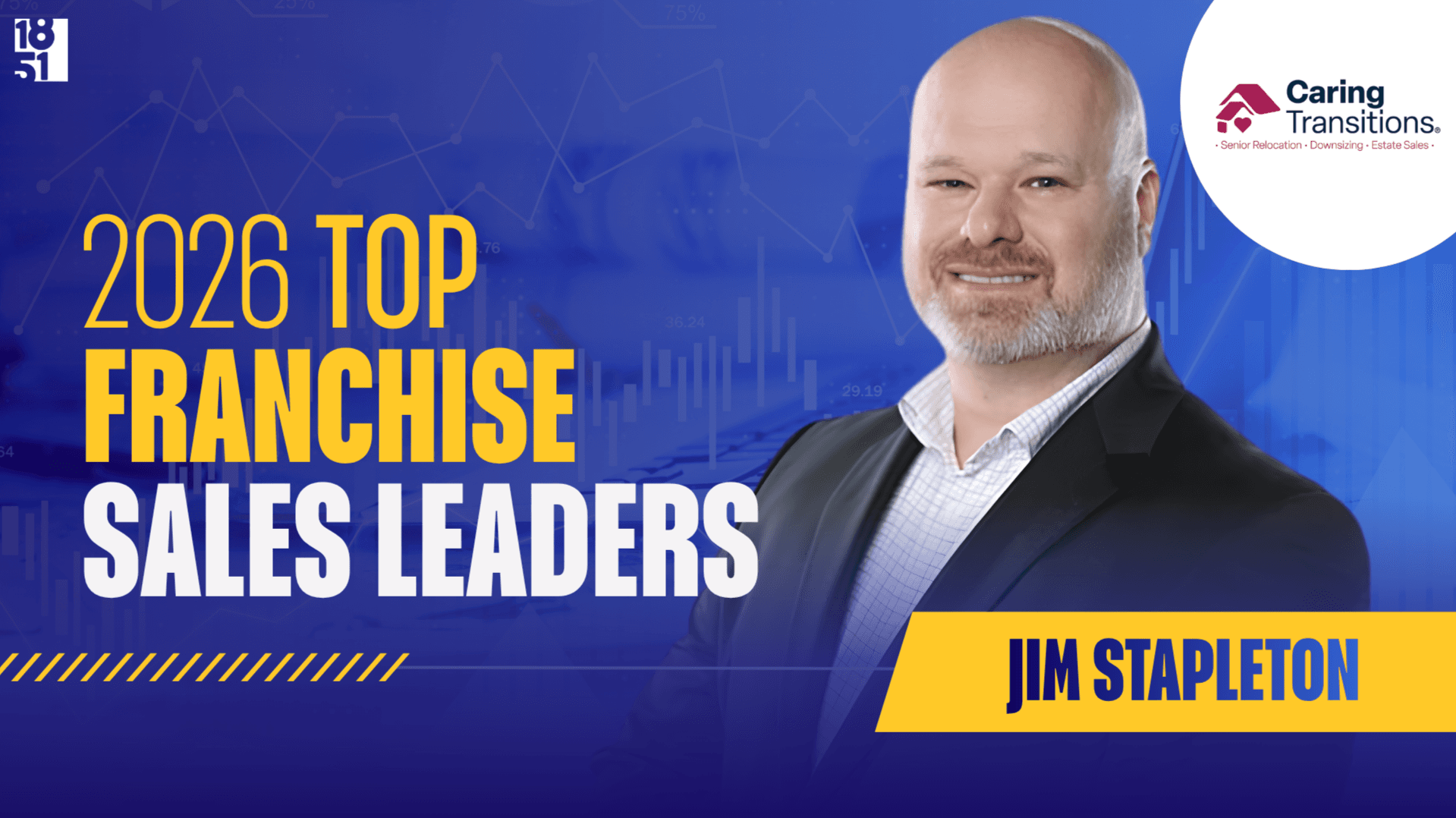
Franchise Sales Leader: Jim Stapleton
Brand: Caring Transitions
Jim Stapleton, vice president of franchise development at Caring Transitions, spent 30 years building a career in sales before franchising entered the picture. He started in door-to-door insurance and later ran eight facilities for the flexible workspace company Regus before setting his sights on a vice president role. Strategic Franchising kept surfacing in his search, and he kept passing on it because the listing asked for franchise experience he did not have. One day at work, his wife submitted the application for him. Stapleton took the interview, chose Caring Transitions from the five brands in Strategic's portfolio and has been with the franchise ever since.
When Stapleton arrived, he said franchise recruitment lacked structure and existing processes were loose, so he built a more structured recruitment process that Strategic later carried across its other brands. Seven years on, he oversees a five-person development team that has helped Caring Transitions maintain a steady pace of growth, with 73 franchises awarded last year and 79 the year before. Since a private equity firm acquired the franchise in June, Stapleton has pushed harder into the broker channel. He added a director of broker relations who works with brokers full time and raised the referral fee the franchise pays. He is also adding a candidate assessment platform to discovery, giving his team more information about a prospect before the first call.
Stapleton spoke with 1851 Franchise about the recruitment process he built at Caring Transitions, from the first lead through discovery, and why he now focuses on speed to trust.
1851 Franchise: Can you tell us about your background and how you entered the franchise world?
Jim Stapleton: I've been in franchising for seven years, but I've been in sales for 30. I started in door-to-door insurance. That was my trial by fire. Knock on someone's door, get in the house, sit at a kitchen table. Before this, I was with Regus for six and a half years. Then I was looking for a VP role, because Regus only saw me as a sales guy. Strategic Franchising kept coming up in my search. It said this was the perfect profile for me, but it also said I needed franchise experience, which I didn't have, so I kept skipping it. Little did I know that while I was at work, my wife was submitting resumes, and she submitted one to Strategic. That is how I got into franchising.
Strategic had five brands at the time, but when I heard about Caring Transitions, I understood the need, because we went through this with my grandmother. I came in headfirst, not knowing anything about franchising, which I believe helped me. There was no, ‘Oh, we did this at the other brand.’ I set up the processes for my team, and they carried through to the rest of Strategic.
1851: The franchise buyer has changed dramatically over the past few years. What are the biggest shifts you're seeing in today's candidates, and how has your approach evolved?
Stapleton: It's a really weird time right now. The only time I've seen anything like this, where there's this much fear of the future, was during COVID. A lot of people are holding on to their money. People are getting financing where it used to be a cash deal back in the day. For our brand, you don't need half a million dollars liquid to get into Caring Transitions.
With the development of AI, we've streamlined a lot of what we used to do manually, including the personality profiles coming in. This is a passion brand. It is a certain type of person who is successful here, someone who wants to wrap their arms around mom more than they are worried about the ROI. AI helps us get them the information they want faster and keep them engaged longer. Our process is four to six weeks. Keeping somebody engaged that whole time is an art form. You have to keep it top of mind so it doesn't go to the back of the mind as soon as they jump off a Zoom call.
1851: What separates the highest-performing franchise sales organizations from those that struggle to attract qualified franchisees?
Stapleton: It's where you put your focus. If I set a goal for myself, nothing will stop me from hitting it. The goal doesn't change because of the circumstances around me. We just got bought out by private equity back in June, and we've had speed bumps that slowed our momentum. That doesn't change the goal. When we have to redisclose somebody and wait another 15 days, when we can't talk to people because we're dark in certain states, you learn something about yourself.
It's not me selling. It's my team. I would put my five people up against anybody in franchising. I'm more of a therapist than a coach most times, because we're salespeople, emotional people at all points. Whatever is going on in their lives personally, that's the stuff I want to know about more than, “How come you didn't get five questionnaires this week?” It's, “Listen, what's going on at home?” Because I know their personal life is going to affect their business life.
1851: How does your team build credibility with candidates through the discovery process, and what mistakes do you see brands making?
Stapleton: I started a mastermind group called Steel Sharpens Steel through the IFA, and trust was one of the topics I brought up a couple of months ago. There are four reasons somebody's not going to buy from you. No need, no trust, no money, no hurry. Trust is the biggest one. It takes forever to build and a second to take away. If something we say or do puts doubt in this person's head over four to six weeks, they're gone. People don't buy from their head. They buy from their heart. Sales aren't contingent on the prospect's attitude, but on the salesperson's. The Zoom lights come on, and we need to be engaged, no matter what's happening in our personal lives.
Where brands make the mistake is complexity. As soon as somebody feels overwhelmed, they pump the brakes. My process gives them enough to feel full, digest and be ready for the next piece. A lot of franchises make it complicated because they're worried about selling a franchise instead of taking care of the prospect. If a candidate can't close their eyes and see themselves walking into the store and working the counter, you're never going to sell.
The analogy I use is climbing the high dive. Each step gets you a little higher until, during the brand visit, you're on the end of the diving board looking down and everything they want is in that pool. But they're the ones who have to jump. If they start drowning, we've got lifeguards who will save them. The longer they stand there staring at the water, the more they think, “It's really high up here. It's windy. Is the water cold?” If they don't feel comfortable enough to jump, they're going to walk back down. That's exactly what happens in this process.
1851: So far in 2026, what has been the most impactful change your franchise development team made, and what results did it deliver?
Stapleton: A lot of what we're doing now is because of private equity. One thing we're focusing on is franchise brokers. That's always been kind of an aside, like we'll get a couple of broker leads in. I've got a director of broker relations on my team now who spends 100% of her time on brokers. We increased the broker fee we pay, and we're doing an event in Louisville, Kentucky, bringing a select group of brokers from IFPG and FranServe onto the Bourbon Trail so they can learn about Caring Transitions. Our new capital injection lets us do events we couldn't do before.
We're also adding Zoracle to our process. We've always used a DISC assessment, but I think Zoracle gives us better insight into who the client in front of us is. I've talked for years with my president about how we can't change the person in front of us. They are who they are. But how do we become a chameleon to who that person is and give them the information the way they want it? Are you a just-the-facts person, or do you want to hear every story in my process? Those are two totally different people.
1851: What advice would you give an emerging franchise brand looking to accelerate development without sacrificing franchisee quality?
Stapleton: Don't be afraid to try new things. The process I have now doesn't look anything like the process I started with. My superpower is taking a big, complex problem and breaking it into simple terms. There are a lot of franchisors stuck in their ways, leaders who say, well, I've been doing this for X amount of years, so I know best. I tell my team all the time, this is a malleable process. It's not in stone in any way, shape or form.
AI is a perfect example. When I first heard about it, I thought of Terminator 2. You can dive in knee-deep or be terrified of it, but one way or another, you're either going to be ahead or behind. Right now I feel like I'm a caveman with fire. I've got this amazing thing, and I’m figuring out all the new ways to use it.
People also talk about speed to lead. You submit for a franchise and you're inundated with 50,000 pieces of information in two seconds. It's overwhelming. What matters more is speed to trust. If they don't trust you on that first call, you won't get a second one.
Want to learn more about how 1851 helps franchisees find the right franchise opportunity? Visit www.1851growthclub.com and start your journey.