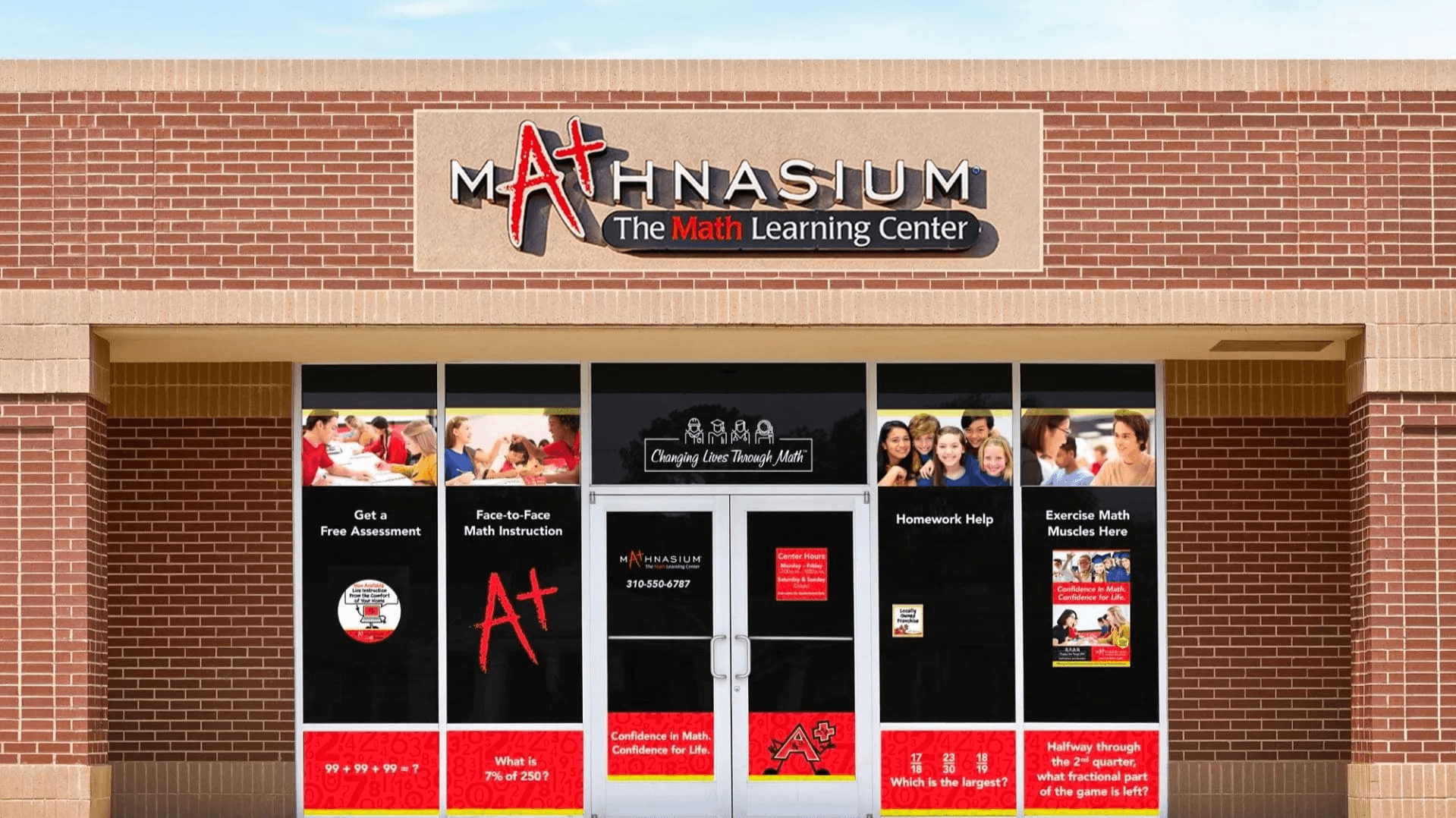
Mathnasium Learning Centers, the math-only supplemental education franchise, has grown to more than 1,300 locations worldwide as families continue to navigate ongoing learning gaps, increasingly competitive academic expectations, and rapid technological change. At the same time, Mathnasium’s streamlined operational model, relatively low startup costs, and strong margin potential create an accessible and scalable opportunity for franchise owners.

“We’re still in that sweet spot where we have over 1,000 units, but there’s still plenty of opportunity left,” said Kevin Shen, chief financial officer of Mathnasium. “We’re proven, we have the support, and we have a demonstrated capacity to go through economic cycles.”

A Business Built Around Inelastic Demand

Mathnasium addresses a recurring concern for families: whether their children are developing the skills and confidence they need to succeed in school.

Students may come to Mathnasium because they have fallen behind, developed gaps in foundational concepts or lost confidence in the classroom. Others enroll because they want to get ahead, prepare for advanced coursework or compete for admission to selective schools and colleges.

“If your child is struggling with math and they don’t have confidence when they get to school every day, that represents a highly inelastic demand,” Shen said. “You’re going to stick with Mathnasium and figure that out so they can catch up or maintain their positioning. Parents will continue to invest in education for their child long before they cut back on that cost.”

That demand has helped Mathnasium remain insulated from many of the economic pressures affecting other franchise sectors. The business has virtually no inventory, supply chain or cost-of-goods complexity. Its primary fixed expense is real estate, with centers generally occupying approximately 1,100 to 1,500 square feet.

“When you think about all the general noise and headlines that are out there, a business like ours is pretty well insulated from that,” Shen said. “Whether it’s tariffs or taxes, it’s a very straightforward business. There are virtually no logistics and cost of goods sold to manage.”

Mathnasium has also demonstrated resilience across multiple economic cycles, including the financial crisis and the COVID-19 pandemic. While uncertainty may cause prospective business owners to hesitate, the underlying need for supplemental education does not disappear when the economy changes. “Families are going to spend in that area,” Shen said. “They’re always going to spend to improve their kids’ education, just like they spend on health or their pets.”

A Proprietary Method That Is Difficult to Replicate

Mathnasium is not a general tutoring center that simply helps students complete the next homework assignment. Its differentiation begins with the Mathnasium Method™, a proprietary instructional system designed to identify and address the specific gaps preventing each student from progressing.

“A student might be in algebra but still have gaps from third-, fourth-, fifth- or sixth-grade math,” Shen said. “We target those areas to get them back on track and set them up for future success.”

The approach focuses on conceptual understanding rather than rote memorization. Students learn through mental, visual, verbal, tactile, and written exercises, with instructors adapting their explanations to the way each child processes information.

That individualized model is one reason former teacher and multi-unit Mathnasium franchisee Derek Pipkorn was drawn to the brand. “I saw it was possible with Mathnasium and the strength of the education behind the concept,” Pipkorn said. “What I love most is the impact we’ve had for thousands of kids. What we do is so unique that it’s almost impossible to replicate anywhere else.”

A Low-Cost Model With Strong Margin Potential

According to the brand’s 2026 Franchise Disclosure Document, the estimated initial investment to open a Mathnasium franchise ranges from $127,316 to $165,846. That includes a $49,000 initial franchise fee, real estate expenses, center improvements, furniture, technology, opening marketing, and additional working capital.

The relatively modest investment stands out in a franchise marketplace where many concepts require substantial real estate development, equipment packages, inventory, and labor.

“It’s definitely a low-cost opportunity to get started,” Shen said. “It is on the low end, especially compared to an early childhood education concept where you might have to buy the dirt, in which case, it can take years to eventually open and generate revenue. For us, it’s a very simple build-out. You can open in a matter of months.”

Results varied across the 914 Mathnasium centers included in the brand’s 2026 FDD. For fiscal year 2025, the average was $384,874 in annual gross receipts with $117,000 in operating income (a 30%+ margin), and the median gross was $326,428. Centers in the top quartile averaged $693,314, in gross receipts and $240,000 in operating income (a 35%+ margin) with the top location grossing above $1.5 million.

The model can become increasingly attractive as enrollment grows. Once a center covers its fixed rent expense, additional revenue can flow through. “Once you pass a certain break-even point, every incremental dollar flows to the bottom line at a very high marginal rate,” Shen said. “The benefit of our business model is the variable expenses scale as your grow the business. When you’re first starting out, you need fewer instructors than you when you’re at 100+ enrollments. That flexibility allows owners to see profit much quicker than many other concepts.”

An Opportunity Designed to Scale

Mathnasium can serve as an owner-operator opportunity, but the model also offers a pathway to multi-unit growth. Pipkorn opened his first Mathnasium in 2017 after spending approximately eight years in public education. He opened his second center in 2019 and later acquired a third location, followed by two more in 2023 and 2024. “That was a turning point because that is when I started hiring center directors to run the day-to-day of the centers,” he said.

Existing franchisees opening additional units also provide an important signal about the health of the system. “Support only means something if it shows up in owner behavior,” Shen said. “The fact that a meaningful share of our growth comes from existing franchisees opening additional units tells you how that support actually lands.”

In-Depth Franchisee Support for All Owners

Although educators can bring valuable classroom knowledge and community credibility to the business, Mathnasium does not require franchisees to have a teaching degree or advanced mathematical expertise.

The brand attracts former educators, engineers, executives, and professionals from a wide range of industries. Shen said Mathnasium is seeing particular interest from corporate professionals who have reached a career crossroads and want to build something more personally meaningful.

“Those folks have gotten to an inflection point in their career where they’ve perhaps accomplished what they needed to accomplish, got laid off, or are just at a crossroads,” Shen said. “They realize there are lots of different opportunities out there, but because they want to do something that not only has a good ROI, but also benefits the community and is more mission-driven, they naturally gravitate toward the Mathnasium opportunity.”

New owners receive training on the Mathnasium Method™, business operations, marketing, customer relationship management, and staff leadership. The brand also provides support with site selection, lease negotiation, center setup, grand opening planning, and ongoing operations.

After opening, franchisees work with field support teams and dedicated business consultants. They also benefit from an active owner community that shares ideas, advice, and best practices.

Mathnasium also offers a 25% discount on franchise fees for qualifying military veterans, active-duty members of the U.S. Armed Forces, and credentialed teachers.

Using AI to Support Franchisees, Not Replace Instructors

As artificial intelligence reshapes education, Mathnasium views technology as a tool for improving franchise operations rather than replacing the human relationships at the center of its model.

The brand has been investing in automation, administrative tools, parent-facing session reports, and a portal through which families can manage profiles, billing, communications, and scheduling.

“Our top priority is making the business easier to run for franchisees,” Shen said. “We’re working on automation and AI initiatives, including parent-facing session summary reports that can be prepopulated. We firmly believe that humans are still the best teaching technology, as they have been for a very long time. You need somebody in the room to read the emotional intelligence of an eight-year-old or even a 15-year-old. You also need them to keep them on task.”

Financial Opportunity With Meaningful Local Impact

For many franchisees, Mathnasium’s greatest strength is the ability to combine an attractive business model with work that creates visible results in the community. Franchise owner Lindsey Morgan, for example, said some of the most memorable moments come when families recognize that their children no longer view math with the same frustration or anxiety.

“My favorite part about this business is giving those ‘aha’ moments to parents,” Morgan said. “We’re focused on helping our students excel and improve their grades, but this is a fun environment, and that’s why it works.”

With enrollment and franchisee revenue continuing to grow, a startup cost below many other brick-and-mortar concepts, expansion potential and territories still available, Mathnasium occupies a compelling position within the franchise market.

“We’re proven, we have the support, and we have a demonstrated capacity to go through economic cycles,” Shen said. “There’s still plenty of opportunity left.”

To find out more information on costs to buy this franchise, please visit https://1851franchise.com/mathnasium.

Mathnasium Learning Centers, the math-only supplemental education franchise, has grown to more than 1,300 locations worldwide as families continue to navigate ongoing learning gaps, increasingly competitive academic expectations, and rapid technological change. At the same time, Mathnasium’s streamlined operational model, relatively low startup costs, and strong margin potential create an accessible and scalable opportunity for franchise owners.

“We’re still in that sweet spot where we have over 1,000 units, but there’s still plenty of opportunity left,” said Kevin Shen, chief financial officer of Mathnasium. “We’re proven, we have the support, and we have a demonstrated capacity to go through economic cycles.”

A Business Built Around Inelastic Demand

Mathnasium addresses a recurring concern for families: whether their children are developing the skills and confidence they need to succeed in school.

Students may come to Mathnasium because they have fallen behind, developed gaps in foundational concepts or lost confidence in the classroom. Others enroll because they want to get ahead, prepare for advanced coursework or compete for admission to selective schools and colleges.

“If your child is struggling with math and they don’t have confidence when they get to school every day, that represents a highly inelastic demand,” Shen said. “You’re going to stick with Mathnasium and figure that out so they can catch up or maintain their positioning. Parents will continue to invest in education for their child long before they cut back on that cost.”

That demand has helped Mathnasium remain insulated from many of the economic pressures affecting other franchise sectors. The business has virtually no inventory, supply chain or cost-of-goods complexity. Its primary fixed expense is real estate, with centers generally occupying approximately 1,100 to 1,500 square feet.

“When you think about all the general noise and headlines that are out there, a business like ours is pretty well insulated from that,” Shen said. “Whether it’s tariffs or taxes, it’s a very straightforward business. There are virtually no logistics and cost of goods sold to manage.”

Mathnasium has also demonstrated resilience across multiple economic cycles, including the financial crisis and the COVID-19 pandemic. While uncertainty may cause prospective business owners to hesitate, the underlying need for supplemental education does not disappear when the economy changes. “Families are going to spend in that area,” Shen said. “They’re always going to spend to improve their kids’ education, just like they spend on health or their pets.”

A Proprietary Method That Is Difficult to Replicate

Mathnasium is not a general tutoring center that simply helps students complete the next homework assignment. Its differentiation begins with the Mathnasium Method™, a proprietary instructional system designed to identify and address the specific gaps preventing each student from progressing.

“A student might be in algebra but still have gaps from third-, fourth-, fifth- or sixth-grade math,” Shen said. “We target those areas to get them back on track and set them up for future success.”

The approach focuses on conceptual understanding rather than rote memorization. Students learn through mental, visual, verbal, tactile, and written exercises, with instructors adapting their explanations to the way each child processes information.

That individualized model is one reason former teacher and multi-unit Mathnasium franchisee Derek Pipkorn was drawn to the brand. “I saw it was possible with Mathnasium and the strength of the education behind the concept,” Pipkorn said. “What I love most is the impact we’ve had for thousands of kids. What we do is so unique that it’s almost impossible to replicate anywhere else.”

A Low-Cost Model With Strong Margin Potential

According to the brand’s 2026 Franchise Disclosure Document, the estimated initial investment to open a Mathnasium franchise ranges from $127,316 to $165,846. That includes a $49,000 initial franchise fee, real estate expenses, center improvements, furniture, technology, opening marketing, and additional working capital.

The relatively modest investment stands out in a franchise marketplace where many concepts require substantial real estate development, equipment packages, inventory, and labor.

“It’s definitely a low-cost opportunity to get started,” Shen said. “It is on the low end, especially compared to an early childhood education concept where you might have to buy the dirt, in which case, it can take years to eventually open and generate revenue. For us, it’s a very simple build-out. You can open in a matter of months.”

Results varied across the 914 Mathnasium centers included in the brand’s 2026 FDD. For fiscal year 2025, the average was $384,874 in annual gross receipts with $117,000 in operating income (a 30%+ margin), and the median gross was $326,428. Centers in the top quartile averaged $693,314, in gross receipts and $240,000 in operating income (a 35%+ margin) with the top location grossing above $1.5 million.

The model can become increasingly attractive as enrollment grows. Once a center covers its fixed rent expense, additional revenue can flow through. “Once you pass a certain break-even point, every incremental dollar flows to the bottom line at a very high marginal rate,” Shen said. “The benefit of our business model is the variable expenses scale as your grow the business. When you’re first starting out, you need fewer instructors than you when you’re at 100+ enrollments. That flexibility allows owners to see profit much quicker than many other concepts.”

An Opportunity Designed to Scale

Mathnasium can serve as an owner-operator opportunity, but the model also offers a pathway to multi-unit growth. Pipkorn opened his first Mathnasium in 2017 after spending approximately eight years in public education. He opened his second center in 2019 and later acquired a third location, followed by two more in 2023 and 2024. “That was a turning point because that is when I started hiring center directors to run the day-to-day of the centers,” he said.

Existing franchisees opening additional units also provide an important signal about the health of the system. “Support only means something if it shows up in owner behavior,” Shen said. “The fact that a meaningful share of our growth comes from existing franchisees opening additional units tells you how that support actually lands.”

In-Depth Franchisee Support for All Owners

Although educators can bring valuable classroom knowledge and community credibility to the business, Mathnasium does not require franchisees to have a teaching degree or advanced mathematical expertise.

The brand attracts former educators, engineers, executives, and professionals from a wide range of industries. Shen said Mathnasium is seeing particular interest from corporate professionals who have reached a career crossroads and want to build something more personally meaningful.

“Those folks have gotten to an inflection point in their career where they’ve perhaps accomplished what they needed to accomplish, got laid off, or are just at a crossroads,” Shen said. “They realize there are lots of different opportunities out there, but because they want to do something that not only has a good ROI, but also benefits the community and is more mission-driven, they naturally gravitate toward the Mathnasium opportunity.”

New owners receive training on the Mathnasium Method™, business operations, marketing, customer relationship management, and staff leadership. The brand also provides support with site selection, lease negotiation, center setup, grand opening planning, and ongoing operations.

After opening, franchisees work with field support teams and dedicated business consultants. They also benefit from an active owner community that shares ideas, advice, and best practices.

Mathnasium also offers a 25% discount on franchise fees for qualifying military veterans, active-duty members of the U.S. Armed Forces, and credentialed teachers.

Using AI to Support Franchisees, Not Replace Instructors

As artificial intelligence reshapes education, Mathnasium views technology as a tool for improving franchise operations rather than replacing the human relationships at the center of its model.

The brand has been investing in automation, administrative tools, parent-facing session reports, and a portal through which families can manage profiles, billing, communications, and scheduling.

“Our top priority is making the business easier to run for franchisees,” Shen said. “We’re working on automation and AI initiatives, including parent-facing session summary reports that can be prepopulated. We firmly believe that humans are still the best teaching technology, as they have been for a very long time. You need somebody in the room to read the emotional intelligence of an eight-year-old or even a 15-year-old. You also need them to keep them on task.”

Financial Opportunity With Meaningful Local Impact

For many franchisees, Mathnasium’s greatest strength is the ability to combine an attractive business model with work that creates visible results in the community. Franchise owner Lindsey Morgan, for example, said some of the most memorable moments come when families recognize that their children no longer view math with the same frustration or anxiety.

“My favorite part about this business is giving those ‘aha’ moments to parents,” Morgan said. “We’re focused on helping our students excel and improve their grades, but this is a fun environment, and that’s why it works.”

With enrollment and franchisee revenue continuing to grow, a startup cost below many other brick-and-mortar concepts, expansion potential and territories still available, Mathnasium occupies a compelling position within the franchise market.

“We’re proven, we have the support, and we have a demonstrated capacity to go through economic cycles,” Shen said. “There’s still plenty of opportunity left.”

To find out more information on costs to buy this franchise, please visit https://1851franchise.com/mathnasium.
Don’t Miss the Next Big Franchise Story

Sign up for the 1851 Franchise newsletter to get our biggest stories before everyone else

By signing up, you agree to our user agreement (including class action waiver and arbitration provisions), and acknowledge our privacy policy.

Luca Piacentini

About the Author

Luca Piacentini

Follow

1851 Managing Editor

All Articles

No related articles found