Franchise Sales Leader: Matt O’Reilly
Brand: Layne’s Chicken Fingers*
Layne’s Chicken Fingers, the Texas “Born and Breaded” chicken finger franchise, started as a College Station classic in 1994. Over the decades, it has changed ownership, entered the franchise sphere and grown to dozens of locations across multiple states.
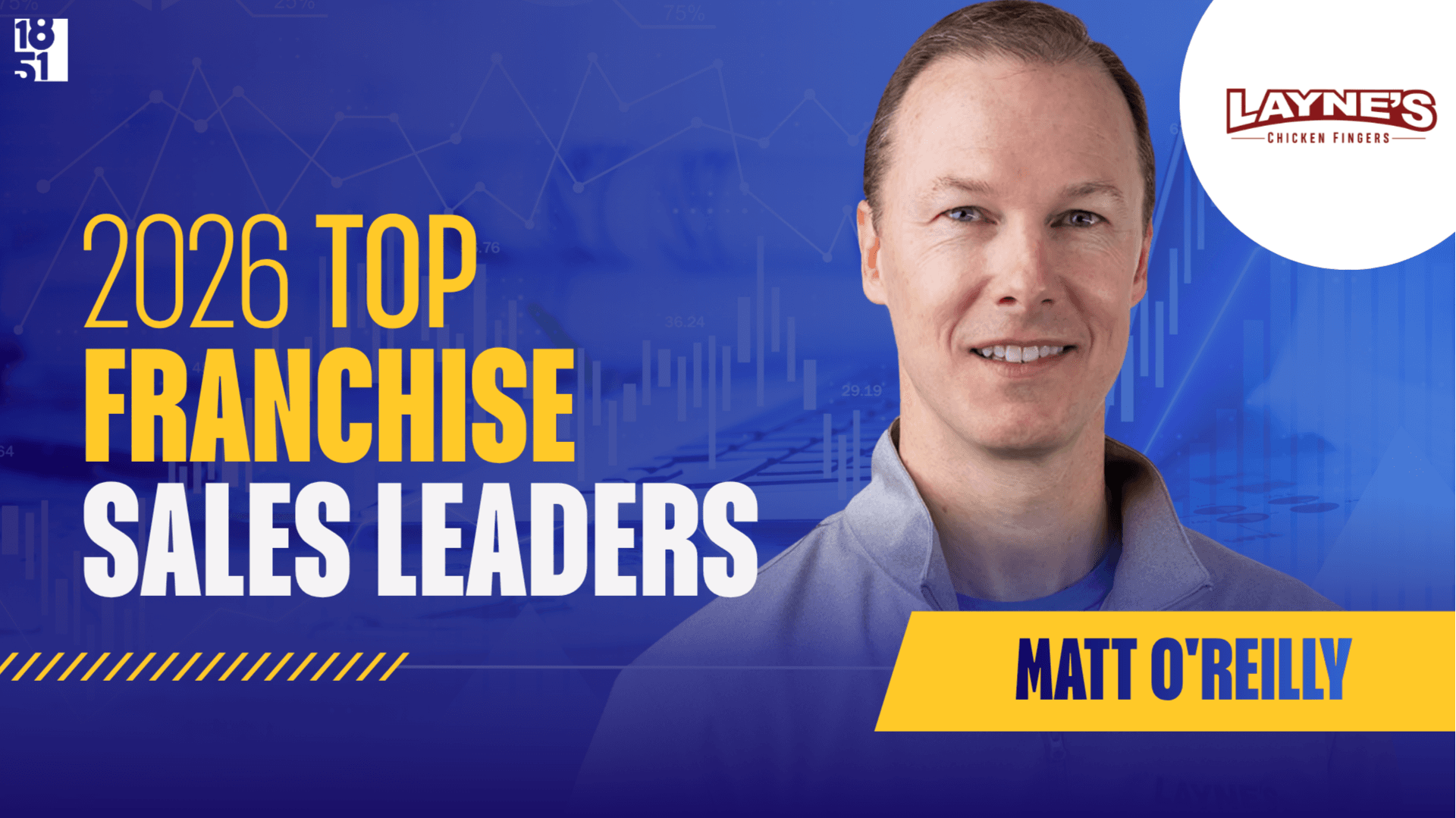
Matt O’Reilly, franchisee liaison for Layne’s, has been a crucial part of the brand’s franchising launch and recent growth. After acquiring the business in partnership with now-CEO Garrett Reed, O’Reilly helped launch the Layne’s franchise opportunity and remained closely involved in its continued expansion.
Throughout the entire process, O’Reilly has been flexible in terms of franchisee requirements, consistently raising the bar to align with an increasingly sophisticated system. But no matter the technical requirements, a cultural fit has always been a key focus.
“That is one of my talking points on an introduction call,” he said. “I always say before things advance, meet the team to see if you like us and we like you as trust is the first step in the process. I don’t care how good the concept is or what the returns look like if you don’t trust your partner.”
For a brand so deeply rooted in its cultural identity and relational strength, this is a nonnegotiable, and the results of O’Reilly’s diligence are clear in Layne’s recent performance.
1851 Franchise spoke with O’Reilly about how the franchise sales process has changed, what he looks for in a development team and the risks emerging brands face when choosing investors.
1851 Franchise: Can you tell us about your background and how you entered the franchise world?
Matt O’Reilly: I have always been an entrepreneur from a young age. I started mowing lawns for neighbors at age 8, had a tanning bed in my college dorm room that rented nonstop, and started my first real business at 28. Most of my career dealt with investing on behalf of large pension funds. Having the privilege to invest billions of dollars for firemen, policemen, teachers and city employees was an honor, but the entrepreneurial mindset of building something has always had a gravitational pull on me.
Back in the early 2000s, one of my clients introduced me to Garrett Reed, and we became best friends. Garrett had the idea to buy Layne’s in 2017 and asked me to partner with him. I was hesitant as restaurants have the perception of long hours and significant capital, but he was one of my best friends whom I trusted with my life. I could tell he was passionate about this, and it was his hometown brand, which had a cult following.
After saying let’s go, I talked to large capital providers that lend money to franchise companies, and they told me the pros of being in the QSR space, which changed my thought process of investing time and money in the space. I became excited about the opportunity to invest in a sector that has shown to be resilient in recessions, has a great playbook to grow and expand, and is growing. However, the most important thing was doing something with a friend and the belief we would make it a success.
In 2017, Garrett and I were fortunate enough to buy the brand and start down the road of the franchise world. We knew we had to have systems, operating stores, a supply chain, marketing and the support a franchisee expects, so in 2018 we opened three locations to prove it out and show a track record.
1851: The franchise buyer has changed dramatically over the past few years. What are the biggest shifts you're seeing in today's candidates, and how has your sales approach evolved to meet them?
O’Reilly: I don’t know if buyers have changed, but our requirements and type of franchisee have changed drastically. In late 2020, when we started franchising, if someone had operations, capital and passion, we would talk to them. The one thing that hasn’t changed is that we have to like them, and they have to like us, as it is a partnership.
Today, if the potential franchisee doesn’t have an existing operation in the QSR space, it is extremely hard to get past the introduction call to be invited in for a discovery day.
1851: What do you believe separates the highest-performing franchise sales organizations from those that struggle to consistently attract qualified franchisees?
O’Reilly: At the end of the day, you have to have a concept that generates an attractive return on your investment as well as a franchisor that supports the franchisee.
1851: Trust has become one of the biggest factors in franchise recruitment. How does your team build credibility with candidates throughout the discovery process, and what mistakes do you see brands making?
O’Reilly: That is one of my talking points on an introduction call. I always say before things advance, meet the team to see if you like us and we like you as trust is the first step in the process. I don’t care how good the concept is or what the returns look like if you don’t trust your partner.
1851: If you could give one piece of advice to an emerging franchise brand looking to accelerate development without sacrificing franchisee quality, what would it be and why?
O’Reilly: If you have pressure or have to sell a franchisee, don’t be a franchisor. Having the wrong franchisee can quickly ruin your business.
Want to learn more about how 1851 helps franchisors grow their franchises with confidence? Visit www.1851growthclub.com and see what we can do for you.