
Mellow Mushroom
How Mellow Mushroom’s Flexible Formats Help It Adapt to Every Market Opportunity
The brand’s fast-fine model and customizable footprints are expanding real estate options and supporting strong unit performance.
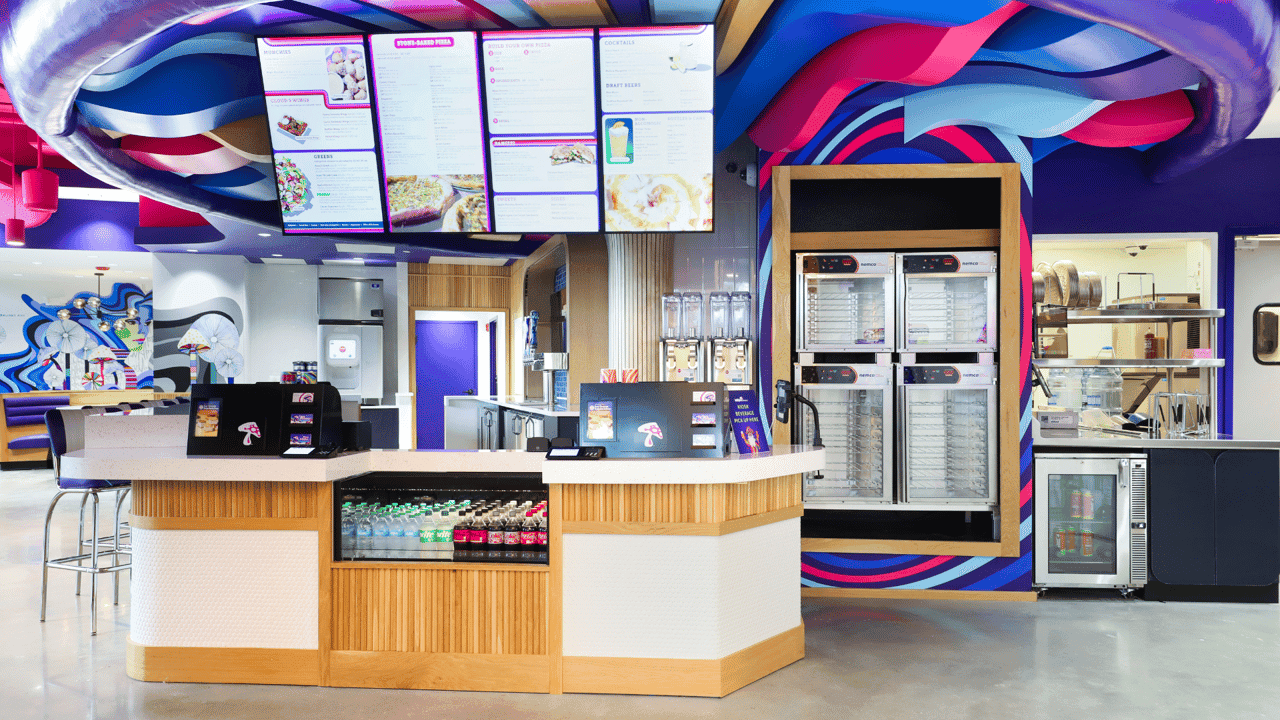
About 18 months ago, Mellow Mushroom, the psychedelic pizza franchise known for its imaginative pizzas and unique atmosphere, introduced a smaller-format fast-fine concept designed to give franchisees a more flexible and efficient way to enter new markets.
The fast-fine model trims roughly 1,500 to 2,000 square feet off the traditional full-service footprint. Guests order at the counter, but the experience still includes draft beer, cocktails and Mellow Mushroom’s core menu items. Food is run to the tables. Drinks are refilled. It doesn’t feel like a stripped-down version of the brand.
It still feels like Mellow Mushroom, just smaller.
“It takes our greatest hits from a food and beverage standpoint and condenses it down to a smaller footprint,” said Ahsan Jiva, executive vice president of strategy and transformation. “You still get the great experience in terms of the food. You can still order great, delicious cocktails; we still have beer on draft, as well as bottled and canned beverages. We still run the food to our guests and refill drinks, even though it’s counter service.”
From a financial standpoint, the early results have exceed expectations. Smaller spaces reduce occupancy costs. The streamlined menu is easier to execute. Fewer employees are needed to run the restaurant.
“The beauty about it is we’ve seen really encouraging financial results,” Jiva said. “Not only that, but we have consistency operationally, while giving customers a unique experience.”
The first fast-fine unit opened in Grant Park, Georgia, in November 2024. A second is under construction in Newton, Georgia, with additional sites planned. Leadership expects the format to expand throughout the Southeast before moving into other regions.
But the smaller box is only part of the story.
Mellow Mushroom has long resisted a rigid prototype. While many casual dining brands require one specific building size and layout, Mellow Mushroom operates in spaces ranging from about 2,500 square feet to as large as 14,000 square feet.
“If you’re pigeonholed into one box, there are only so many of those out there,” Jiva said. “When you have flexibility, it opens the door for a lot more opportunities.”
That range allows franchisees to pursue ground-up builds, end caps, strip centers, high-rises and adaptive reuse projects. Some locations operate in former indie theaters. Others are housed in historic buildings..
“We have locations that are old museums. We have locations that are old theaters,” Jiva said. “Can you imagine the experience for a guest? When you walk in these ginormous high ceilings, our artwork, the stained glass and architecture…., it provides a level of experience for our guests that other brands can’t match.”
In other markets, the brand reflects the local community through design. One restaurant near an airport features an aviation theme. A Gatlinburg location draws inspiration from the Smoky Mountains and the area’s outdoor culture. Elsewhere, Mellow Mushroom opened in a former city hall, preserving much of the building’s original character while transforming it into a restaurant.
The front-of-house design is often customized to reflect the surrounding community, while the back-of-house systems remain standardized. Kitchens follow consistent layouts. Equipment packages are aligned. Dough is prepared through a centralized commissary using a proprietary recipe.
The result is consistency where it matters operationally, and individuality where it matters to guests.
That flexibility plays a role in performance. Mellow Mushroom reported average gross sales of more than $2.68 million in 2025. Top quartile restaurants are reaching approximately $3.81 million in AUV.
According to Jiva, execution still comes down to leadership inside the four walls. “Everything starts and ends with the general manager,” he said. “They follow the systems and standards we provide, and then they adapt to their local market.”
Franchisees receive labor models tied to sales bands, operational coaching and structured marketing programs. But local operators are encouraged to make adjustments based on their trade area and keeping the guest experience the #1 priority. The format flexibility — especially with the addition of fast-fine — gives them more ways to do that.
Leadership sees the fast-fine concept not just as an infill strategy, but as a way to test new territories.
Because the investment is lower and the footprint is smaller, franchisees can enter tighter urban corridors, secondary trade areas and emerging neighborhoods without committing to a large full-service buildout.
“We really believe this is a step into new markets as well,” Jiva said.
For a brand born in Atlanta that now stretches from Northern Virginia to Arizona and Ohio, the product has proven it travels well based on the consistent AUVs across all markets. The flexible format makes expansion easier to execute.
Mellow Mushroom’s identity has always leaned into individuality. Now its development strategy reflects that same mindset.
The fast-fine model gives franchisees a lower-cost entry point. The full-service format offers high-volume potential. The wide real estate range creates more options in competitive markets
“What we’ve done throughout our entire existence is individualize the footprint and adapt the branding and the art to the local community,” Jiva said. “So it does actually feel like it’s part of the local community instead of taking a cookie-cutter box and just dropping it into the communities that we serve.”
For operators looking at the pizza category and wanting something beyond delivery-only boxes, that combination may be the difference.
To find out more information on costs to buy this franchise, please visit https://www.mellowmushroom.com/franchising/.
Mellow Mushroom
The brand’s fast-fine model and customizable footprints are expanding real estate options and supporting strong unit performance.
About 18 months ago, Mellow Mushroom, the psychedelic pizza franchise known for its imaginative pizzas and unique atmosphere, introduced a smaller-format fast-fine concept designed to give franchisees a more flexible and efficient way to enter new markets.
The fast-fine model trims roughly 1,500 to 2,000 square feet off the traditional full-service footprint. Guests order at the counter, but the experience still includes draft beer, cocktails and Mellow Mushroom’s core menu items. Food is run to the tables. Drinks are refilled. It doesn’t feel like a stripped-down version of the brand.
It still feels like Mellow Mushroom, just smaller.
“It takes our greatest hits from a food and beverage standpoint and condenses it down to a smaller footprint,” said Ahsan Jiva, executive vice president of strategy and transformation. “You still get the great experience in terms of the food. You can still order great, delicious cocktails; we still have beer on draft, as well as bottled and canned beverages. We still run the food to our guests and refill drinks, even though it’s counter service.”
From a financial standpoint, the early results have exceed expectations. Smaller spaces reduce occupancy costs. The streamlined menu is easier to execute. Fewer employees are needed to run the restaurant.
“The beauty about it is we’ve seen really encouraging financial results,” Jiva said. “Not only that, but we have consistency operationally, while giving customers a unique experience.”
The first fast-fine unit opened in Grant Park, Georgia, in November 2024. A second is under construction in Newton, Georgia, with additional sites planned. Leadership expects the format to expand throughout the Southeast before moving into other regions.
But the smaller box is only part of the story.
Mellow Mushroom has long resisted a rigid prototype. While many casual dining brands require one specific building size and layout, Mellow Mushroom operates in spaces ranging from about 2,500 square feet to as large as 14,000 square feet.
“If you’re pigeonholed into one box, there are only so many of those out there,” Jiva said. “When you have flexibility, it opens the door for a lot more opportunities.”
That range allows franchisees to pursue ground-up builds, end caps, strip centers, high-rises and adaptive reuse projects. Some locations operate in former indie theaters. Others are housed in historic buildings..
“We have locations that are old museums. We have locations that are old theaters,” Jiva said. “Can you imagine the experience for a guest? When you walk in these ginormous high ceilings, our artwork, the stained glass and architecture…., it provides a level of experience for our guests that other brands can’t match.”
In other markets, the brand reflects the local community through design. One restaurant near an airport features an aviation theme. A Gatlinburg location draws inspiration from the Smoky Mountains and the area’s outdoor culture. Elsewhere, Mellow Mushroom opened in a former city hall, preserving much of the building’s original character while transforming it into a restaurant.
The front-of-house design is often customized to reflect the surrounding community, while the back-of-house systems remain standardized. Kitchens follow consistent layouts. Equipment packages are aligned. Dough is prepared through a centralized commissary using a proprietary recipe.
The result is consistency where it matters operationally, and individuality where it matters to guests.
That flexibility plays a role in performance. Mellow Mushroom reported average gross sales of more than $2.68 million in 2025. Top quartile restaurants are reaching approximately $3.81 million in AUV.
According to Jiva, execution still comes down to leadership inside the four walls. “Everything starts and ends with the general manager,” he said. “They follow the systems and standards we provide, and then they adapt to their local market.”
Franchisees receive labor models tied to sales bands, operational coaching and structured marketing programs. But local operators are encouraged to make adjustments based on their trade area and keeping the guest experience the #1 priority. The format flexibility — especially with the addition of fast-fine — gives them more ways to do that.
Leadership sees the fast-fine concept not just as an infill strategy, but as a way to test new territories.
Because the investment is lower and the footprint is smaller, franchisees can enter tighter urban corridors, secondary trade areas and emerging neighborhoods without committing to a large full-service buildout.
“We really believe this is a step into new markets as well,” Jiva said.
For a brand born in Atlanta that now stretches from Northern Virginia to Arizona and Ohio, the product has proven it travels well based on the consistent AUVs across all markets. The flexible format makes expansion easier to execute.
Mellow Mushroom’s identity has always leaned into individuality. Now its development strategy reflects that same mindset.
The fast-fine model gives franchisees a lower-cost entry point. The full-service format offers high-volume potential. The wide real estate range creates more options in competitive markets
“What we’ve done throughout our entire existence is individualize the footprint and adapt the branding and the art to the local community,” Jiva said. “So it does actually feel like it’s part of the local community instead of taking a cookie-cutter box and just dropping it into the communities that we serve.”
For operators looking at the pizza category and wanting something beyond delivery-only boxes, that combination may be the difference.
To find out more information on costs to buy this franchise, please visit https://www.mellowmushroom.com/franchising/.
Sign up for the 1851 Franchise newsletter to get our biggest stories before everyone else
By signing up, you agree to our user agreement (including class action waiver and arbitration provisions), and acknowledge our privacy policy.

No related articles found