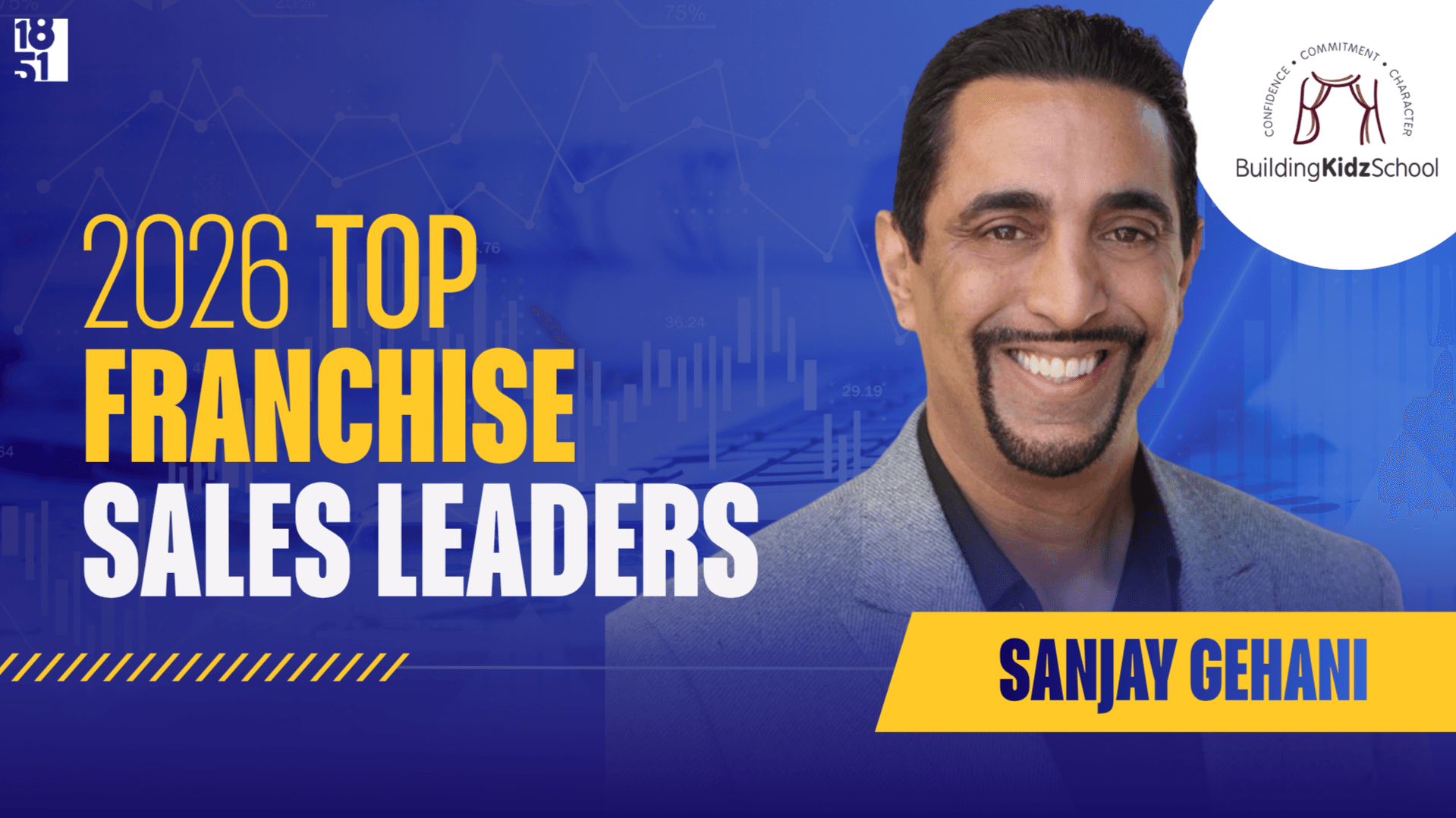
Franchise Sales Leader: Sanjay Gehani
Brand: Building Kidz Worldwide
Sanjay Gehani, managing partner and chief revenue officer at Building Kidz Worldwide, spent 15 years at semiconductor company Xilinx before entering franchising. At Xilinx, he worked across engineering, sales, marketing, business development, operations and pricing, including an expatriate assignment in Japan. He also managed partnerships in Europe and Asia and traveled roughly 17 weeks a year.
That changed after his son was born in October 2012. While searching for a preschool, Gehani met Vineeta Bhandari, who founded Building Kidz in 2003 and had built multiple campuses in the Bay Area. Gehani invested alongside her and left Xilinx about a year later. He joined Bhandari and partner Sangeet Karamchandani to build the company into a franchise system.
Building Kidz launched franchising in 2016 and now has 58 schools across 11 states. The company signed its 100th franchise agreement in April 2026.
1851 Franchise spoke with Gehani about how the franchise sales process has changed, what he looks for in a development team and the risks emerging brands face when choosing investors.
1851 Franchise: Can you tell us about your background and how you entered the franchise world?
Gehani: I never thought I'd be here. I thought I was going to be the first pitcher of Indian descent in the major leagues, and when that dream ended at a Division II college, I got a degree in electrical engineering and came back into high tech. At the time, tech was quite centralized in Silicon Valley, where I was raised, so I came back home. Over 15 years with one company, I had various roles. I started in engineering, then traveled overseas in an expatriate position in Japan, then came back and got into sales, marketing, business development, operations and pricing. I was getting a broad base of experience. I ended up partnering with companies in Europe and Asia and managing a series of partnerships there, which had me traveling about 17 weeks a year. I also got an MBA in marketing and leading organizations.
I became a father in October of 2012, and after spending some time at home with the family, I quickly realized I was going to miss a lot of my son's life. I started looking at preschools and realized you can put preschools into three categories. No way would you ever. You would if you had to. Or you absolutely want to. And every school that you absolutely want to put your child into usually has a 12- to 18-month waitlist, which got me thinking about the difficult decisions families are making, putting their children in substandard environments just because they have to go to work.
I had that in mind and had an opportunity to sit down with Vineeta Bhandari, the founder of Building Kidz, who at that time had multiple campuses in the Bay Area under her management, and she gave me an opportunity to invest with her. A year later, I left my career and we joined hands along with my other partner, who came from high tech as well. We decided we wanted to do three things. We wanted to become a world-class franchisor. We wanted to keep providing great experiences for the families who had already chosen us through our company-owned locations.
And Vineeta's dream, which we internalized, was to touch the lives of 1 million children. So we dedicated some of the profits from the franchise side, at no expense to the franchisees, to a 501(c)(3) she oversaw, a nonprofit helping orphaned and abandoned children, children with hearing disabilities, vision impairment and juvenile diabetes research right here at home and around the world. That's how I got started in franchising. That was back in 2015, and then we launched in 2016.
1851: The franchise buyer has changed dramatically over the past few years. What are the biggest shifts you're seeing in today's candidates and how has your sales approach evolved to meet them?
Gehani: Franchise candidates are getting a lot more information as they come to us these days. While the mutual evaluation process hasn't changed much structurally, the engagement level at different points in that process has, with people coming to that first conversation with thoughtful questions and a lot of research already done. The AI engagement that's out there, Claude and ChatGPT, for example, has really allowed franchise candidates to understand the child care industry earlier and franchising earlier. They can do a lot more research on their own. That decentralization of knowledge has changed the experience we're having with franchise candidates today. They come into the initial calls much more prepared than they were five or 10 years ago.
1851: What do you believe separates the highest-performing franchise sales organizations from those that struggle to consistently attract qualified franchisees?
Gehani: It really comes down to having clarity at the top about what is a priority and what isn't. There's no substitute for incredible talent, so that's definitely a characteristic of really strong performing franchise organizations. But it's also having that relentless focus. What are our goals over the next four or five years, and how do we work our way backward and lock in on measuring what we're doing today? Is it getting us to our goals or is it not, and what should we shift? Those conversations tie into disciplined execution day-to-day and week-to-week. And there's no substitute for true relationships and culture that get built over time, so I think that's a key component as well.
The franchise development organization inside a company has to be critically focused on the franchise candidate, not themselves. Yes, we represent the broader organization to candidates, but the whole mutual evaluation process has to be nurturing and filled with white-glove service to the franchise candidate. That takes special people who can keep the focus on the candidate as they learn about us.
1851: In 2026, what was the most impactful change your franchise development team made, whether through technology, process improvements or marketing?
Gehani: The use of AI has definitely accelerated the amount of time it takes us to document something like this call right here. Just being able to get a transcript and your notes means we save so much time. The ability to evaluate candidates from multiple angles, with data available online and aggregated, so we get a picture of who we're going to be meeting with and what might interest them, has been a big shift for us. So I would say, in one answer, AI.
1851: If you could give one piece of advice to an emerging franchise brand looking to accelerate development without sacrificing franchisee quality, what would it be?
Gehani: Don't sacrifice your values for revenue up front. No emerging franchise brand can survive on royalties alone, so there will be tremendous pressure to bring in new franchisees to offset the company's costs. But if you do that, you could face long-term headwinds from franchisees in your system who may not be a good fit for the brand and may not become brand ambassadors. When you trade that strategic thinking for near-term revenue, that could be one of the biggest pitfalls you hit early.
Want to learn more about how 1851 helps franchisees find the right franchise opportunity? Visit www.1851growthclub.com and start your journey.