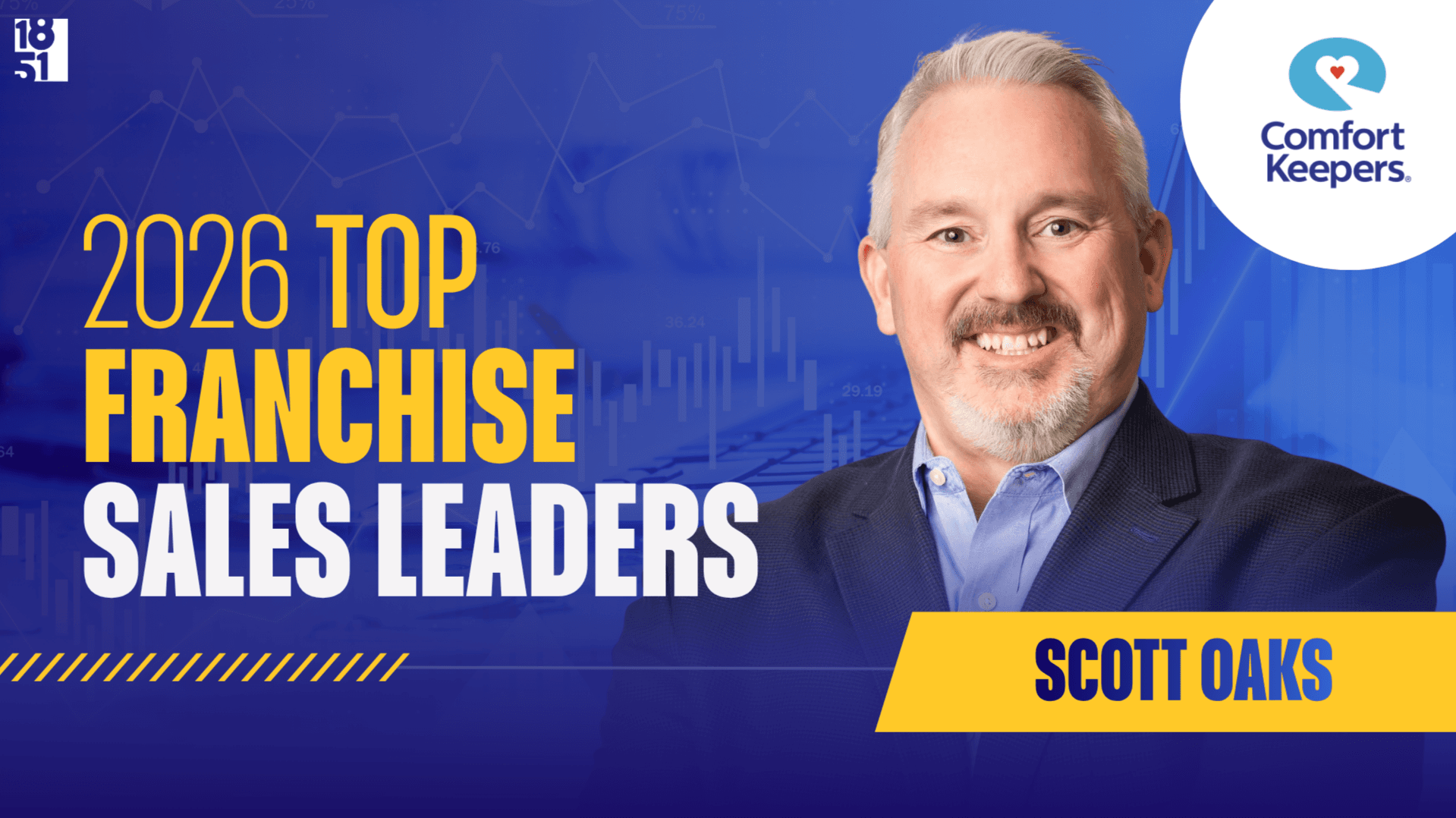
Scott Oaks, vice president of franchise development at Comfort Keepers, began his franchise career with a job posting on Monster.com. At 28, he was five years into a manufacturing sales career when a round of layoffs forced him to rethink what came next. He spent weeks in meetings about staff reductions, looking at his team and working out who might have to go, and then walked in one Thursday and learned he was the reduction. He had a three-month severance, no plan and no particular interest in franchising when a development executive at Handyman Connection pulled his resume off the job board. The brand wanted a franchise development director who had never worked in franchising, on the theory that he would arrive without bad habits.
That was 2003. Oaks has spent 23 years in franchise development. He now runs recruitment for Comfort Keepers, the in-home senior care franchise. He said candidates now show up with far more information, sometimes after pulling an old FDD from a state registration site or asking an AI tool to rank brands in the category. That means his team is getting into substantive conversations much earlier than it used to. His team is also spending more time on something that wasn't part of the job a few years ago: making sure Comfort Keepers shows up when a prospect asks a chatbot where to start.
Oaks spoke with 1851 Franchise about the role unit economics play in franchise recruitment and how he handles questions about low performers in the system.
1851 Franchise: Can you tell us about your background and how you entered the franchise world?
Scott Oaks: I got into franchising the way many people do. I was in my late 20s, five or six years into a manufacturing job doing sales and account management. This was 2003, after 9/11 and the dot-com bubble. There was a recession and it hit manufacturing pretty hard. I was in meetings about staff reductions, looking at my team and figuring out what we might have to do. Then I walked in one Thursday and found out I was the staff reduction. I called my wife and told her 28-year-olds don't get downsized; that happens to older people. She said middle management is middle management; it doesn't matter how quickly you got there.
So I was at a crossroads. What I had been doing was completely commoditized. It was all about price, and I wasn't getting much personal satisfaction out of it. Then the VP of development at Handyman Connection found my resume on Monster.com, which tells you how long ago this was. He wanted a director of franchise development who hadn't come from franchising, because he didn't want anybody with bad habits. The more we talked, the more excited I got. I liked the idea of helping people start their own business. It was also right in my wheelhouse. I cut my teeth in high school selling newspaper subscriptions over the phone, so calling strangers and getting told no was familiar territory. The brand also made sense to me. Handyman Connection did the jobs where you don't have the tools, time or talent. That was me in a nutshell. If my wife sees me walking around with a tool in my hand, she follows me to figure out what I think I'm doing.
1851: The franchise buyer has changed dramatically over the past few years. What are the biggest shifts you're seeing in today's candidates, and how has your sales approach evolved?
Oaks: The biggest shift is the amount of research people do before they ever talk to you. It used to be the reverse. When someone inquired on your website, they were starting the investigation, and you would send them the information to do it. Your site had less on it, and what was there existed to get them interested enough to fill out a form. Today it's the exact opposite. People come in as educated as possible. They may have found an old FDD of yours on a state registration site. They're looking at competitors. With AI, they're asking for the top brands in a category. They're reading your team's bios on LinkedIn. So you have to be ready to get into fairly in-depth conversations quickly. You used to have a slower dance at the beginning where you felt more in control, because you controlled the information you were giving them. Now you have to put so much out there that people have enough knowledge to want to engage with you at all.
1851: What separates the highest-performing franchise sales organizations from those that struggle to attract qualified franchisees?
Oaks: This is going to sound really simple and it always amazes me, but it comes down to unit economics. If your franchisees are doing well, feel supported and feel like the franchisor is setting them up for success, you see that growth. Candidates are smart enough to see growth from a unit standpoint, but what they really want to see is Item 19. They want to see economic growth and unit-level growth, because that's what they're buying into. They're trying to predict and plan. If I do this, this is what everyone else has done. If I can be like everybody else, or conservatively 25% less than everybody else, is that going to work for me?
Brands that focus more on selling franchises end up with a bunch signed but not open. They may have sold too many and don't have the support staff to back it up. You'll have franchisees coming in with an expectation of Y when they're getting Z, and that turns the relationship sour very quickly. It affects the development schedule, especially at brands selling multi-unit packs. If the unit economics are good, that signals the support is there to get franchisees to those levels consistently.
1851: How does your team build credibility with candidates through the discovery process?
Oaks: Let your personality and your authenticity come through on those calls. We all have our scripts and our bullet points we need to get across. What I've found is that who you actually are comes across better than what you think a candidate wants to hear. You want to project confidence in your brand and your answers. But it's also OK to tell someone, “I haven't gotten that question before. Let me find out and get back to you.” That beats trying to BS your way through it and being wrong, which a lot of people can see through.
Every franchise system has low performers and a bell curve in the middle. If a candidate asks what's wrong with low performers, answer it honestly. Maybe those were folks we shouldn't have let into the system. I've said this to candidates many times. It may sound like a cop-out, but the ultimate variable in a franchise's success is the franchisee. If everybody has access to the same tools and the same training, it comes down to what you're going to do with it, and I can't predict that. That's why I get a little annoyed when I hear about semi-absentee ownership. Unless a brand has a really strong system for identifying general managers, something will be lost. You can't replace an owner's sweat equity. So authenticity comes from having candid conversations. It's not always rosy. There are really difficult days in this.
1851: So far in 2026, what has been the most impactful change your franchise development team has made?
Oaks: From a technology standpoint, and I hate to say it because it's very buzzwordy, it's understanding the candidate's journey through AI. We need to understand what prompts people are putting into these tools, what results they're getting back and how we get in front of that. Many prospects use AI as an advisor. Unlike a broker network, which has its own inventory of brands, AI is looking at every brand. So we're working to stay relevant in those searches, building content around it and making tweaks to the websites.
It's a moving target. What we thought it was five months ago isn't where it will be five months from now, so you don't want to dig in too far because you need maneuverability to adjust as it goes. Just as you think you have a handle on AI relevancy, the next wave is going to be paid ads around the AI modules, because they're not going to walk away from the revenue moving out of traditional search. Lead generation is where we spend the most time, and it's an ongoing challenge.
1851: What advice would you give an emerging franchise brand looking to accelerate development without sacrificing franchisee quality?
Oaks: Scale your brand enough before you start franchising so you know what it takes to run it successfully in multiple geographies and different circumstances, the way your franchisees will. Get your unit economics down. What does it take to have a successful launch? What does it take when they hit a plateau to get past it? Build that into your operations manual.
Another is to be very selective with your first 15 to 20 franchisees. Get people who are passionate about the brand and want to do this as their main thing, because their success and buy-in fuel the next 80. It's OK for that to go a little slower if you get the right mix of folks, because it pays off long term.
1851: What is your favorite part of the job?
Oaks: Going to our annual franchisee conference and seeing people I helped through the decision-making process get recognized for their success as owners. My role in that was so small. They did the work. But knowing you had a hand in helping someone follow that path, and then seeing them be successful, is probably the greatest satisfaction I get out of this. Even more than hitting a yearly goal.
Oaks was hired 23 years ago because he knew nothing about franchising. Today, he said, the job still comes back to being straight with candidates about what they are actually buying.
Want to learn more about how 1851 helps franchisees find the right franchise opportunity? Visit www.1851growthclub.com and start your journey.