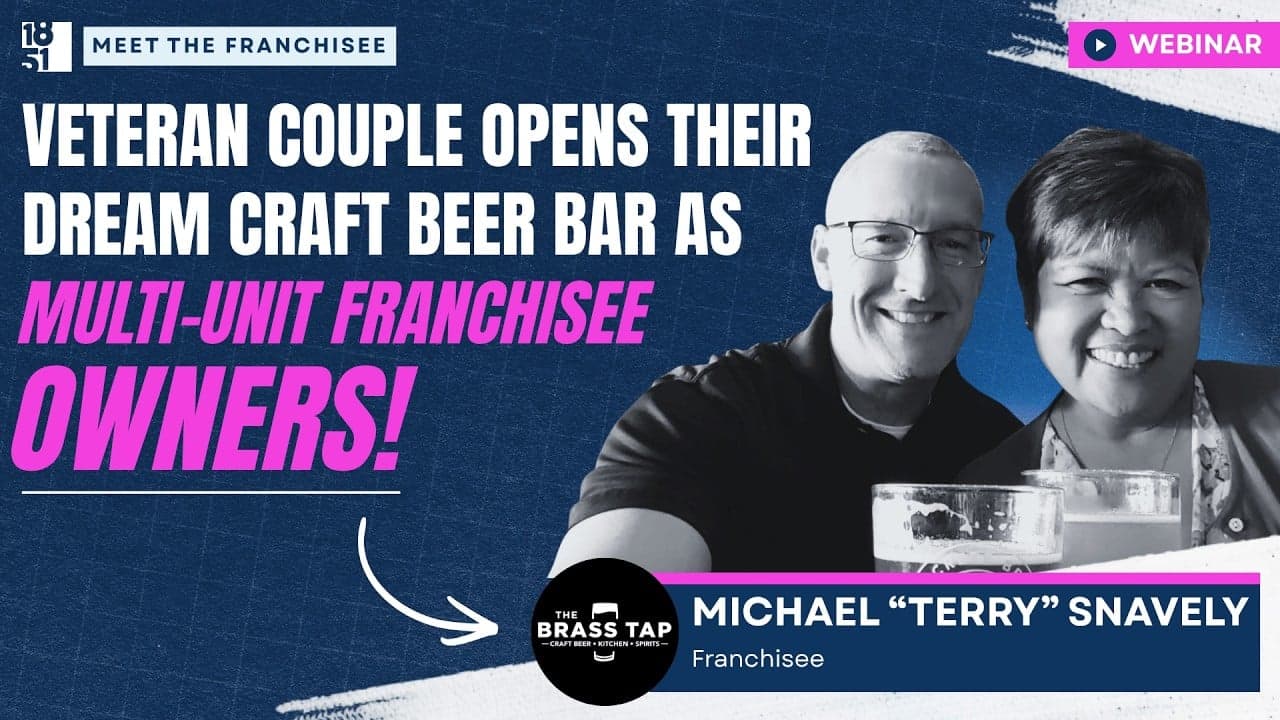
Terry Snavely and his wife, Josephine, had spent years talking about what they wanted to do after their careers supporting the military and the Department of Defense. Both shared a love of craft beer, good food and the social atmosphere of a neighborhood pub, and they envisioned eventually opening a place of their own. Franchising, however, was not part of the plan.
“Oh, yeah. It wasn’t that it didn’t cross my mind. It was a no. It was a hard no for me,” Snavely said. “I was like, nope, I’m not franchising. This is my place. I’m not giving it to anybody. So I was a hard no until that point.”
That point came after the couple discovered The Brass Tap while house hunting in Miami and later encountered another location in National Harbor, Maryland. After learning the concept was a franchise and speaking with an owner who had a similar military and government background, Snavely and his wife began reconsidering their assumptions about franchising. A visit with the FSC Franchise Co. team ultimately convinced them that the support of an established system could help them open the type of business they had envisioned.
“For somebody who was so anti-franchise, once we looked at this and had our discussions, it was a no-brainer for us,” Snavely said.
The couple committed to five locations and now operates The Brass Tap restaurants in Southern Maryland and Hampton Cove, Alabama. They are exploring additional locations as they work toward fulfilling their five-unit agreement. Snavely said their growth has depended on developing strong general managers, giving them the ability to run their restaurants like owners and putting systems in place that can be repeated as the business expands.
“You want the GMs to think like you would think,” Snavely said. “The appearance of the restaurant, the way the food comes out, the atmosphere, taking care of the guests, taking care of the employees — you want them to feel like that’s their bar.”
Snavely is clear that franchise support does not eliminate the work required to build a successful business. Franchisees still need to choose the right locations, build strong teams and remain involved in their operations. For Snavely and his wife, however, The Brass Tap has given them an opportunity to build the next chapter they had talked about for years.
Snavely joined 1851 Franchise Publisher Nick Powills on a recent episode of the “Meet the Franchise” podcast to discuss his military background, what changed his mind about franchising and how he and his wife are building a multi-unit business with The Brass Tap. A transcript of the interview has been provided below. It has been edited for brevity, clarity and style.
Nick Powills: As I usually do, I look at someone’s LinkedIn beforehand to try to understand, why in the world did they get into franchising? And that’s exactly why I was like, how in the world did you get into franchising? Give me your backstory because I think it’s deeply valuable to anybody who may be considering something different in their life. Tell me your goal.
Terry Snavely: Yeah, sure. Of course, we’re a partnership. It’s my wife, Josephine, and myself as partners in our business. For years, we talked about what we wanted to do once we fully retired. My wife is retired Air Force. I was Army. She retired from DoD. I still support DoD and the Army. But we were like, all right, what’s next?
We wanted to do our own bar, our own pub, mainly because we have this love for craft beer, good spirits, food and just the social side of it. So we had gone down the path of, is this what we’re going to do?
As fate would have it, I took a job in Miami working for the Army, and as we were house hunting, we came across The Brass Tap. It immediately grabbed us. That’s their goal — to be that local feel and vibe that just brings you in — and that’s exactly what that Brass Tap did.
We didn’t know it was a franchise. When we walked in, we were greeted, all the beers, the food — it was great. We were like, this is going to be our local spot while we’re here.
Then we went back up to Maryland to pack for our move to Miami, and we came across a second one in National Harbor. We were like, this cannot be that big of a coincidence. So we walked in, talked to the owner, Mark, and he said, “No, it’s a franchise.”
We just started talking. He had a similar background to ours — military, worked with the government — and this is what he was doing. So we started taking notes because it fit with what we wanted to do for our next chapter.
We went back down to Miami, moved down there, did our homework, found out FSC was in Tampa and made the appointment. We went up, sat with them and did their discovery day. Within an hour, we knew this was where we wanted to settle.
Actually, as we were driving back down to Miami, my wife was on her computer already signing the contracts. We were on a team with FSC because it just had that feel. It really fit. This was what we wanted to do, and now we had found somebody we could do it with, somebody who was going to walk us down the path and help us so we didn’t make all the normal mistakes of somebody opening a pub, restaurant or bar. There are a lot of pitfalls you can fall into.
Honestly, we had never thought about a franchise before. But after we had our meeting with the team and they showed us the value they were bringing to us, how they were going to help us and how they were going to make our dream become a reality, we dove in.
That’s how we got here. It was a dream that became reality through, I want to say, a little divine intervention and some great luck. That’s how we did it.
Powills: And today, what does the footprint look like?
Snavely: Currently, we operate The Brass Tap in Southern Maryland. It’s next to the Patuxent River Naval Air Station, and we have a second location in Hampton Cove, about 20 minutes from the Army’s Redstone Arsenal.
We just hit three years on one and the one-year mark on the second one. Josephine can’t be with us, but she’s actually in Vegas right now looking at a third location that hopefully we’re going to sign a deal on. She and I have also started talking to potential landlords for two more locations in Alabama, in Athens and Huntsville.
Powills: All right, so much that I want to unpack. You’re not thinking about franchising. You guys are talking about, after we retire from the military, what do we want to do? And you’re landing on, wouldn’t it be cool to own a bar? You’re looking at that because of community, relationships and every reason you would want to own a bar.
Then you happen to fall into franchising. Before that moment, it wasn’t really crossing your mind? You guys were like, OK, how do we go about opening a bar?
Snavely: Oh, yeah. It wasn’t that it didn’t cross my mind. It was a no. It was a hard no for me. I was like, nope, I’m not franchising. This is my place. I’m not giving it to anybody. So I was a hard no until that point.
Powills: Flash forward, obviously, you’re going through the process. When you’re going to this discovery day, you’re driving there from Miami. Are you guys going there discussing, it’s a no and they’ve got to convince us it’s a yes? Are you thinking it’s a yes, but you’re going to look for loopholes that will make this a no? How are you approaching that moment, given that you thought about doing it on your own?
Snavely: I think what you were saying is probably the path we were on. It was still a no while we were driving. We did our homework. We were investigating them, reading about them.
Part of it was the atmosphere of The Brass Tap. It immediately grabbed us and had us. But there was still the hesitation about, OK, really, what does a franchise deal look like? Am I going to come in and do a ton of work for somebody else to take the majority of the profits or revenue?
It was still a no as we were driving. We were discussing it back and forth, hitting on pros and cons all the way up until we walked in the door and met The Brass Tap team.
Powills: Was that the moment that started changing? You started seeing who was behind you if you were to do this?
Snavely: Oh, absolutely. There were three couples there. We sat down at a conference table, and Jesse came in and talked to us. Jim came and talked to us. These are your directors within FSC and The Brass Tap, and they started showing us all the possibilities and the backing and support they were going to give us.
Then Chris Elliott, the CEO of FSC, came in and talked to us. It wasn’t a briefing. This was, “Hey, here’s who we are. Here’s how we’re going to help you. Here’s what we think. This is how we feel about our brand and how we want it to be.”
And, by the way, we’re not just going to hand out a franchise agreement. This is why you’re talking to us. We need to look into you as well.
As much as we were looking into them, they were looking into us. That really intrigued me because now I knew they weren’t in it just to open as many franchises as they could. They really wanted the brand to be solid.
Powills: One of your hesitations was the fees. I just want to shake the entire franchise industry. When you call it a royalty, it creates this idea of, well, you’re going to have to pay money to be part of this brand. But the reality is, when you think about what you actually get for that, you have a team of sophisticated human beings who are actually cracking the code on this. I’d pay more for it.
Snavely: Exactly. You don’t have to lose a lot of money to learn a bad lesson, right?
I won’t get into the structure of the fees. That’s for FSC. But I can tell you, if anybody’s looking at the franchise, look at other franchises and look at what they’re going to require you to give them. Then come back and talk to FSC. You’re going to be very surprised and very happy, and then you’re going to realize exactly what you’re getting for what you’re giving them. I probably can’t stress it enough. For somebody who was so anti-franchise, once we looked at this and had our discussions, it was a no-brainer for us.
Powills: So that’s hurdle one. Hurdle one is, OK, we’re going to sign the agreement. Now comes, in my opinion, the hardest part of becoming a franchisee. You’re going to start bleeding cash because you have to get a unit open. You’re like, well, there goes my money, there goes my money, but there’s no unit open, so there’s nothing coming back. You’re like, OK, this is painful. You have to be properly prepared for that.
That expectation line is so critical because if, in all this dance, they gave you BS and you opened this unit and there was no support, then you’re not talking about unit two. You’re not talking about Vegas. You’re not talking about Alabama. You would have stalled out and said, “All right, we’re in one. We’re not overly happy, but we’re stalled out.”
The proof, at least as I see it, is the fact that you want more units. That means expectations were set correctly, and they’ve continued to meet or exceed them.
Snavely: Oh, absolutely. Yeah, 100%. You’re right. If it had not been there, we would have found out after the fact. We would probably just do our time on one unit, maybe look someplace else, but just do our time to come out of it. But no, they’ve exceeded our expectations from the day we walked in the doors.
Powills: Obviously, you have a ton of passion for this side of the business. I’m curious because you built up a tremendous career in the military and protecting our country, which I’m sure you’re super proud of. How do you balance your own internal pride on this? Because it’s two ginormous accomplishments. How are you reconciling how your life has led up to this moment?
Snavely: It’s a good question. I think you’re thankful for what you were able to do in your career, to not just build yourself financially but build yourself professionally and give yourself the confidence to jump in.
The first time you’re doing it, you’re jumping off the deep end. You’re off the high dive and you’re just letting go. I think our careers — not just mine, our careers — allowed us to have that confidence to go into a new chapter. We’re thankful for the first part of our careers that helped us get to this. Now, this is what we want to do. This is where we want to take it to sunset.
Powills: It’s a tremendous career, especially everything that you learned, both of you being in the military. I’m sure it sets you up for systems and processes and how you battle the hardest demon in being a business owner, and that’s your own head telling you whether you can do it or not, right?
Snavely: Yes. You definitely have to convince yourself. But give credit back to the franchise, too. You’re going through these different emotions: Should I? Should I not? I am going to put a lot of cash out front to start this.
But as you work with a franchise, they’re still giving you all the data points. They’re still helping you along the way. As a franchise owner, we sign all of our documentation, our leases and all of our commitments to our vendors, and we do our build-out. However, the franchise is still there with you, behind you, and they’ll read it with you and help you if there are things you don’t understand.
You still have that support that helps build on top of the confidence you have in yourself.
Powills: How do you and your wife manage roles and responsibilities? You were in different branches of the military, working in very similar environments but in different branches. How are you guys owning roles and responsibilities together?
Snavely: Our military backgrounds help us out there as well. Josephine and I are 50-50 in the business. We don’t make large decisions without talking to each other. We come to one decision, and really, that decision has to be agreed on by both of us. If one of us is still hesitant, then either it’s a no or we go back and look at it again. We’ve worked this way the whole time we’ve been together.
Josephine handles the minor decisions, and I give her all the credit. Josephine handles all the day-to-day operations because I still work. I still support DoD. She handles all the day-to-day activities with our general managers at the bars.
But when it comes to those larger decisions, like she’s in Vegas now, she’s going to gather all the information. She and I are going to talk, and then we’ll decide together if we want to move forward with that location.
I think that’s how we manage. That’s why we’re capable of being successful with what we’re doing. There’s no animosity between us at all. We are partners all the way through. Even when we’re talking to other vendors, you don’t get one of us. You get both of us. That’s us.
Powills: There’s another thing that I’m curious about. If we go back to when you walked into the National Harbor location and met Mark, now you’ve met the owner. In that area, it’s almost like “Cheers.” He’s going to know your name when you walk in there.
When you become a multi-unit operator, whether it’s in the same state or across borders, now you have to train your GMs to think like owners so that they treat everybody the same way you would if you were in that unit. How hard was that for you guys to figure out as you went to multiple units? What’s maybe the magic trick to managing a multi-unit operation?
Snavely: I’m trying to think if it’s a magic trick or partly luck. Your premise is correct. When we hire our GMs, you want the GMs to think like you would think. The appearance of the restaurant, the way the food comes out, the atmosphere, taking care of the guests, taking care of the employees — you want them to feel like that’s their bar.
We give our GMs the latitude to operate as they need to because we’re not always there. We talk to our GMs constantly, making sure each bar and each restaurant is doing it the same way and following the same standards.
But the people side is hard. I don’t want anyone to think it’s not. That takes a lot of your time in this business. The turnover rate for the service industry is high, so you’re constantly looking for new people.
But once you find them, once you find the people who are solid and working for you, then you take care of those people. They stay with you, and they’ll take care of you. I’m not sure it’s magic, but it’s definitely a lot of common sense. You have to take care of the people who are there and working hard for you.
Powills: The reality is, take the military. How many kids come in at 18, and then how many have a career like you’ve had? They fall off because, for whatever reason, it’s not the right fit at the right time, and then they move on to other careers. Very few people would be in the military as long as you have.
The same is true for jobs. The same is true for friendships. The same is true for marriages. All of this comes down to aligning expectations with people and meeting them in the middle on the things that are important to them.
Once you start cracking that code and working through it, it probably is time, luck and volume. It’s not like it can happen overnight. But it seems like as long as you have that mentality, it kind of is what it is, and you build up businesses.
Snavely: Exactly. We have gone through our share of personnel, even with our general managers. We’re not on our first general manager. It took a couple of evolutions to find that person, but we’re very blessed that we have good GMs. We structured ourselves a little differently as well. One of our first GMs in Maryland, within our company, we elevated him to our VP of operations. He oversees each bar with us.
As we scale and add another bar, while Josephine and I are out taking care of the build-out and opening that bar, it falls under his purview as well. He makes sure that all three bars — four or five, however far we go — operate the same way.
Powills: I love that. Let’s just say hypothetically you sign this lease in Vegas. How do the two of you manage that unit from signing the lease to groundbreaking through, say, that first year? Do you guys have to split time in that new state to be able to manage it? How do you navigate that?
Snavely: Well, we’ll say it’s Vegas. We’ll actually go back to Vegas, and we’ll be there for the build-out, the opening and the first six to 12 months. It’s the same way we did Maryland, the same way we did Alabama.
It’s funny because our journey actually started in Vegas. When Josephine retired out of DoD while we were in Miami and then I did my remaining time, we moved to Vegas. We were going to put our first one there. That’s just not how it worked. Our first one actually went to Maryland, where my hometown was.
Then we were like, OK, we’re going to go back to Vegas, and that didn’t work either. We were heading down to Florida, and my cousin was like, “Hey, you really need to check out Alabama. I just moved to this location. It’s great.”
So we said OK. Josephine immediately found the spot. She said, “This is the spot we’ve got to be in.” So we did it. I think now maybe we’re going to get back to Vegas and put one in. We’ll see. We’re not stressing the location, and FSC is not pressuring us either, which is fantastic. If that works, we’ll go there. If it doesn’t and Alabama is the next move, we’ll stay there.
But to answer your question, Josephine and I will actually go to that site. We will be on-site through the build-out, through the opening and for the first six to 12 months until we establish a strong management system.
Powills: Got it. You’ve got time to get a large banner, climb the new Hard Rock to the top and stick the banner up there and say, “This is ours.”
Snavely: That’s exactly right. Yes, that’s exactly right.
Powills: So now you’re accomplishing scale. Where does the dream go now? Are you living the dream?
Snavely: Yeah, we 100% are. This is what we wanted to do. When we first discussed our agreement with FSC, you can buy individual franchises or you can buy multiples. We were so sure in FSC, The Brass Tap and the concept that we bought five right out of the gate.
That’s what we’re working on. We’re scaling to our five now, and then we’ll see. Do we add a sixth? You never know.
Powills: Once you figure out the math equation, it’s just math. It’s just, how do we duplicate it, right?
Snavely: Yeah. Rinse and repeat if it works.
Powills: Well, it’s interesting. So you signed a five-unit agreement, but you didn’t declare the territory as part of that? You said, we’re going to commit to five, but you didn’t declare territory?
Snavely: We did. We declared two territories. But here’s another great thing about FSC: The first bar went into one of our territories, and we were trying to get into Vegas.
At the time, some of the rules within Clark County were hard to navigate because if you’re going to bring in a bar, you can’t be within so many feet of another bar that has gaming. There are just a lot of rules.
As we were trying to navigate it, Alabama came up. So we called FSC. We said, “Hey, we’ve got a spot. Here’s what we’d like to do.”
They didn’t hesitate. They were like, “All right, just think this through.” Then it was, OK, we’ll work with you. We’ll add that location to your current agreement. That’ll be your spot, and we’ll move forward. They give you the flexibility to do what you want to do or handle things as they happen.
Powills: Well, it’s part of what I said. This is now my 22nd year in franchising, and I’ve seen the story so many times. It’s not necessarily a bad franchisor, but it’s the franchisor that feels, “I’m the franchisor. I’m in charge,” versus the franchisor that says, “We’re in the business of supporting franchisees.”
It’s impossible for a franchise buyer to cut through that clutter, that BS, in the buying process because everybody’s telling you what you want to hear because they want to sell. So you almost have to get lucky that you land with the right franchisor.
I’ve been working with FSC, or had a connection to the brand, for all 22 of my years. It’s been consistent since I started working with these brands. But it’s hard because you don’t know. The proof, in my opinion, is, again, if you would have opened one and stopped growing, then there’s an insight there that says, pump the brakes on this. This is not the right franchise for me.
But the fact that you’re continuing to grow, the only way you would do that, again, to engineer that math equation, is: What are my costs to get in? How much can I potentially make? What’s the payback on my initial investment? And then you have to have some fanatical following of what you’re getting into from an industry standpoint.
All these stars align. If someone is watching this and looking for the indicator of, is this real or not, Terry, your and Josephine’s story is exactly why this is a factual thing.
Snavely: Yes. It absolutely can work. Again, you find your location. FSC helps you with that. They help you look at the spot. You get to pick your own spot. They don’t dictate where you go. You get to operate as you need to operate with their back-end support.
But for anyone watching this, what I want them to understand as well is the reality side of opening a business. You don’t build it, unlock a door, get a million people and make a million dollars a year. That’s not how this works. That’s not how any business works.
Understand that even with all the support you’re going to get, you have to work. You have to work it. You have to be dedicated, and you have to like and love what you’re doing. I think that’s where Josephine and I thrive. We love what we’re doing. We love the brand. It’s work, but with a fun twist. Not every day is going to be rosy, but every day is a good day.
Powills: Well, Terry, one, thank you for your service. Most importantly, thank you for your service. Secondly, because you’re now doing it again, congratulations on being true entrepreneurs. You guys are doing it the right way. I can tell from your energy and the excitement that you have that you are enjoying this ride, and it’s awesome to see it. I love that you’ve found another road to success. Congratulations.
Snavely: Thank you. I appreciate that.
Powills: I’m grateful that you shared some of your story. I think sometimes there are plenty of human beings sitting on the sidelines and looking for a reason to just take the swing. I’ve advised people: It costs you nothing to fill out a form. It costs you nothing to go to discovery day. You want to figure out whether a brand is right or not? You can do it at $0 and then decide if it’s the right fit.
Snavely: Do what we did. Ask a franchisee. Ask another owner. Absolutely.
Powills: Well, awesome. For Terry, I’m Nick. This was another episode of “Meet the Franchisee.”
Watch the full episode above or on YouTube.