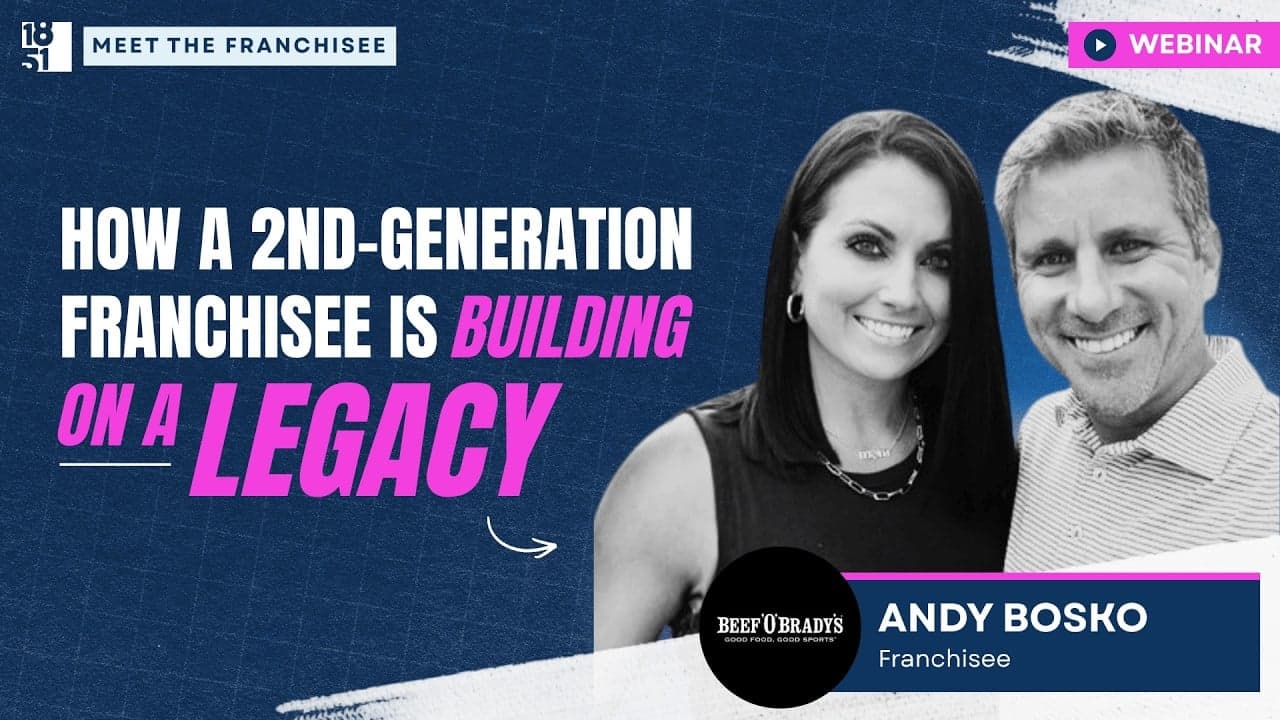
For Andy Bosko, restaurant ownership was never simply a career he selected. It was something he grew up around. Bosko was about 10 years old when his father opened his first Beef ‘O’ Brady’s in Lakeland, Florida, in 1991. Bosko remembers being there before the first wall was broken, watching the restaurant come together and eventually joining the operation himself. Over the years, he worked nearly every role possible, from washing dishes and prepping food to working as a barback and line cook.
Today, 35 years after his family first became involved with Beef ‘O’ Brady’s, Bosko is his father’s business partner and helps lead two locations.
“I went from working as just a dish boy to a prep cook to a barback to a line cook, to then a manager after college and now a business partner with my dad at two locations,” Bosko said. “It’s been a heck of a ride.”
Despite growing up in restaurants, Bosko didn’t always expect to stay in the business. As a teenager, he saw the long hours and sacrifices his parents made and initially thought ownership was not for him.
After earning a degree in business management and gaining outside experience, however, he returned to Beef ‘O’ Brady’s and has now been managing restaurants for more than 20 years. One of his biggest lessons is that successful ownership depends less on restaurant experience than on mindset.
“You’ve got to have that mentality,” Bosko said. “As a leader and as an owner, you have to have that calmness and know that you don’t freak out with everybody because then they’re all going to freak out.”
Bosko also keeps his team focused on continuous improvement. At his recently relocated South Lakeland restaurant, he hung a sign in the kitchen inspired by Notre Dame football’s “Play Like a Champion Today” message. His version reads, “Cook Like a Champion Today.”
Each week, he posts the previous week’s guest check count and challenges the team to beat it. “We’ve got goals, and that’s how you become the best version of yourself and the best restaurant, the best person, best cook, best staff member, whatever that is,” he said.
For Bosko, those goals ultimately come back to the customer. “Our mission is to make every guest become a loyal guest,” he said.
That means delivering quality food, but also creating the small moments that make a restaurant feel personal. Employees are encouraged to greet guests, make eye contact and bring extra care to each interaction.
“That extra special touch goes a long way,” Bosko said. “That’s why they keep coming back.”
That local feel is also what he believes separates Beef ‘O’ Brady’s from larger chains. Individual franchisees can reflect their communities through local sports memorabilia, schools, organizations and relationships.
For Bosko, the business today is about much more than operating restaurants. It is about continuing what his parents started. “My dream is to take over his legacy,” he said. “I want that legacy to continue on, and that is the name of the Boskos in the Lakeland community to continue another 40 years.”
That legacy may already be entering its third generation. Bosko’s 16-year-old son began working in the restaurants at 12 after asking for the opportunity, while his 13-year-old is already asking when he can start.
That approach reflects the broader lesson of the Bosko family story. Beef ‘O’ Brady’s has provided them with more than a business. It has created decades of relationships, community involvement and opportunities for multiple generations to grow.
“It makes my heart warm to know you can go anywhere and somebody’s going to say hi to you,” Bosko said. “That’s where I see me continuing the legacy.”
Bosko joined 1851 Franchise Publisher Nick Powills on a recent episode of the “Meet the Franchisee” podcast to discuss what those decades have taught him about restaurant ownership, leadership, community and building a business that can last across generations.
Nick Powills: All right, Andy. What’s your Beef ‘O’ Brady’s story?
Andy Bosko: Gosh, my Beef ‘O’ Brady’s story starts 35 years ago, back in 1991, when I was just 9 or 10 years old. My father had just started his first Beef ‘O’ Brady’s franchise in Lakeland, Florida. I was just a young kid back then. I didn’t know what I was doing. He brought the whole family in. I’m the youngest of four kids, so he brought all of us in. We got to see it from a champagne toast before the first wall was broken to it being built to what it became.
We’ve moved to our third location now in South Lakeland with that store, 35 years later. I went from working as a dish boy to a prep cook to a barback to a line cook, then to a manager after college and now a business partner with my dad at two locations. It’s been a heck of a ride, and I’ve seen a lot of different things in 35 years, if you can imagine.
Powills: Obviously, I hear legacy in this story. Your dad builds a business, and you’re now involved. I would imagine a lot of parents who decide to go into business have an extension of their dream that someday someone in their family is going to say, “Hey, can I be a part of this?”
Some people don’t have that luxury at 9 years old. Did you understand it? Were you going to school saying, “Yeah, my dad owns a sports restaurant”? Where was your head at? How long did it take you to understand not just the appeal of being a business owner, but also the management of stress that your dad had to go through while raising four kids?
Bosko: It’s funny. Back then, working as a cook at 16 or 17, I’m in high school and it’s like, “Oh, Andy, by the way, this guy didn’t show up. You’ve got to come into work.”
I’m like, “Crap, that sucks. I can’t go to the movies now with my friends.”
Going through that and then seeing what my parents went through, the amount of work and the hours they put in, I was like, “I’m not going to do this. There’s no way.” I played sports, and I thought maybe one day I’d be in sports or college or whatever. But when I got to college, I still wanted to study business because, knowing what my dad was involved in, business was a very broad degree.
So I got a degree in business management. That’s when I knew that was probably the road I was going to go down because that’s what I knew. By then, it had been more than half my life. By the time I was 25, I was like, “I’m probably going to do business.”
I tried several different companies. I learned a lot through those companies, whether it was through a small company in Winter Park or a big company in Vero Beach. I learned a lot through that and then brought it back to Beef ‘O’ Brady’s. I fell back into the family business after graduating college in 2005, and I’ve been managing ever since.
Now we’re 21 years later, and I’m still doing it. It’s kind of my story of how I didn’t think I’d be involved, but now I’m sitting here involved, running two stores, and I’m the only kid left in the family of four who is actually running the stores. It seems unreal, but my priorities are right. God’s first, family second and then the restaurant. I’ve been able to figure it out along the way.
Powills: I think there’s a bigger lesson that you learned along this pathway. It may not have hit yet, but it’s almost appreciation. You figured out the value of spending life the way you want to spend it. You get out of college, you’re able to work with your family, you’re able to continue to build something and take all the lessons that you learned figuring things out on your own.
I’m going to go morbid here, but if you think about the deathbed, you’re going to think back on the time you spent with people. You established that in your career. It doesn’t mean you’re any less busy or that you’re not working just as hard as you would have if you took another route. But the fact that you’re able to work with your family, all that time is currency, too, even if it doesn’t translate to money.
You’re achieving one of the highest values of wealth you can in life.
Bosko: What has really resonated more than anything for me is the fact that my dad is almost 80 years old and I’m 45 now. For instance, I hired a young lady two weeks ago who is 19 years old, and her mom worked for us when she was 19 years old. To see generations come through the restaurant like that, and the impact you have on the community, that’s probably hit home with me more than anything in terms of why I do what I do and the job that I have. I love seeing that.
This young lady is just so bright, such a breath of fresh air and very outgoing and personable. By day four, people were already writing comments in reviews about how they had such a great experience. That’s what’s cool about my part in this. What resonates with me is the different generations you have. I’m already second generation.
Even my grandfather, my dad’s dad, passed at 101 years old. To have that longevity and know that family history is there is great to me, too. That’s really what resonates with me.
Powills: I think this applies to everybody who decides to become a franchise owner. They look around the room and they’re working for someone else. They don’t have much control over their schedule, and they don’t have control over the time they’re spending with the people they want to spend time with. The term “work-life balance” exists because you want to give some of that balance to other people who are in your life, your community, your church or whatever it is. But when you’re able to merge the two, that’s interesting.
You were just talking about all the jobs you had when your dad still owned the business. You’re still grinding to figure this out. You’re still having to skip the movies and go into the restaurant and work. Is it the restaurant experience that makes the magic, or is it the mindset that makes the magic?
Bosko: That’s a great question. I’d say it’s more the mindset, to me, that makes the restaurant, and the grind. You’ve got to have that mentality. When everything is blowing the roof off or going loose, you’ve got to be able to stay calm. The computer goes down on a Friday night at 7:30 and no orders are ringing back to the kitchen, can you imagine? You’re doing an $1,800 hour. You have to have that mentality.
Restaurant experience has a little bit to do with that, but there are times when those kinds of things happen. As a leader and as an owner, you have to have that calmness. You can’t freak out with everybody because then they’re all going to freak out. I think that’s more important than the restaurant experience, honestly.
Powills: How do you find love for this after doing it for so long?
Bosko: For me, I find it in goals and setting goals and parameters for my staff and for the business, whether it’s revenue or labor. It’s funny, like I was saying, we just recently relocated our South location for the third time. We’re in our first freestanding building for this store.
I got a little piece of motivation from the 1980s Notre Dame college team with Lou Holtz. Going down to the stadium, they have a sign that says, “Play Like a Champion Today.” I put that sign in the kitchen for our staff, and it says, “Cook Like a Champion Today.” Then below that, I put our check count, our ticket count from last week.
We’re a new store, so I don’t want to compare it to last year because we know we’re going to be up. I’m looking at last week. Let’s beat last week. I’m looking at guest check counts. Let’s say we did 100 for lunch. The goal today is 105. If it was 100 last Wednesday or last Friday, let’s beat it.
I put that up there to remind my staff that we’ve got goals, and that’s how you become the best version of yourself and the best restaurant, the best person, the best cook, the best staff member, whatever that is. That really motivates me to do more and to have the love for it.
Also, my wife helps me out a lot and reels me back in to say, “Hey, listen, don’t forget about us. Don’t forget about church.” You can get sidetracked and go down that road of just work, work, work and grind, grind, grind because it’s a lifestyle. It’s definitely a lifestyle. If you don’t have somebody to put you in check real quick, it can get out of hand. I appreciate that from my wife, too.
Powills: I think about the customer experience and what that sign does for it. The reality is, to go from 100 to 105, what you’re ultimately saying is, “Let’s exceed the expectations of our customers so that a percentage of those customers return at a frequency that’s greater than any other business.”
I went to lunch yesterday with a coworker, and there were two things where I said, “Boy, if the restaurant industry could just back up and look at the guest for a second, they can win.” In that scenario, there was a 3.5% service charge. It’s not a big deal, but it said it was for the employee health fund. I get it. You need that. But now you’re telling the customer, “Here it goes.” Then there’s a disclaimer that says, “We’re putting that on there so we’re not raising food prices.” All right, that sounds good.
But then our server came over and said, “Do you guys want any more bread?”
We’re like, “Sure, we’ll have another piece of bread.”
He says, “One or two?”
We go, “Two.”
Now there’s an $8 charge on the bill for two pieces of bread. I was like, “Well, I’m confused by this.”
I’m using this as an example because it seems like the experience that’s happening in your kitchen, “Cook Like a Champion,” translates into the food coming out right, as I expected. Back to the guest, the guest experience is good because the team is built around, “Let’s serve the customer like a champion.” Now the customer is having a greater experience, which takes up that number.
It doesn’t seem like brain surgery to me, but it seems like we’re in this moment in the restaurant business where brands like Beef ‘O’ Brady’s end up winning because it’s not nickel-and-diming the customer. It’s creating great value and an experience that exceeds expectations. It builds customers, but it seems like nobody else gets this in the restaurant world. How does that relate to you?
Bosko: Our mission is to make every guest become a loyal guest. It starts from the caboose, from the kitchen. If they don’t put out the best food they can, you’re already behind.
Then it’s also about the server hitting those steps of service. Our motto is, if you’re within 20 feet of somebody you’ve never seen before, whether it’s someone walking in the front door or even someone walking in to clock in for the first time, it’s a simple smile and wave or, “Hey, how are you doing?”
For our staff, it’s smiling and welcoming guests in. Then they seat them, introduce themselves, share the special of the day and go into suggestive selling: “Would you like to start off with a Coke, a tea or something from the bar?” instead of, “What can I get you to drink?”
That extra special touch goes a long way. That’s what makes you want to create a different experience than any other place. That’s why they keep coming back. That’s why you want to make that regular guest a focus. That’s what hits home with me about why I made that change.
It’s funny, I had one guy on his way out the door. He put his two-week notice in and had about a week left. Somebody wrote on that message board I had with the guest count or check count, and he wrote, “Nobody cares.”
Boy, he was gone in a heartbeat. I couldn’t believe it. He went to another Beef ‘O’ Brady’s franchise probably an hour away. He moved away.
It’s sad when people are like that. Now it’s funny because I heard the other day that one of our cooks and him still text. He had said how he’s the leader and the big guy there because we were doing 180 checks a day, 250 checks a day, and they’re doing half that. It’s kind of funny now. It does resonate with him, even though he wrote that. It makes me feel good, like I did something.
Powills: No matter what your position is, from the guy who takes out the trash to the guy who owns the business, it’s not just work. It’s your approach to life.
When someone writes, “No one cares,” I look at that and think, if I’m going to have empathy in that situation, what caused that person to even get to that level? What happened to them in their life where now they’re in a business that actually does care and wants to win for them, their family and the guests, and they still feel that way? It’s sad.
I think it’s probably more visible today in a world of social media where everybody has a voice. Maybe it was more silenced in the past. Maybe it’s always been this way. But if we have fewer of those people in a restaurant or a business, the odds of our sales being higher are going to be greater.
Bosko: It’s funny, when you’re talking there, it brings back memories with this particular employee. You’re right. What struggles did they go through in life? What hurt them in the past to do such a thing?
I remember this same employee. It was Mother’s Day morning. I get out of the car and park next to him in the parking lot before we’re going to clock in at 8:00. He goes, “I hate this place.”
I’m like, “Are you seriously going to start the day off like that right now? I just got out of the car and you’re going to tell me that?”
Again, that’s him. It’s his past. I’ve tried to help the young man out, and it’s unfortunate. You’re going to have the bad apples and you’re going to have the good apples. As an owner and a manager, you have to go through the bad ones, get them out and get the good ones in, like the young lady I was talking about.
It’s every day. The saying goes, if you didn’t have to deal with the staff, your job would be so easy. It’s so true because the majority of the time, what you’re managing is 50 employees on a staff, schedules, personalities and availabilities. That’s what’s hard about it and the lifestyle.
Powills: I was thinking about this the other day. I think my mistake as a leader, and obviously I can identify things I need to work on, is that I believe I can build an organization that can solve the challenges for everybody who works at the organization.
We have 35 people. I’m going to put this as a fault of mine, but when I hear someone is unhappy or the system isn’t working for them, I think, “Maybe I could twist it this way to fix it for them.” Operationally, it almost turns into a house of cards because I’m fixing it for one person, then it slides over here and makes it uncomfortable for this person.
I talked to a franchisor yesterday on a podcast, and he said something that stuck with me. All these franchisors talk about support, how they support a franchisee. He used to be a franchisee, and he said, “It gave me guardrails so I wouldn’t screw it up.”
I was like, “Oh, that’s a different way to look at it.”
In your scenario, you have these guardrails around you. You know what the business has been built to do. You’re like, “Look, my guy, I want you to work out here, but if you hate it here, no problem. You’ve got to go somewhere else.” Versus the mentality of, “All right, I have empathy for that person. How do I make the shift?” That actually gives you a benefit in franchising.
Bosko: I looked at Chick-fil-A. They have a different model. I looked into it before I bought my own location back in 2019. I had bought a Davenport location from another generational owner previously, and I have since closed that store location six years later because of a lease issue. The landlord went up 55% on my rent, so it kind of forced me out, which sucked. It put my hands behind my back.
But I was still running the Lakeland locations at the time and had my own at Davenport. What I mean is the support of the corporate office. When you’re in a franchise, there is a corporate office, but the support they’ve given me and my family over the years is important.
I’ve known some staff members at the corporate office for 15 or 20 years. They don’t look at you just like a number, like you probably would in a Subway when there are thousands of them, or McDonald’s. That’s the big difference for me.
Not only is Beef ‘O’ Brady’s a family-style restaurant, it’s not your typical chain restaurant. It’s also supported by family people who help out the best way they can. It makes a big difference.
Powills: I want to shift over into the magic of Beef ‘O’ Brady’s. I can look at it from a business standpoint. I have the benefit of having done some sort of work with Beef ‘O’ Brady’s for 20 years. I can look at it and see the magic of the community, which then turns into the numbers.
But it’s interesting because if you said, let’s take a hot brand like Dave’s Hot Chicken versus a Beef ‘O’ Brady’s, you’d say, “Oh, Dave’s Hot Chicken is exploding.” If I put them side by side, I’m like, “I don’t know that it’s performing as well as Beef’s is based on the investment, the return and the impact to the community.”
I look at these things and think Beef ‘O’ Brady’s should be as big as it wants to be because it has all these foundational elements. It’s almost like the best-kept secret in today’s world. There’s magic happening within these four walls. As you look at the business, what do you see as the magic? Why does this restaurant actually work better than others in the communities you serve?
Bosko: I would say first and foremost, it’s because we’re all individually owned. We have our own particular style, whether it’s the style of the restaurant, our work ethic or our leadership. That’s what makes us unique, I think, at Beef ‘O’ Brady’s, and that’s what makes it so appealing and enticing.
Then, behind the scenes, there are the people working at the corporate office, whether it’s getting prices down on food or using buying power. It might be different if you have 1,000 units versus 200, I get it. But those people are working hard to get us the best prices possible so we can make money as franchisees. Again, that same person might have been working there for 20 years. We know she’s going to do a good job. That’s a big difference for me.
Then there’s the fact that it’s not a chain restaurant. It’s a family restaurant. You go into a Beef ‘O’ Brady’s, and it’s sports. There are TVs everywhere, memorabilia everywhere and things about the community on the walls. It could be local sports teams, churches or organizations. You could even have employees of the month on the wall. They highlight the employees and staff.
Those are things that are different. You don’t see that at a Chili’s, Applebee’s or Outback. You don’t get that nostalgia. I think that’s what sets us apart.
Powills: Obviously, with your family story, it hits that mark of building legacy within your own family. But it also connects the dots. The closest you probably get elsewhere is a high-end steakhouse that takes care of you in a hospitality way that makes you feel good no matter what day it is, where every occasion is a celebration. Then you have diners that feel local, where they care about you from a server-to-customer standpoint. But “family restaurant” is such a good term. I’m going to steal that.
At what point does your dad’s dream transition to your dream? In your story, when did that start happening? What is the dream now for you as a business owner and what you’re doing with the business?
Bosko: Obviously, my dream is to take over his legacy. I see where it’s gotten my family, my original family, my brother, sisters, mom and dad, and what it’s done in the community. I want that legacy to continue. I want the name of the Boskos in the Lakeland community to continue for another 40 years. That’s the dream I see.
The relationships we’ve gotten over the years are huge to me. It makes my heart warm to know you can go anywhere and somebody is going to say hi to you. Usually, it’s always great feedback, whether it’s about Mom or Dad, the restaurant, my kids or my golf game, whatever it is. That’s where I see myself continuing the legacy. Not to get dark, like you said, but once they pass away, that tradition continues and I stay focused on that.
My kids now are 16 and 13. My 16-year-old works for us at the restaurant. He started at 12 years old. He actually asked us. I never forced him. He said, “Hey, can I work in the restaurant?”
I had him work at another location we have on the north side of town because I didn’t want to be too forceful on him. Again, it’s hard to draw that line between, “Now I’m your boss,” and, “I’m your dad.” It is tough and difficult in the family business. We’ve struggled with that, even my dad and I.
So I put him at the other store. I had a general manager look over him and guide him, and it did him good. He’s got a great work ethic and a great background from my wife and me. They loved him there. Now he’s at the new location that we relocated six months ago, and he’s killing it. Everybody loves him there. He’s just a workhorse.
But he says to me now, “I want to start looking for another job.”
I’m like, “You’re more than welcome to. I want you to. You’ve got to experience that. Go get interviews. Experience that stuff.” I’m trying to guide him and show him the way on that.
Then my 13-year-old is like, “When can I work, Dad? When can I start working?” At the grand opening of the new location, he came and helped out. He had a Beef ‘O’ Brady’s shirt on and was bussing tables. It’s cute to see because that’s what’s so cool to me.
Again, it’s a full-circle moment. I have a picture of my son at 12 years old, who’s now 16, in front of the front door at the other location. It melted my heart to see that he was now working there.
I remember him coming home saying, “I got 50 bucks, Dad. I got a $50 tip.” Someone sees a 12-year-old kid sitting there working and asks, “Who’s this kid?”
“Oh, that’s the owner’s son.”
They slip him $50. That’s what it’s about. It makes that kid smile and makes his day, and it makes my day, too. That’s the legacy I want to continue.
Will my kids do it one day? I don’t really care. I always push them. I don’t necessarily want them to because I know what I go through, and I know what my mom and dad have gone through. I hope and dream and wish for them that they become pro athletes because they’re both really good athletes, and my wife and I were athletes, too. That’s what we’re pushing for, but you know how that goes. It’s still hard out there.
But that’s kind of my wrap-up for Beef ‘O’ Brady’s and the legacy that I continue for my family. I look forward to it.
Powills: I did a podcast with your dad, and I said, “This is going to sound really crazy.” I met him at my first Beef ‘O’ Brady’s conference. I was doing PR for another agency a long time ago. That was over 20 years ago. For me to talk with you, I’m flashing back to the first time I talked with him because he’s obviously been a larger-than-life presence in the Beef ‘O’ Brady’s community for a very long time. It’s cool because I can see how the story continues.
But it’s also about really appreciating the moments. You just talked about a photo of your 12-year-old, who’s now 16 and talking about getting other jobs. This thing goes very fast. If you don’t take a moment to smell the flowers, you miss out on some of the best joys.
That’s what I was saying earlier. Currency comes in the form of cash, but currency also comes in the form of love and loving what you’re doing. It’s really cool to see how your family has built a legacy.
That “family restaurant” statement you said really hits it. The Boskos are continuing the Bosko legacy. This is a brand, and this is not a dig on Dave’s Hot Chicken, but I don’t think “Bosko’s Hot Chicken” is going to be part of their model. It just doesn’t fit in the DNA. Whereas at Beef ‘O’ Brady’s, if we’re looking for that one inch of difference in a crowded marketplace where people have a million places to go and get food, just the fact that customers know this is one of your restaurants, that you care about them as a customer and that you’re part of the community they’re part of, I think that makes a big difference. It creates a very unique look into why you would want to look at a Beef ‘O’ Brady’s.
Similar to what I said to your dad, I’m grateful for you giving me all this time. I look forward to seeing where it goes. Hopefully, I don’t have to talk to you again in another 20 years because then both you and I will be 65. Let’s slow that down a little bit.
Bosko: Amen to that.
Watch the full webinar here.
To find out more information on costs to buy this franchise, please visit https://1851franchise.com/beefobradys.