Franchisor Stories
SPONSORED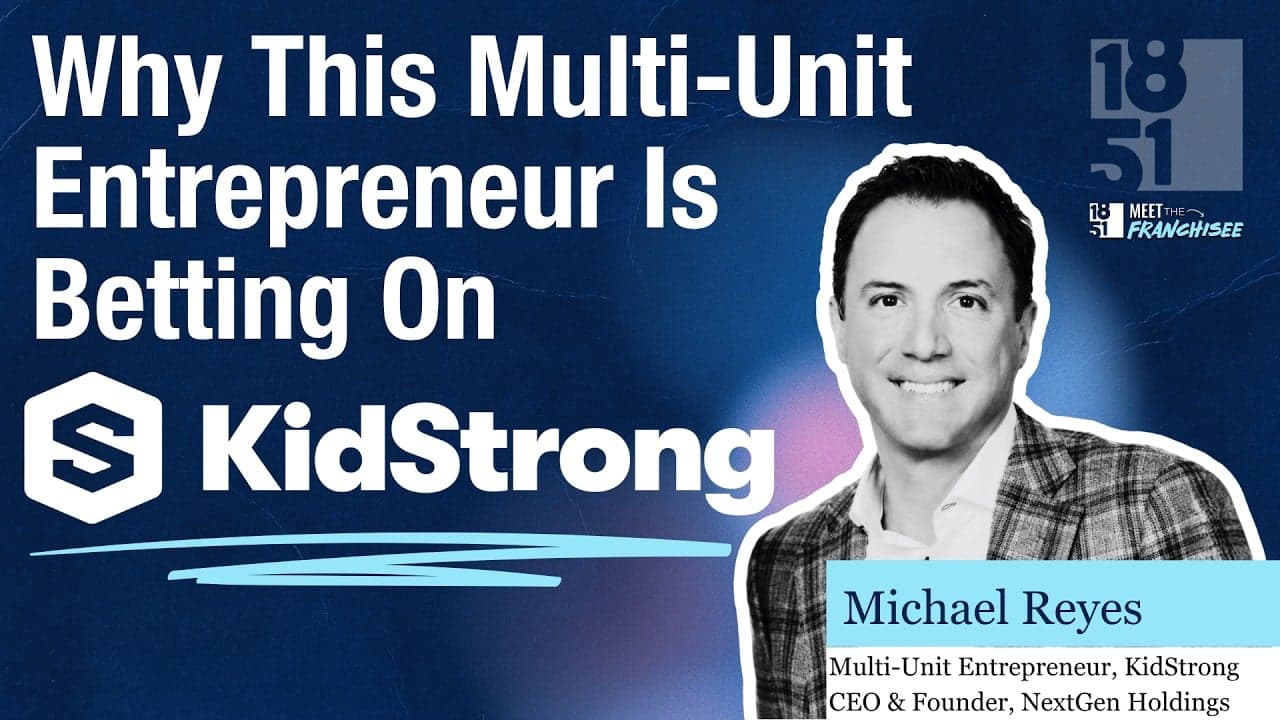
Why This Multi-Unit Entrepreneur Is Betting on KidStrong
Mike Reyes is drawing on two decades of leadership, franchise growth and real estate experience as he works toward a 50-unit KidStrong footprint.
Franchisor Stories
SPONSOREDMike Reyes is drawing on two decades of leadership, franchise growth and real estate experience as he works toward a 50-unit KidStrong footprint.
Mike Reyes has never been interested in dabbling. The founder of NextGen Holdings spent 20 years building his career with Aflac before becoming a multi-unit Orangetheory Fitness franchisee and developing a real estate portfolio. Today, he is applying those lessons to KidStrong, where his organization is rapidly expanding across multiple markets.
“I’ve always been wired to go big or go home,” Reyes said. “I was never a dabbling guy. If I’m going to do something, I’m going to do it 100%.”
Reyes’ entrepreneurial education began long before KidStrong. At 22, he joined Aflac as a 1099 associate, selling business-to-business and eventually building teams as he moved from district manager to regional manager, state sales coordinator and market director.
“I cut my teeth growing and mentoring and developing people at a young age,” Reyes said. “I always knew that I wanted to work for myself, that I wanted to be in control of my career.”
In 2014, Reyes began looking for another investment vehicle and discovered Orangetheory Fitness. He and a partner initially signed for four units and ultimately opened eight stores in roughly five and a half years. The experience showed Reyes how skills he had developed in insurance, including sales, leadership, hiring and market development, could translate directly to franchising.
But it also reinforced another lesson: Passion matters. “It’s 90%. It’s your purpose. It’s your story,” Reyes said. “It’s what you’re all about. It’s why you get up in the morning.”
That connection to health and wellness would eventually lead him to KidStrong. Reyes was introduced to KidStrong by another area developer who had also been involved with Orangetheory. At the time, KidStrong had only about 25 to 30 centers open.
Rather than immediately jumping in, Reyes spent roughly three months vetting the opportunity. He reviewed the FDD, spoke with franchisees and spent time with KidStrong leadership.
“I didn’t need to be sold. I just needed the facts,” Reyes said. “The devil’s in the details.”
That process convinced him the underlying model worked when franchisees executed the playbook properly. It also helped that KidStrong’s mission aligned with his own life. Reyes has three sons, coaches youth sports and believes strongly in child development and enrichment.
He initially purchased four licenses on Long Island. Nearly five years later, NextGen has grown to 20 open and operating centers, according to Reyes, with plans to open another 10 next year and continue toward a roughly 50-unit development commitment.
“It starts like every other entrepreneur,” Reyes said. “It starts with one and a vision and a whiteboard, and then you just go to work.”
As NextGen has expanded, that has meant building a leadership team and ensuring KidStrong’s mission remains consistent across locations. For Reyes, that mission is not an afterthought. His team regularly discusses how many children they are serving, how many students are progressing through the program and the feedback families are providing.
“Everything is about team,” he said. “If you don’t have the right people in the right seats and empower them to be a part of the growth strategy, you can’t do it on your own. It just takes a village.”
For Reyes, that disciplined approach has helped turn an initial four-unit KidStrong investment into a much larger growth platform. And despite already reaching 20 operating centers, he believes NextGen is still near the beginning.
“I am hyper-focused and diligent on the growth of the platform and the brand,” Reyes said. “I’m excited to take this awesome brand to communities all over the country.”
Reyes joined 1851 Franchise Publisher Nick Powills on a recent episode of the “Meet the Franchisee” podcast to discuss how he evaluates franchise opportunities, why he believes KidStrong has significant runway ahead and what entrepreneurs need to understand before trying to scale.
Nick Powills: I don’t know if anyone’s given you this label before, Mike, but it seems like you’re the guy who makes safe, smart bets because you’ve done it now multiple times. You can get it right once, but to do it twice, that means there’s some skill set to that, right?
Mike Reyes: Yeah, a little bit of that, serendipity, luck and timing, but sure.
Powills: Go back to the first time you decide to make an investment in a franchise. I assume the first one was Orangetheory, right?
Reyes: Correct.
Powills: What was the trigger? That was relatively early stage in the brand. They had a little bit of success at that point, but not to the level of where it ended up. What even got you into franchising? Why did you pick franchising as an investment platform?
Reyes: I’ve always been an entrepreneur my whole life. I started with Aflac at 22 as a 1099 Aflac associate and built insurance agencies as a 1099. It’s the only thing I knew. I cut my teeth growing, mentoring and developing people at a young age. I always knew I wanted to work for myself and that I wanted to be in control of my career. I had a great run for 20 years at Aflac, but along the way, I realized I wanted to diversify and have a couple of other vehicles to invest in. I was always actively investing in the stock market and buying real estate.
In 2014, at that point, I was about 12 years into Aflac. I realized that I wanted to pursue something else, a side hustle, if you will. I was approached by another Aflac individual who became my partner, and we looked at Orangetheory. At that point, Orangetheory was kind of in the middle innings of its brand growth, maybe store 450 or 500 of roughly 1,200 today.
I jumped on board. I took my first Orangetheory class here in Fairfield, Connecticut, and fell in love with the concept. I’m a health and wellness guy myself. I like to work out a lot.
But it was still very early. Most people thought we were Orange Therapy or Orange Julius. The brand recognition really wasn’t there yet, especially here in Connecticut.
My partner and I met with the area developer, and we had a conversation about buying a four-pack up in Central Connecticut.
I said, “Hey, I think this is it.”
You never know until you get into the business. We ended up opening eight stores in about five and a half years. Then COVID impacted everybody. That was my first foray into franchising.
But building insurance agencies at Aflac was very similar in terms of people, structure, leadership, commissions, how we invest money back into the business, how we grow people, how we grow into markets and how we sell.
There were a lot of parallels between the two. When Aflac had low brand recognition, before the duck campaign hit the market, that eventually exploded. I’ve been a part of three amazing brand stories and growth stories now. That’s how I got started and how I jumped into Orangetheory. It was the best decision I ever made, getting into franchising.
Powills: A few things I want to unpack. One is the comparison to someone who’s at Aflac. The reality is it’s set up where you eat what you kill.
Reyes: Yeah. Truly.
Powills: What that trained you for, at least from a mindset standpoint, is that you’re looking at what you were able to do at Aflac and looking at Orangetheory and saying, “All right, I see the white space. I see where the opportunity is. I know whatever money lands in my pocket is going to be due to the way I approach this from a hustle standpoint.”
That probably makes you look at marketing differently, hiring differently and real estate differently.
Looking back, Aflac ends up being your MBA in how to be a good franchisee, right?
Reyes: At 22 years old, I was out of college, got my insurance license, went business-to-business and closed a ton of accounts. I wrote a ton of premium, and I built teams from district manager to regional manager to state sales coordinator and then to market director. In those 20 years, I learned from some of the best people in the business. I had a seat next to Dan Amos, the CEO of Aflac, and I was learning from people along the way.
But I didn’t realize that what I was learning was going to be so applicable to franchising, or really any business. When I became a market director in 2014 and then became a W-2 employee, I rode that out, and that’s when I knew my road was over at Aflac. I wanted to break back into being an owner, being in control and being as entrepreneurial as I could because I like to innovate, create, influence people and build platforms.
That road ran out. But along the way, I learned so much about entrepreneurial sales, leadership, how to build teams correctly and how to motivate and incentivize them. I apply a lot of those strategies and tactics in my franchise businesses today.
Powills: I’m going to make an assumption with this statement, but your passion for insurance is different than your passion for wellness and fitness. If you’re looking at the map of earning potential in your career, you’re maximizing at Aflac, but now you’ve added something where you say, “I’m passionate about taking care of myself and obviously taking care of other people through this model.”
What percentage difference does that make now that you’ve attached passion back to the financial side?
Reyes: It’s 90%. It’s your purpose. It’s your story. It’s what you’re all about. It’s why you get up in the morning, right? Insurance, fitness and KidStrong are really about how you have an impact on people. Whatever they’re looking to accomplish, how do I influence change? How do I make somebody’s life better?
With insurance, we paid a lot of claims to people who got hurt and sick. We were on the risk mitigation side.
With Orangetheory, it was about staying healthy and fit because you can prevent illness and claims. I understood what happens if you don’t take care of yourself. I understood what happens to people because I paid out millions of dollars in claims.
There were some sad stories, but it kept people’s lives together. Then on the fitness side, I realized, wow, if we can be proactive on the health and wellness front, we can probably eliminate a lot of issues people are having around diseases, disorders and other things going on in their lives.
It’s about being more conscientious about what we’re putting into our bodies and how we’re moving our bodies. I realized that was the side of the world I wanted to be on, proactive and preventative, versus selling insurance and paying claims. But insurance is a safety net. It helps people. I think about how I can impact people and how I can apply our concepts and how we’re building the brand to better people’s lives, however that may look.
Powills: I’ll get to my question, but I’m going to make a statement. Clearly, Aflac built the infrastructure of who you are as a person, how you address your career, your work ethic, hustle, grit, all of the above. Now you’re going to plant that into an investment where you become a franchise owner.
You sign a four-unit agreement. When I’m advising franchisors and franchisees, I usually say buy one, have enough money for a rainy day and enough to scale. When you’re qualifying your investment, you need to look at something you can buy at least three of. You and your partner qualified to buy four, but that’s still a giant fee to swallow up four off the bat.
Are you looking at it as protection? Are you looking at scale? Before you open unit one, how are you even addressing how large of a footprint you want to commit to?
Reyes: I’ve always been wired to go big or go home. I was never a dabbling guy. If I’m going to do something, I’m going to do it 100%.
I want to acquire as much white space and opportunity as I can if I believe in the brand, the growth of the brand and the senior leadership, and if the KPIs are marrying up with what the financial upside can be. Then I want to try to monetize that over and over and over.
But you have to start with one. If one goes well, you move on to two. I always use a lens of the small picture, the medium picture and the larger picture. Where am I today? All right, I’m going to buy three. Let’s go out there and open three and really knock it out of the park. Do a great job from an execution perspective on operations, how we measure and manage our members, how we monetize and how much of those dollars can be put into future growth.
Then you stagger the growth. Most franchises want to open 20 tomorrow. The reality is you can’t scale that quickly. You have to have a progression, and you have to be able to replicate success and take a blueprint, a proven playbook that a franchisor develops, and go out there and run the play and execute.
I can want to get to 20-plus units or 40 units, but if I’m not willing to execute the basics of the business, follow what’s been proven, replicate that and rinse and repeat it over and over again, there’s no way you’re going to scale.
Then you become fragmented, you have broken processes, and you’re setting yourself up for failure. You have to get it right on the first couple.
That’s the springboard to, “All right, how do I go into other markets? How do I really grow with a qualitative and quantitative approach?” I look at it both ways. There’s the quality, and then there’s the growth plan for the next couple years to attack markets where I feel like the brand can have success.
Powills: You’ve twice landed with franchisors that clearly set expectations properly. A general issue I have with franchising, and I’m going to oversimplify this, is that if I couldn’t take every dollar out of my business and pay back my initial investment in four years, then I’m in a hobby business. If it’s before four years, I’m in a business that can scale.
But so many franchisors manipulate Item 19 to tell a story. The franchisee comes in saying, “I’m going to be a millionaire,” and then says, “Well, I just made $800,000,” and they’re upset.
They could sign a 10-unit deal. They could sign a billion-unit deal. It doesn’t matter. It stalls out because expectations didn’t align with reality. You landed in Orangetheory, a business that said, “Here are the expectations. Here’s what you should do.”
You do it with KidStrong, probably with Aflac to some degree. The exercise in scaling is just an exercise in math. You said 90% for you is the passion piece, but the widget almost becomes irrelevant once you understand the math equation of what is good business and what is scalable business, right?
Reyes: Yeah. You said it perfectly. Too often, we want to reinvent the wheel. I will say that with KidStrong, from the beginning, my first conversation with Matt Sharp, he was brutally honest about the day in the life of being an area developer and an owner at KidStrong. It was all positive, but he said, “If you can’t perform or you can’t meet the commitment of being an owner-operator, we don’t want absentee owners. We don’t want investors. We want people who are really invested in the vision and where KidStrong is going because we are a purpose brand.”
If that doesn’t fit you, you’re not the right fit. To me, that was really important. I have three boys. I’m a coach myself. I believe in youth enrichment and child development. To your point, you can go out there and blaze the market and open one, 10, five or 50, but if you’re not willing to take the passion and drive it through the mission of what has to get done to be successful, it’s not going to work.
You always keep that purpose front and center with yourself and your people. We just had a big kickoff call, and I always remind them how many students we impact every day, how many new students are coming in, how many kids are ranking up, the goals and the feedback we’re getting from members about the success they’re having at KidStrong.
That message has to continue to be echoed. For me, it fuels me to want to go open more, and it fuels me because what we’re doing is working. The operating plan the franchisor is giving us does work. But you have to keep rinsing and repeating it. You don’t have to deviate from it. It gets hard because once you scale, you have so many layers and so much infrastructure and so many people that the game of telephone becomes part of the problem.
You have to keep messaging the growth strategy, the development plan, why we’re doing what we’re doing and who the right people are in the right seats to help us get to those next levels of growth, whether it’s an open store or a de novo new store opening.
For me, I have to continue to be a part of that segment that we’re trying to create to scale. My team gets that pretty well.
Powills: I like your line about the middle innings. That’s where you found Orangetheory. I assume that’s the way you’re looking at KidStrong, too. That’s probably the perfect time if you want to buy into a franchise because a franchisor is funded enough to support the franchisees with technology, infrastructure and an understanding of membership acquisition.
At the same time, there’s enough white space for it to be valuable to you so you can actually scale the business. How do you even find KidStrong in the middle innings and think there could be another Orangetheory? The way KidStrong is engineered, it seems like there could be.
Reyes: We’re early innings. We’re probably second or third inning. We have so much more runway, and the growth plan is outrageous. Our franchisor is on fire right now. We’re super excited for all the latest and greatest things we’re getting from them. I was introduced to KidStrong by another area developer who was looking at KidStrong. They were at Orangetheory. There was a big contingent of Orangetheory owners who went to KidStrong early. I’m always listening to investment opportunities.
After rebuilding the insurance business and rebuilding Orangetheory, I said, “All right, I’m at this inflection point in my life. I’m looking to leave Aflac to take the leap fully into doing something on my own and building the business from the ground up the way I envisioned it.”
I had this great call and said, “Oh my God, that sounds amazing. KidStrong, the brand sounds cool.” I’m a coach. I’m an active dad. I have three boys. We throw so much money at our kids’ sports and training. It’s crazy. I said, “Wow, that’s a great industry. That’s a great market, and it’s going to continue to grow.” I had that call, reached out to the franchisor, and back then, I think we had 25 or 30 stores open in the system.
Talk about super early. That was late 2021 or 2022. I had my discovery call with Matt Sharp, the owner, and connected the dots. I did probably three months of vetting with them just to make sure it was the right opportunity for me. I looked at their FDD, spoke to other franchisees and tried to understand what great looked like if I came into the system.
Then I had to pivot to the best market that was still available, which was Long Island, New York. Fairfield had just sold. My backyard was sold. I was frustrated, but things happen for a reason. I ended up buying four licenses on the North Shore of Long Island.
That’s turned into, now almost five years later, 20 stores open and operational in New York, Westchester County, Central Connecticut, all of New England, the Boston area and Charlotte.
There’s another opportunity coming. We’ll open 10 next year, and we’ll hit our 50-unit development deal probably in the next three years with some accelerated growth partners to help us get there. It starts like every other entrepreneur. It starts with one, a vision and a whiteboard. Then you just go to work.
Powills: You also have to have the ability to be unemotional about the initial money that comes in, right? You have to look at it and say, “How do I continue to plant enough seeds that eventually...” I usually say somewhere between five and seven units, one starts dropping money to the bottom line and you get to make a decision. Do I keep that, or do I keep scaling? You have to be unemotional about the financial component in order to do that.
But if you go back to the Mike who’s buying into Orangetheory and opening unit one and say, “You’re going to be on your pathway to 50 units of a children’s wellness franchise,” what would Mike have said?
Reyes: I wouldn’t be surprised. That’s who I am. I always wanted something bigger and more. I’m a visionary. I’m always thinking, “What can I do differently? How can I impact myself and people around me?” I knew that if I bought the four, I would get to 20 and beyond. But I had to go prove myself. I knew my team and I were good operators, but KidStrong didn’t know that yet. You can have interviews and conversations. Sometimes a franchisor brings in developers who don’t want to develop or just don’t have the experience. They don’t know until you actually get into the weeds.
For me, once I could grab this opportunity, I knew I was going to go. Keep in mind, I have a pretty big real estate portfolio of a couple hundred units. That throws off a lot of passive income. I had the Orangetheory money coming in. I had some Aflac money. So I planned to make a big bet, a big play here with KidStrong.
I was going all in on this brand because I was very confident it was a great growth engine. At the same time, I bet that the franchisor was going to get a lot of things right in the future. So far, that bet has paid off. There was a lot of pain in the beginning.
Any time you’re a 1.0 franchisor, you’re always going to go through some bumps and bruises and ebbs and flows. But we all persevered as an area developer group to help the franchisor and ourselves get better every single day. We challenged ourselves. A lot of what we’ve created has come from the field, from us. With collaboration, it becomes best practice. It becomes part of the system.
That’s been really cool to be part of that story as well. I always wanted to do something really big on my own with a team. It’s that “I, we, they” model. I’ve done it. We do it. Now they’re kind of running the day-to-day.
It’s great to see the maturation of NextGen Holdings as far as where we are today and where we’re going in the next couple years.
Powills: You said something that I think is important, and this probably goes back to the whole vetting process. You said, “I’m a visionary.” Typically, if you say, “I’m a visionary,” a franchisor would say, “Rejected. We don’t need any visionaries. We’re the visionary.” But what I just heard is a franchisor that respects the visionary.
Am I hearing that right? If they don’t respect that, then they wouldn’t be able to tap into your genius. Why would a franchisor not tap into the geniuses around them to make the business better? It seems like they’re allowing you to hit that part of what’s important to you as an operator.
Reyes: Yeah. If we’re all low ego, meaning we just want to get it right, then Matt has always talked about, “Best idea wins.” If you bring an idea and we can test it, improve it and prove the concept, then we can scale it. It’s good for everybody. A high tide raises all boats.
I think there’s a contingent of area developers who have second- or third-generation franchise experience, who have been there, done it and seen it. They can bring their experience and their toolset and say, “Hey, there are some parallels between what we’re doing here and what I did over there. Can we bring that sales concept here? Can we bring that programming idea here?”
Then we flesh that stuff out through the FAC and committees and roll it out. I think that’s been their attitude from the beginning. Obviously, it’s the franchisor’s baby. It’s their business. But I applaud Matt and Megan and the HQ team because now they’ve brought in some of the brightest and smartest people we know who are leading the charge.
They’re still very involved, but they’re letting those assets go out there and help us execute the concepts we’re trying with them to make the brand even stronger for that next level of growth.
That’s the key thing. They could have stifled us and said, “Hey, just go do this because it works.” But if it’s not working, can we make it better? If it’s broken, we need to kill it and reintroduce a completely different initiative or strategy around acquisition, four-wall experience or unit economics. There are a million different examples.
But they’ve been very open to listening and then applying what we feel is going to be not just what’s great for Mike Reyes and NextGen Holdings, but what’s good for the entire system. How do we get everybody to win? Because in the end, we all win if every franchisee is succeeding.
Powills: In those 90 days when you’re doing your due diligence, what could you have heard that would have made you walk away? What were you expecting to hear that would have said no? What red flag were you looking for that you didn’t find?
Reyes: That’s a good question. I would say if I didn’t have the face time with Matt Sharp. He really invested early in who was coming into the system. To have face time with him, or even just a casual conversation, and get into the mind of the creator and the brand builder was really important. You’re investing a lot of money into the franchisor and the partnership. You expect reciprocation. Is this real? Is it a fad? Then there was the data, the industry numbers and what they were doing down in Frisco and at other centers. I was able to call area developers and say, “Hey, how’s your experience? Will you share some baseline numbers with me?” You reach out to the ones who are winning and then talk to the ones who aren’t. You try to draw a correlation as to why. Then you say, “All right, I would have done it differently. That’s why they’re not succeeding.” It’s not the brand. It’s not the playbook. It’s execution or not operating properly.
For me, Matt was very candid. Sometimes when you almost talk somebody out of something because you’re brutally honest, that’s more credible. It wasn’t a big sales job. I didn’t need to be sold. I just needed the facts. The devil is in the details. He was very honest with me. I did my Discovery Day. I flew down, met him and the senior leadership at the time, along with some other area developers who were like-minded. I said, “All right, I think there’s something here.”
But it’s a bet. Nobody has a crystal ball. It could be a different story. I could not be on this call today because things were going in the wrong direction. But clearly, we’re exploding right now. It was a good experience early on for me.
Powills: I’m going to end with this question because it’s been top of mind for me. I have two boys. I started our business, and I think a lot about, one, how do they view this? What do they look at as our success? Are they proud? Then, what do they want to do with their lives that we can impact? You obviously have three kids who are going through the same thing. Has it started turning at all toward legacy? Are you thinking about them in that light? Has that hit you as a person, as a leader and as a dad?
Reyes: In terms of their future with the brand or just their development as kids?
Powills: Their future with what you’ve done in business because you’ve accomplished a lot. Are they looking at you and saying, “Boy, my dad is awesome at business,” or are they looking at it as, “My dad is awesome at playing sports with me”?
Reyes: It’s funny because I do work from home a lot, but I’m on the road, too. There’s a balance there. I think they’ve learned through observation. I’m having conversations about, “What does Daddy do? You’re an owner. What does that really mean?” I really try to share with them stories about my journey, the grind, the failures as much as the successes.
I’ve always said that if you have more failures on the ledger than successes, you’ve got to try something different. But if you have more successes than failures, you’re doing well because you’re not always going to win. I think they see how well we’re doing. But I really try to normalize the conversation and explain to them the fundamentals of just being a business owner and what that means.
My oldest wants to be an entrepreneur. He wants to major in business and get involved in franchising or real estate. They hear me on calls. We have conversations.
I’m dropping seeds along the way when we’re chatting in the car or they have a question about KidStrong or our real estate because they see me pivoting sometimes. But 99% of my time is focused on the development of KidStrong. And 100% of the time is focused on, “How can I make my kids win at life?” Because that’s our brand story, helping kids win and building confidence. Not just within the four walls at KidStrong, but in the classroom, on the field and out in public.
I think that’s such a missing part today, Nick. Kids’ confidence isn’t always there. They’re on technology and platforms and social media too much. They need to disconnect, get into a center and feel what we’re doing from a programming perspective, how great our coaches are and the results and goals we’re achieving for those students who are coming in each and every week.
It’s powerful. That’s why I’m staying in. I know I can impact thousands of families every day by bringing this product to other markets. My kids see that firsthand for sure.
Powills: There’s the passion piece. Eventually, you’re going to put Aflac out of business, too, because you’re just going to make everybody so healthy that we don’t need insurance anymore. That’s going to be the story. But seriously, it’s awesome. The way I think about it, I’ve had plenty of success. What I don’t want my kids to see is just the vacations. I want them to understand that Michael Jordan got cut from his basketball team and that there’s value in the chip on your shoulder.
Don’t just expect things to come. Work hard. Fail. Learn from those failures. Get back up after you bruise your knee. I think that’s the hardest thing for people like you and me who are surrounded by a level of success when there are young minds around. How do you continue to show them that there is tremendous value in grit and hustle that comes from those bruises?
Reyes: That’s the tip of the iceberg, right? This is what they see. Most people see success, money, accolades and recognition. They don’t see underneath the water. They don’t see the pain, the sleepless nights, the big decisions, the risk mitigation, the modeling and the pounding of the table saying, “We’re not going to fail. We’re going to figure this out.”
You figure it out because you build a team. Everything is about team. If you don’t have the right people in the right seats, and if you’re not empowering them to be part of the growth strategy and the things that have to get done that are critical to the business, and giving them the right tools, you can’t do it on your own.
It takes a village. Your kids see that, but they don’t always see who comes in and out of your life from a business perspective. My kids are like, “Who are you talking to now?” I say, “That is my chief operating officer. That is my head of marketing analytics.” These people are pillars to my business, and I need to have conversations with them. It’s everything underneath that people don’t see. Honestly, the journey is more rewarding than holding the trophy and saying, “I’ve won.” That’s where you build calluses. That’s where you build the ability to bounce back and help your teams in ways you didn’t think you could.
But you find a way to do it because you know there is light at the end of the tunnel for most entrepreneurs. You just have to keep putting one foot in front of the other. One other thing I wanted to mention, and I know we have to wrap up soon, that I think is important for listeners with early franchising is the marketing and the demographics. You really have to own the marketing. You have to own the site selection. You have to really understand where your customer is, where they’re coming from, because once you anchor down your store, that’s 10 years.
Sometimes franchisees are so quick to want to open their first store or their 10th store, and they rush through lease negotiations. But if the demographics aren’t right, you have a problem. The data points you in the direction. At that point, it’s literally paint by numbers, and then you just go execute the playbooks and have a really great team.
But if the franchisor didn’t provide me with the right marketing analytics, the segmented data, the SAMs and TAMs, where the kid counts are and who our competitors are, that is by far the most important part of vetting. You need to make sure you have the right information to go put down your first unit and have success.
Because if you crush number one, you’re going to move fast on two. But if you don’t do well on your first unit, you’re probably not developing for a while. The marketing tells you everything.
Powills: I love that advice. I had a prospective client recently where I said, “I can’t help you.” They were more focused on getting doors open than protecting franchisees. All the advice you just gave is tremendous advice. Most franchisees don’t have the experience to actually understand all of it. The franchisor should be listening to your advice and saying, “Let’s protect the franchisee by being really thoughtful about where you put the unit.”
Reyes: If you’re in the business of selling and just getting doors open, you’re not truly invested in the success of a franchisee.
Powills: I couldn’t agree with you more. I’m grateful for your story. I look forward to seeing when you strike it right for the third time, whatever that brand is. Maybe it’s senior wellness.
Reyes: We’ll see.
Powills: They don’t stay customers that long, so that’s probably not the right one. We have to figure out even younger. But wherever you go, I’m going to watch.
Reyes: I appreciate it, Nick. I’ve got to get to 20 units by the end of the year. I’ve got to get to 50-plus, 60 units in the next few years. I am hyper-focused and diligent on the growth of the platform and the brand. I’m excited to take this awesome brand to communities all over the country. We’re coming. If we’re not there in your community and anybody listening has kids, soon enough we’ll have a KidStrong in your backyard.
Powills: Well, if you’re listening, Mike just said he’s going to go buy your territory before you do. If you want to do it, stop sitting on the fence. Get off and buy it, or else Mike’s coming for you. Go develop. It works. Mike, thanks for doing this. I love sharing these stories. Thank you for sharing yours. This was awesome. I really appreciate you.
Reyes: Thanks, Nick. That was a lot of fun. Appreciate it.
Watch the full webinar here.
To find out more information on costs to buy this franchise, please visit https://1851franchise.com/kidstrong.
Sign up for the 1851 Franchise newsletter to get our biggest stories before everyone else
By signing up, you agree to our user agreement (including class action waiver and arbitration provisions), and acknowledge our privacy policy.