Franchisor Stories
CUPBOP Builds Its Franchise Growth Strategy on a Decade of Operating Experience
The Korean barbecue brand spent years growing company-owned restaurants before opening its system to multiunit franchisees.
Franchisor Stories
The Korean barbecue brand spent years growing company-owned restaurants before opening its system to multiunit franchisees.
Cupbop has spent more than a decade operating and expanding its restaurant model before making franchising a larger part of its growth strategy. The Korean barbecue concept now has 72 U.S. locations, along with a significant international presence, and is beginning to add new multiunit franchisees. That operating history has also given the company time to address the infrastructure needed to support expansion.
“We bootstrapped our brand from a food truck to essentially 40 corporate stores on our own, which is a testament that we know the brand works because, all along the way, we were building our own stores,” said Dok Kwon, president and chief operating officer of Cupbop.
The brand started as a Utah food truck in 2013 and later built much of its domestic footprint through company-owned restaurants. Cupbop only began talking with new franchisees last year, and Kwon said the company has deliberately focused on experienced multiunit food operators rather than selling individual units as quickly as possible.
“Our franchise journey has been 100% inbound, only multiunits between three and five units,” Kwon said. “We vet them very rigorously. We want to make sure they’re food operators. We want to make sure they know what they’re getting into. We want to make sure that we can protect the brand long term.”
That patience was tested after Cupbop appeared on “Shark Tank.” The exposure generated a surge of franchise interest, but the company chose not to capitalize on it immediately because its supply chain and other systems were not yet prepared to support franchisees.
“We just got flooded with franchise inquiries,” Kwon said. “We weren’t ready. We didn’t know anything about franchising, really. We were mostly corporate, and a lot of our proprietary items and supply chain were just not ready.”
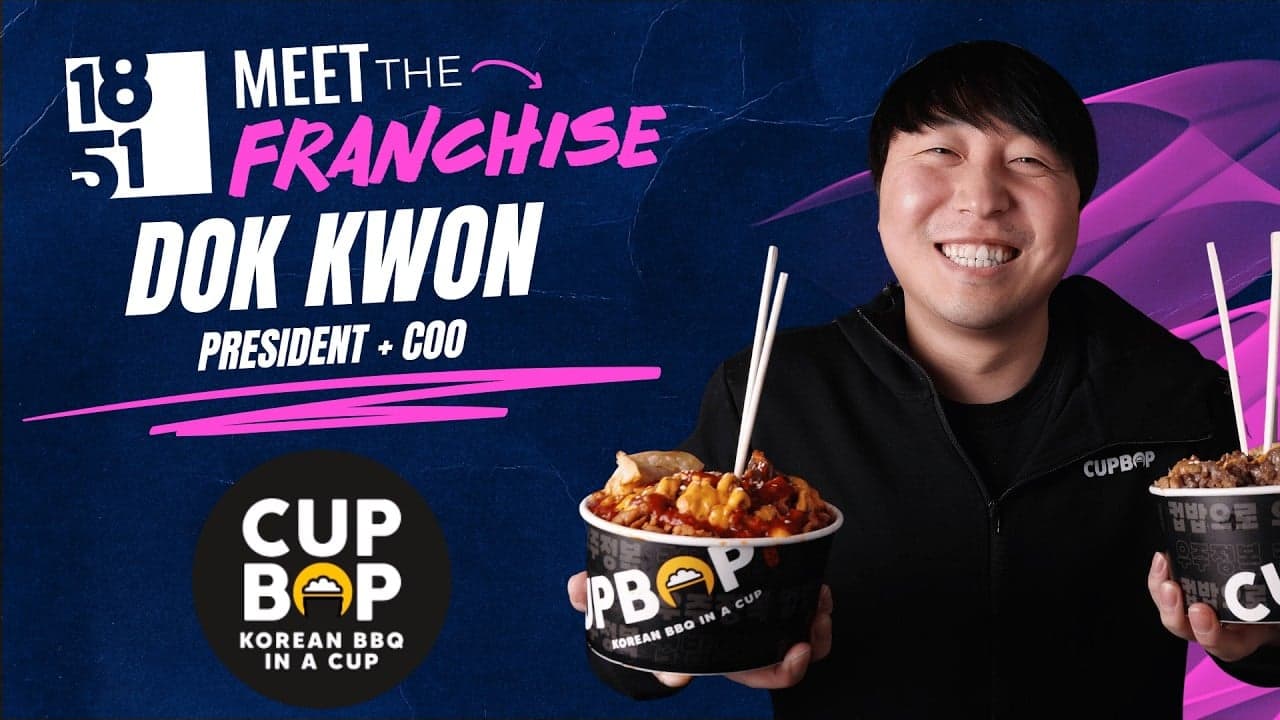
Kwon joined 1851 Franchise publisher Nick Powills on a recent episode of the “Meet the Franchise” podcast to discuss Cupbop’s company-owned foundation, its move into multiunit franchising and the long-term growth potential for Korean food in the U.S. A transcript of Kwon’s interview with Powills has been provided below. It has been edited for brevity, clarity and style.
Nick Powills: Tell me what Cupbop is and walk me through the state of the business right now.
Dok Kwon: Yeah, Cupbop is Korean barbecue in a cup. I think that’s the simplest way to put it. Think Korean barbecue in a quick, casual, Chipotle-style way of filling a bowl and having an affordable, quick lunch or dinner. That’s the brand.
We started from a food truck out in Utah in 2013, and we’ve been growing. I personally joined the business in the summer of 2019, so I’ve been with the company now for just over seven years, which is crazy to think about. We were just building our 10th location at the time. As of today, we have 72 locations here in the States, about 250 locations overseas in Indonesia and three locations in Dubai as well.
Powills: The first thing that comes to mind when you say you joined in 2019 and you started with the food truck: Did that position you differently going into COVID? Did you have more flexibility? Not on purpose, but did you?
Kwon: No, not really, because we had graduated to brick-and-mortar stores by then, and I was brand new to joining a restaurant. I actually never thought I’d ever work in food. I was never very close to it as far as the business side of things, only as a consumer.
I think it obviously took a lot of hard work to survive, with a lot of open-to-close shifts between a lot of people when people called out, somebody got COVID and things like that at the time. But I think we were fortunate that, thankfully, we were set up. That’s one of the first things I got done. We did get set up with third parties before COVID hit, and our concept and our food travel very well.
There was a window when a lot of restaurants decided to completely shut down, even takeout for a while. There was an opportunity for consumers to discover us for the first time because we were open throughout. That allowed us to get back on our feet. Actually, through COVID, we expanded pretty aggressively. No, I don’t think we were more ready than anybody else, to be honest. But we were blessed that we already had third parties, and the concept was pretty well suited for third-party delivery and pickup.
Powills: Seventy-three locations in the U.S.?
Kwon: Seventy-two right now.
Powills: How many different franchise owners is that?
Kwon: That’s a great question. We started out and grew, until pretty recently, all through corporate stores. We’ve had strictly corporate stores, with the exception of one franchisee who was grandfathered in before my time and now owns 20 locations.
We started talking to franchisees just last year. Most people don’t know we’re franchising. We don’t advertise it. We don’t have a franchise sales organization we work with currently. Of the new franchisees, call it maybe eight different franchisees started trickling in at the end of last year, but most of them haven’t opened yet. They’re in the process, so they’re just starting to open. Since last December, we’ve probably had around four franchise stores from actual new franchisees, which was a first for our brand other than the 20 that were grandfathered in.
Now the waves are starting. We probably have another seven stores or so coming from today through the end of the year, so we have a pretty busy year-end schedule.
Powills: What’s the cost to open one right now?
Kwon: It depends. Costs have definitely gone up through COVID. There are big cost differences between first-generation and second-generation spaces. For second-generation, depending on size and depending on the equipment the location already has, it’s going to be anywhere between, call it, $50,000 to $200,000-ish. First-generation right now tends to run around $500,000. I would say that used to be closer to $300,000. Now I’ve been seeing it closer to right around $500,000. Some states are less. Some states, obviously, like those with big cities, I would imagine are more. I would say that’s the overall build cost.
Powills: What are you reporting in Item 19?
Kwon: We just have our revenue figures right now.
Powills: What’s average unit volume right now?
Kwon: Our average volume is around $700,000.
Powills: I’m going to make a comment because I’m seeing some of the roadmap, and I’m curious about your opinion. I’m going to use a few of our clients as examples. Paris Baguette* is a Korean bakery. When they break into the U.S., it’s a reverse strategy because you’re in the U.S. and you’re breaking internationally. When they break into the U.S., they’re in H Marts. They’re going into predominantly Korean markets because they have a built-in customer base that has traveled over to the U.S.
The game changer for them is — and I label it this — how do we get the white American cowboy to love this brand? If we can do that, then it’s not a flavor issue. It’s still a great cafe, and they have the bakery, right?
Now we’re doing the exact same thing with Jollibee: 100 corporate stores build the baseline, which is fantastic from a cash flow standpoint because now you can actually fund the support and the mechanism.
The two buckets I continue to fill up with water are, one, the franchise buyers, because I see what an international flavor does when it hits the white American cowboy. Then, because you’re getting more exposure to the white American cowboy, average unit volumes continue to pick up as more customers come in and the repeats start to materialize. You have rising AUVs, and at the same time, you’re getting franchisees who are like, “Ooh, I better buy this before I can’t get in.”
For your brand, obviously, you crafted a code because Korean barbecue feels like it’s on an upward trend. You can see Korean barbecue, those sit-down places where you make your own, have grown into the white American cowboy markets. Now you have the fast-casual version of this. You go there for your special occasion, but you come to us for your regular daily meal.
I’m seeing this blueprint because you took the “let’s build the corporate infrastructure first so that we have the cash flow to go fund this” route. That’s what I’m seeing. How closely does that resonate with you?
Kwon: Very closely. The only difference is that we started here in the U.S. with the food trucks in Utah, where there really isn’t an Asian population. I think we started right off the bat with the mainstream, and that’s how we resonated from day one. It wasn’t a brand that we brought from Korea. It was a brand that we started here, out of all places, Utah, and then expanded across 10-plus states.
I think Korean everything right now is in a big wave of secular demand growth. Korean barbecue or any Korean food already has everything it takes to succeed on its own. It has all the ingredients. People love the food. It’s got wide appeal across any ethnicities, any people, whether it be Asia, the U.S., Europe — you name it.
But on top of that, Korean food has something that no other culture has right now, which is the whole cultural influence and impact globally. You look at Netflix shows. I mean, “KPop Demon Hunters” is the No. 1 most-watched Netflix show in history. If you have kids, you cannot avoid it because you’ve probably done about the 100th birthday party, right?
You get little kids eating it because there’s a huge barrier to foreign foods that is much higher than people actually realize. You can see that just in the numbers. You look at the top 100 U.S. restaurant brands. There is literally one Asian brand, which is Panda Express. It is that hard to actually break in, and that invisible wall is still quite high.
But especially for Korean food, through Netflix shows, K-pop, Korean skin care and beauty, which literally owns TikTok, we have this tailwind that no other cuisine has. One beautiful thing about food is that the demand profile tends to be very sticky. Once it lands and people like it, it stays. It’s not a trend. You can see that with Thai food, right? A lot of Americans have no idea where Thailand is. People want Thai food.
We’re very excited because Korean food is just scratching the surface, in my opinion, of where it’s at. I think it’s going to be decades-long secular demand growth. Penetration is still quite low compared to Thai food or even Chinese food right now.
Powills: If I had never talked to you and I’m looking at this from a roadmap standpoint, I would say Ohio is the only Middle America state where you need to have proof of concept. That would be one level.
The second level, which is going to continue to get addressed based on what you just said, is the magic number. If I were studying your FDD, I’d go back to Item 7 and look at how we set up the business structure to accomplish what I’m going to say.
The next magic number is going to be: How do we break a million-dollar AUV? Because it’s really hard for a franchisor to support a franchisee on royalties that are less than $50,000 a year.
Kwon: There are a lot of corporate sources. I think that’s one thing. Our franchise journey has been 100% inbound, only multiunits between three and five units. That’s what we have been doing, and we’re very grateful for the amazing franchisees who have been joining our family. We’ll have a lot of great stores coming in.
We vet them very rigorously. We want to make sure they’re food operators. We want to make sure they know what they’re getting into. We want to make sure that we can protect the brand long term. The good thing is we bootstrapped our brand from a food truck to essentially 40 corporate stores on our own, which is a testament that we know the brand works because, all along the way, we were building our own stores.
The pathway to a million, I think, is certainly something that we’re going to achieve. Part of the dynamic that we’re running into right now is most of our corporate stores are in Utah, and Utah actually tends to be a pretty tough state to operate in due to very different factors that Utah has.
Utah has the highest debt-to-income ratio out of 50 states. It’s No. 1 out of 50, literally. That has to do with a lot of LDS people, a lot of kids, needing a bigger house, higher mortgage, more cars, multiple kids. Mom usually stays home, so you have a single earner. Utah doesn’t have a demographic that is high single earners. That kind of demographic doesn’t exist in Utah.
It’s also a feast-for-family market. Post-COVID inflation has been tough on everybody generally, and we noticed it. Our thesis has been that our stores are going to do much better than even our corporate stores once we start going out into different states. So far, based on all the stores that we’ve seen since last year, I think our thesis is looking correct. I’m very excited about that.
Powills: I don’t think those numbers are going to be a challenge for you. I also think there’s an important thing in the positioning. If I said, “I have a half-million-dollar investment that can make $800,000,” you’re like, “OK.” If I say, “I have a $1.5 million investment that can make $2.4 million,” they’re like, “Ooh, OK. I like that.”
When you start thinking about it for you guys, there was a raise corporately to break over a threshold to the cash flow that was coming out of these units. It’s the same for a franchisee. If your positioning is that you have to get three of these units open within a two-year time frame in order to make the revenue against the investment that makes this a really sound investment, I think that’s how you start qualifying the franchisees.
We have other international clients that have gotten stuck because they end up selling based on the lure of the brand until they have one-unit franchisees who can barely pay the bills. It’s hard to make money in food with one unit, but they were like, “I love this brand.”
There’s a brand that we worked with for a long time, Pita Pit, and I was always fascinated because it’s all single-unit franchisees. When you look at the average unit volumes of their franchisees, let’s just say it was $800,000 and you’re making 10%. You’re open 24 hours to make $80,000 a year. That’s not sustainable. If you own 10 of those and you’re open 24 hours to make $800,000 a year, that is a sustainable business.
I love the fact that, one, you’re looking at the right candidate who is the right fit. As long as you hold true to that against what you’ve built, go duplicate it. Go find the 40-unit operator like you did before.
Kwon: Especially with supply chain, right? Especially at the beginning. The worst thing you can do is start opening single units all across the state. Your supply chain costs go through the roof, and it doesn’t help anybody. Those are all the learnings that we’ve accumulated over essentially a decade of running our corporate stores.
Powills: Whether purposeful or not, what’s fascinating to me is your blueprint, based on what I said: Paris Baguette, corporate stores, then franchise. Jollibee, corporate stores, then franchise. You, corporate stores, then franchise.
Maybe it’s a capital issue why emerging brands don’t go that route, but it’s almost like they’re encouraged: Open up one and then franchise. But you have no resources then, and you can’t even walk the talk. Look at the brands that can actually surpass 100 units. It’s the ones that follow this blueprint, whether purposeful or not. This is the blueprint.
Kwon: Yeah, I think you’re right. I think it has to do with capital, and it’s hard to grow with corporate units. Ten-plus, 20-plus, 30-plus corporate units are very hard to do with a new brand. It’s a very competitive space these days. That is a huge hurdle that people actually have to go through.
Hence why, when you open a couple up, it’s, “Now let’s just really try to sell,” right? We don’t have to do as much selling because our history kind of sells itself in a way. Especially if you’re familiar with the brand, you love the brand, you love the food and you look at our history, then it’s like, “Oh, OK. That makes sense.”
It’s going to be an interesting journey. I’m really excited about it, but it’s going to come down to making sure we have the right franchise partners. It’s very tempting to sign a lot of franchises, but I just had a call last Friday with great operators currently in food and multiunit. I was talking to them, and they said, “Hey, I’ve done all the research on your brand. We’ve made up our mind. We want to sign. We’re opening another location with our other brand. I have little kids. I know the next step is a discovery day. I’m not going to be able to make it out there anytime soon. But trust me, we’ve done our research. We’re ready to sign. Can we sign?”
I said, “No, we can’t. You’ve got to come. First of all, I’ve got to see you and make sure.” It was going to be a multiunit, and we’re going to see them. I’m excited to meet them, and we’ll have our discovery day. But it’s making sure that you focus on the long term, right?
There’s something to be said about it as a strategy. You sign up a lot, you get a lot of stores opening, you get that cash flow to be able to pivot and do your next thing and actually improve the system. That can happen, too, and that’s been done for sure. That may be the right strategy in its own right.
But for us, we were fortunate to be on “Shark Tank” a few years ago. After “Shark Tank,” we just got flooded with franchise inquiries. That was three years ago, probably, and we just said no at the time. We weren’t ready. We didn’t know anything about franchising, really. We were mostly corporate, and a lot of our proprietary items and supply chain were just not ready.
We said, “Hey, we’re not going to take franchisees when we’re not ready and it’s just going to fall apart. It’s going to damage the brand, and we can’t undo that.” So we said, “Let’s start. There’s clearly demand out there. Let’s get these things ready. Let’s get all the ducks in a row and start from there.”
Powills: Those are the knee-jerk reactions when something happens so fast. Are they sustainable down the line? Probably not. For you to say to the franchise candidate, all I’m hearing is, “Well, I can’t get out there because of my kids.” So when the restaurant — when shit hits the fan — and you need to be in the restaurant, I guess it’s, “No, I can’t go in the restaurant because I have kids.”
No problem. I get the kids stuff. If you’re going to be in business, it comes with sacrifice. It is what it is. That could be, in my opinion, the dumbest thing to say. That means you’re just not ready.
Kwon: I think they were just expecting that almost any franchise brand would say yes. Between your experience — obviously, you’re running multiple restaurant units already and your experience has been food going way, way back — it’s been a good call. Yes. I mean, that’s what she was kind of expecting. A lot of franchise brands — I would say more franchise brands would definitely say yes than no. That’s a reality, right?
Most franchise brands, their biggest focus is sales, which is not a bad thing. At the end of the day, you’ve got to sell to survive. But I think we take a different view. Selling at what cost in the near term, right?
Powills: The businesses that are in the business of getting units open are the ones that win. The businesses that are in the business of selling units end up losing because they don’t protect the brand.
Again, I think these are the lessons of you going through this now. You’ve set up such a good business structure, but you going through this stuff now, you’re going to look back when you’re at 500 units and you’re going to say there’s a reason.
Kwon: And it takes time. Most of these amazing brands have been around for 50-plus years. My next-door neighbor is an amazing guy. He’s a Chick-fil-A operator. He operates two stores in Utah. I said, “Hey, how did you even get into Chick-fil-A? I hear it’s essentially impossible to become a Chick-fil-A operator.”
He said, “Dok, you know what the funny thing is? I started 30 years ago with Chick-fil-A. Back then, they could give anybody a store. Nobody wanted Chick-fil-A.” It’s really been 15 years since Chick-fil-A started taking off, and then really the last 10. People think Jersey Mike’s came and ate Subway’s lunch in the last five years. No, they’ve been around forever.
Most of these brands take a long time to develop because the moat, essentially, at the end of the day, is going to be the brand. But brand equity is something that can’t be built overnight in a durable way.
Powills: Two quick comments. One is Chick-fil-A has appeal right now, but you look at their franchise agreement. At the end of that, there’s no asset. You hand in your keys. There’s nothing to sell. It’s a genius model. You get a general manager who invests their life into a business. They make good money. They own nothing at the end, so there’s no generational wealth opportunity. You just hand in the keys.
Then, based on what you just said, it takes time for brands to grow. I remember sitting in a new client meeting. I go, “What’s going to happen with your brand?”
They’re like, “We’re going to break 100 stores in the next five years.”
I said, “OK, and you’re going to sell these by when?”
“In the next two years.”
I go, “Good luck.”
They’re still at six units.
But in that meeting, I said, “Well, let’s look at Five Guys. Did you know they started in 1984?” They had their big growth in 2005 through 2010. That’s where it took off as a business.
That’s not an overnight success, though. It takes time. I think patience is a virtue when it comes to good business. You obviously have to build up enough cash flow to have sustainability, and then you get the benefit of making the right decision. So, kudos to you. Thanks for sharing your story. I love what you guys are building. I want to continue to watch your success. Thanks for doing this.
Kwon: Thank you so much, man. Love it.
Powills: All right. Thanks for your time. This is another episode of “Meet the Franchise.”
Watch the episode above or on YouTube.
Sign up for the 1851 Franchise newsletter to get our biggest stories before everyone else
By signing up, you agree to our user agreement (including class action waiver and arbitration provisions), and acknowledge our privacy policy.