Franchisor Stories
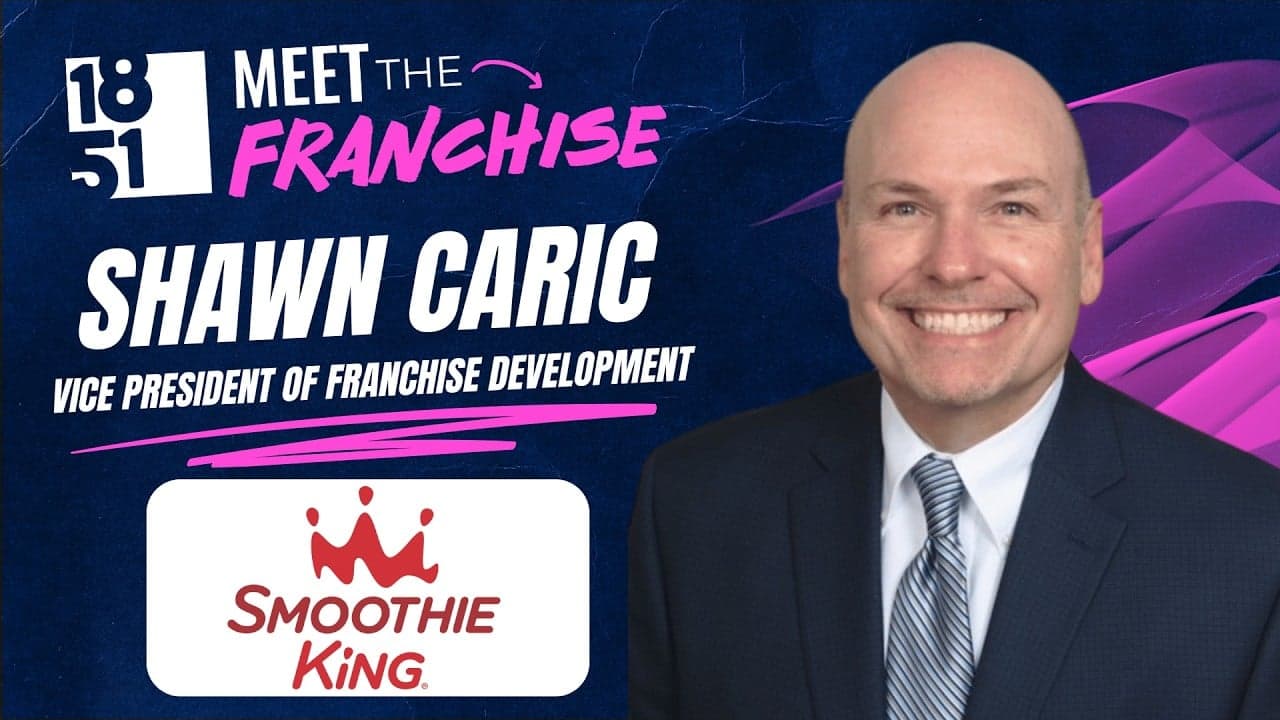
How Smoothie King Plans To Keep Its Crown Amid Protein Crazes and New Food Investments
Vice president of franchise development Shawn Caric shares how the 1,300-unit category leader is traversing changes in the smoothie industry.
Franchisor Stories
Vice president of franchise development Shawn Caric shares how the 1,300-unit category leader is traversing changes in the smoothie industry.
Smoothie King founder Steve Kuhnau first began blending smoothies in 1973 in his vitamin shop to improve his health. More than 50 years later, smoothies are a staple across the country, but no market is immune to change. For Shawn Caric, vice president of franchise development at Smoothie King, adapting to changing consumer habits is part of the entrepreneurial DNA.
"I've been around small business all my life, since age 14, vacuuming my uncle's sporting goods store. My parents had a card shop and a catering business," Caric said. After spending 18 years helping build Dunkin' into a national powerhouse, Caric now leads franchise growth for Smoothie King, navigating modern health trends.
Amid shifting views on high-protein diets and functional nutrition, Smoothie King has expanded beyond the cup through targeted menu additions like smoothie bowls, toasts, flatbreads and a new program called Power Eats that expands on the brand's existing protein options. In tandem with menu expansion, the brand is rolling out an aesthetic refresh to ensure stores feel approachable to everyday guests rather than just fitness enthusiasts.
With nearly 1,300 locations across 38 states, Smoothie King is scaling through both existing franchisees and new operators. For first-time business owners, Smoothie King provides an approachable entry point into franchising.
"We don't say easy. Nothing's easy, right? People are involved," Caric said. "But it's a beautiful brand for first-timers into the hospitality or food space, or franchising space."
At the same time, the brand offers an ideal portfolio expansion asset for experienced operators.
"We fit nicely into portfolios," Caric said. "Most likely we don't compete with anything they're doing, especially if they're dealing with the big five: burger, pizza, chicken, sandwich and coffee. We're not going to compete with that. We're going to complement that menu and give them something to be proud of."
Caric joined 1851 Franchise Publisher Nick Powills on a recent episode of the “Meet the Franchise” podcast. A transcript of his interview with Powills has been provided below. It has been edited for brevity, clarity and style.
Nick Powills: How did you accidentally fall into franchising? What's your franchise backstory?
Shawn Caric: Oh, that's an easy one. We all have an accidental relationship with the industry. I've been around small business all my life since age 14, vacuuming my uncle's sporting goods store. My parents had a card shop and a catering business, so I did that through high school and college.
Shortly after college, I joined Hallmark Cards. It was a non-franchise, non-food brand, but it operated under a license agreement working directly with small business owners. Our attorneys used to call franchising "the F-word," and back then I didn't even know what that meant. The Hallmark license model was very close to franchising, but not quite there.
Then Donald Rose—who is now retired—went over to Dunkin'. In the early 2000s, Dunkin' was a super regional brand, nothing like it is today. It didn't have an organized franchise recruitment team or program and was more reactive than proactive. Donald called me up, we had lunch around the holidays, and he told me about the team and process he was putting together to take Dunkin' national. He asked if I wanted to be a part of it.
Without franchising or food experience, I said sure. It was all about relationships with small business owners. Donald and Tony Padulo—who is now over at Arthur Murray—took a chance on me. We built it out, and the rest was history. Over 18 years, we took Dunkin' from east to west and never looked back. I’ve really enjoyed the industry ever since.
Powills: You have this thing in your blood called entrepreneurship. How have you kept that silenced as you've spent a career helping others get into business?
Caric: That's been difficult. I always think about what life is like on the other side of the cash register. But for me, I've been able to represent great brands and watch others thrive. Who knows down the road if owning a business makes sense for me, but right now I've enjoyed growing brands with other people's money. Helping brands grow, attracting talent, and seeing franchisees flourish is deeply rewarding. I'm old enough in the industry now that I'm starting to see second- and third-generation owners creep in, which is awesome.
Powills: You’ve placed thousands of franchisees over your career. When you’re at high-volume brands, do you ever get to pause and reflect on the economic impact you've had on people's lives?
Caric: I appreciate that perspective. I do some lecturing at universities on this subject, and a student once asked me what I was most proud of. I botched the answer at the time, but driving home I realized the real answer is the relationships I've created. Seeing families invest their lives and children into these businesses is huge.
The ones that stand out most are the successful operators, but funny enough, I also remember the ones I targeted who I thought would be a great fit but got away. Ultimately, it's all about relationships. I can go to almost any state in the country and connect with someone I recruited into a brand who has built a successful life.
Powills: Are you equally proud of the "nos"—protecting people from making a mistake when a brand wasn't the right fit?
Caric: For sure. We talk a lot about that during discovery days, candidate calls, and mentoring sessions. The "nos" are probably as important—or more important—for both sides. Sometimes you just have to protect people from themselves. Whether it's the recruiting process or the real estate process, turning down a candidate or rejecting a lease site that isn't quite right allows things to work out the way they should. The "nos" are often just as valuable as the "yesses".
Powills: When you got involved with Dunkin', how long did it take to realize it was going to become a top 1% franchise brand?
Caric: I was a fan of the brand early on, which has always served me well. Even back in my Hallmark days, I was a fan of the brand. I'm a bit of a brand snob and have been blessed to work with high-volume, high-velocity growth concepts.
When I got to Dunkin' in 2003, we got ourselves organized. But when Bain, Carlyle and Lee acquired us in 2006, we knew we had something special. That private equity backing provided serious fuel, leading up to our public offering in 2011. That 2006 inflection point was when we realized the full scale of what we were building.
Powills: Smoothie King was further along when you joined, but does it feel similar to Dunkin' in terms of category dominance?
Caric: 100%. I actually mentioned this to a franchisee at our brand conference in New Orleans recently. Smoothie King feels like Dunkin' did 10 or 15 years ago. It’s a category leader doing great things with a massive runway ahead. Rare is the brand that has nearly 1,300 rooftops with this much open territory still available. We serve 38 states and D.C., but the similarities to Dunkin's growth potential are what get me excited every day.
Powills: Was there any hesitation or vulnerability when taking on this role, wondering if you could replicate that scale of growth?
Caric: That's the playbook. Having lived it and seen it work, I know the execution required. We deal with macro pressures like post-COVID staffing and inflation, but we're confident. Even at 1,300 domestic locations, we are just getting started. It’s a great inflection point for the brand.
Powills: What does your current growth strategy look like in terms of new vs. existing franchisees?
Caric: Around 60% of our growth comes from existing franchisees expanding their portfolios. That number is actually a bit higher this year. As we enter new markets, we also bring in new local talent.
Smoothie King is a fantastic brand for first-time business owners because of the low-labor model and efficient operations. At the same time, we actively attract multi-unit talent from other concepts. We fit seamlessly into multi-brand portfolios because we don't compete with the "big five"—burgers, pizza, chicken, sandwiches, and coffee. We complement those menus cleanly.
Powills: How do you educate multi-unit operators on the benefits of diversifying with a complementary brand like Smoothie King?
Caric: Some operators come to us recognizing the efficiency—no walk-ins, hoods, or fryers. We remind them that while operations are streamlined, guest experience still takes work.
Additionally, many multi-unit franchisees are getting into commercial real estate. They build multi-tenant developments where Smoothie King fits perfectly into a 1,000 to 1,200-square-foot footprint. If an operator is looking at a 3,000-square-foot location that is too large for their primary concept, they can subdivide it, put Smoothie King on one side, and optimize the strip center. It makes signing real estate deals much easier.
Powills: It’s a compelling model when franchisees use the business to pay off the commercial real estate, leaving them with an equity asset at the end of the term.
Caric: 100%. I’ve seen operators execute that exact strategy time and again.
Powills: What else should potential investors know about Smoothie King right now?
Caric: We’re accelerating our menu innovation. In 2023, we launched smoothie bowls, which brought in younger consumers and expanded our dayparts. More recently, we rolled out "Power Eats," including flatbreads and toast platforms. Corporate funded ovens across 1,200 locations to ensure system-wide adoption.
Our R&D team won a Menu Masters Award for this work because it builds a larger check average without losing our operational speed. We’ve been pioneers in protein beverages since 1973, and these additions make our core product even more versatile. It’s driving strong comp store sales, higher ticket averages, and increased guest frequency.
Powills: Smoothie King also seems uniquely positioned to capture market share among health-conscious consumers and GLP-1 users seeking approachable nutrition.
Caric: "Approachable" is the exact right word. We’ve refreshed our store image to ensure our locations feel welcoming to everyone, not just hard-core fitness enthusiasts.
Our founder, Steve Kuhnau, invented the smoothie in 1973 in the back of his vitamin shop as a "beverage with a purpose". Our CEO Won Kim, who started as our first international franchisee, is taking a page out of Steve's playbook. Because Won understands the business from the franchisee's perspective, our entire culture focuses on supporting our owners, store crews, and guests. We have a 50-year legacy, but as far as market expansion goes, we’re just getting started.
Powills: Shawn, always great catching up. Thanks for sharing the story.
Caric: Thanks for having me, Nick. I really appreciate it.
Watch the full episode above or on YouTube.
Sign up for the 1851 Franchise newsletter to get our biggest stories before everyone else
By signing up, you agree to our user agreement (including class action waiver and arbitration provisions), and acknowledge our privacy policy.