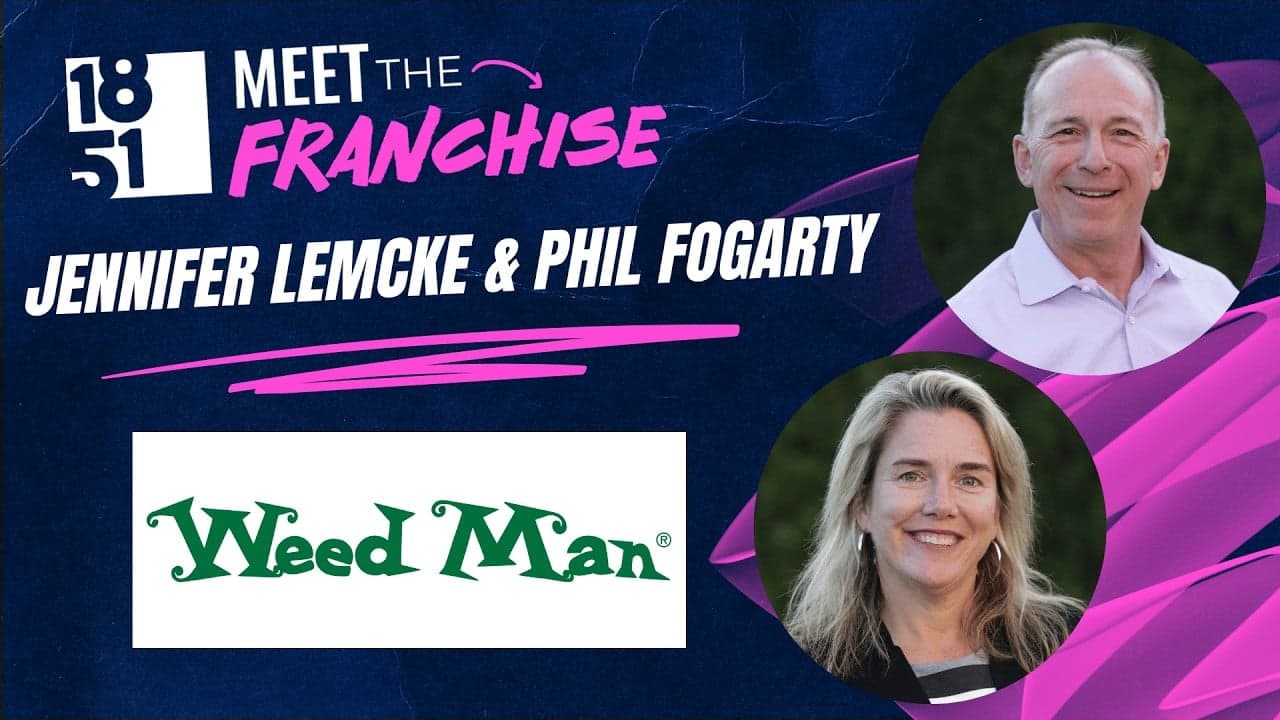
Many lawn care models boast subtle operational differences or communication methods that have led to their success with customers. But when 1851 Franchise publisher Nick Powills sat down with Weed Man CEO Jennifer Lemcke and Head of Franchising Phillip Fogarty, he discovered a different approach to growth. For Lemcke and Fogarty, the secret to success was a focus on a clean system for customers and a pathway to engage the entrepreneurial spirit from within the organization.
This spirit may have started when Lemcke was first introduced to the brand. In 1986, Lemcke’s father, Roger Mongeon, bought just one franchise unit in Hull, Quebec. At the time, there was no grand plan for expansion, which allowed Mongeon to focus on tinkering with the model in a bubble. When Lemcke and her husband finished university, Mongeon had enough success to position himself in Montreal with seven more territories, and he offered to assist Lemcke with her first purchase into the business. From a single unit in Ottawa, Lemcke and her husband used what they had learned with Mongeon to become the largest multi-unit operators in the business, eventually buying the U.S. rights, and soon after the full rights, from the Weed Man founders, making their jump from franchisee to franchisor.
“She (the original founder) is still a shareholder and a director of the company, so she's with us,” Lemcke said. “But with what we had done in the U.S. and with our operational expertise in Canada that we had gained, we felt like we could really take this brand to the next level, which we have.”
Coming from his own sole proprietorship lawn care company, Fogarty is a veteran in the industry. When he was first introduced to Weed Man, he was surprised by the operational simplicity stemming from Mongeon's lessons, which yielded a high customer renewal rate and a passion for internal growth.
“What I marveled at right away was the systems and simplicity they brought to a business that most of us in the U.S. had made very complex,” Fogarty said. “He took what Des and Brenda had created — a great product and a great attitude toward serving people well — and added the systems and the thinking that he had behind it.”
For Lemcke, keeping great people and empowering their first or second unit comes down to two things: the importance of challenge and organizational chart planning. Fogarty and Lemcke both highlight these two priorities as a main reason for their growth through multi-unit operators, so much so that franchise development has become almost tricky. When new franchisees call to do their due diligence, it almost always ends with that franchisee calling corporate to express interest in purchasing the territory in question.
“To think strategically, to think about the org chart and to create opportunities for people is the most important thing you can do as the CEO of a business to continue to push, grow and create opportunity,” Lemcke said.
These two items might seem like late-stage planning, and quite possibly are, but there is no doubt that the number of multi-unit operators Weed Man creates is a method of growth, and one that might feel more successful in the long run.
“This kind of stuff changes people's lives," Fogarty said. "We've seen it in long-term planning; people change the trajectory of their families, where they were going to live, how they were going to live, and what they were going to focus on.”
Fogarty and Lemcke joined 1851 Franchise Publisher Nick Powills on a recent episode of the “Meet the Franchise” podcast, where they discussed the brand's history and the method behind their growth in North America. A transcript of his interview with Powills has been provided below. It has been edited for brevity, clarity and style.
Nick Powills: Jennifer, 1992, and Phil, 1999? 2000? I mean, you don't hear this story anymore in franchising, partly because private equity comes and swallows everything up so fast and makes changes, but talk about longevity. Tell me your stories and why you stuck it out so long with Weed Man.
Jennifer Lemcke: My dad bought his first franchise, a Weed Man franchise. He started with a one-unit franchise in Hull, Quebec, which was the first franchise in Quebec. We moved our family from Toronto to Ottawa. We started the franchise with no aspirations to go beyond the one-unit territory. We had really great success, and he moved to Montreal and bought seven more territories.
While he was doing that, I met my husband in university, and my dad approached us and said, "Hey, would you consider joining the business?" So we did that. We did a year of training in 1992 and then bought our first franchise that my husband and I ran in Ottawa, and we had really good success. He started from a one-unit and then became the largest multi-unit. We had a group of friends and family that were running our franchises for us, and we were partners in all of this.
In 1996, he decided to approach the founders, Des and Brenda Rice, to buy the rights to the U.S. So we went from single-unit to the largest multi-unit in Canada, and then became a franchisor once we bought the rights to the U.S. We opened up a few franchises and sold a few franchises, but realized if we were going to be successful in the U.S., we needed to get Americans involved.
There was an incredible opportunity at the time because TruGreen was very active in buying out local lawn care operators (LCOs). We were coming into the U.S. when a lot of the non-competes were coming up, and we went and met with some of the leaders in the industry, past presidents of our national association, and pitched the idea of a sub-franchise contract. We were the master, and then the sub would come in and help us. They'd have a flagship office, help award franchisees, and actually help us support the franchisee. So the contractual obligation was with the sub and the franchisee. We just worked really harmoniously together to build the U.S.
Fast-forward to 2018, Des passed away during that time, and Brenda, the founder's wife, approached us to purchase the rest of the rights of Weed Man. We said, "Yeah, we feel that we have the system now." She's still a shareholder and a director of the company, so she's with us. But with what we had done in the U.S. and with our operational expertise in Canada that we had gained, we felt like we could really take this brand to the next level, which we have.
Philip Fogarty: We're doing a lot of reminiscing recently because of 26 years of us being in the U.S. I had run my own sole proprietorship lawn care company, and I was the first acquisition for Scotts LawnService when Scotts, the big butterfly company, wanted to get into the business. I worked for them for about 18 months and realized I really don't want to work in a corporate atmosphere. I was not geared for this at all.
Right about that time, I got a call from a friend, another lawn care operator with a sole proprietorship in New York State, and he invited me up to see what the Weed Man folks had to say. What I marveled at right away was the systems and simplicity they brought to a business that most of us in the U.S. had made very complex. Anyway, we took the rights to a few states, and over the course of the next several years, we awarded a lot of franchises and watched this thing grow.
Roger Mongeon, Jen's dad, had this incredible mind for systems, and he had come out of corporate Canada. He took what Des and Brenda had created, a great product and a great attitude toward serving people well, and added the systems and the thinking that he had behind it. It was remarkable to see how he turned this into a great business opportunity.
We talk about being a lawn care company, but really we're a marketing and customer service company that happens to deliver the very best lawn care that there is in the country. We have the highest renewal rate, and that's partly because we have a great product, but mainly because we have really good systems and a great culture of keeping everybody transparently informed of every number that's important and focused on the right things.
Powills: So that’s why neither of you have left?
Fogarty: That's right. Yeah, that's why.
Lemcke: And you know what? Some of my key employees who started with me back when I was in operations in Ottawa, quite a few of my team have been with us for over 30 years. With the philosophy that you treat people well and they will stay, that has been our philosophy for our customers. We have some of the highest retention rates in the industry, if not the highest. Our employees stay because we treat them well. Our franchisees stay, and they expand and continue to buy more territories. We have multi-units that are bigger than some franchise organizations just in their own right. It's just that simple philosophy: treat people the way you want to be treated, treat them well. I know it sounds cliché, but it's what we do.
Fogarty: Everybody says they treat people well. Everybody says they have great products and great services. We just have a remarkable culture. We don't have failures. We have people who stick around. We have people who, as soon as a franchise comes up for sale, can't wait to get the next opportunity. We have people who started as door-knockers and salespeople who now own franchises. It's just a culture where everybody's going to win here, and we're going to do anything we can to help you win as a franchisee and as an employee of a franchisee.
Powills: I'm at 18 years of running this business. I would say any of the challenges that we faced, which is going to be odd to say, are not financial challenges. It's, “Do we have a business where, when I walk in every day, I'm excited about the people I work with, and I'm excited about continuing to figure out whatever this fake challenge is?” Because at the end of the day, these businesses don't matter. We're building them for something deeper with our families and what's around us as humans.
So what I reflect on at 18 years, I'm further behind you guys, but I walk in and say, "Am I excited about continuing to try to figure out this puzzle?" The day that I'm not is the day that I'm going to say I'm done. What I'm hearing from you guys is you've got plenty of puzzles, and Jennifer, even you saying, "We still feel like there's plenty of room for growth."
Lemcke: I think it has to do with having a growth mindset. Some people would look at that and say, "Oh, you're just worried about the big mighty dollar." When you stop growing or you stay stagnant, you start to lose your A-players. I don't care if you're a franchisee or a franchisor, you have to be pushing for growth. If you're staying stagnant, you're going backwards. There's no way around it in this business, or in any business, in my opinion.
These A-players have to be challenged. They have to see the company's success and growth, and there has to be excitement around that. It's not a bad thing that the company is growing and making money, because it's what you do with it. We open new markets, we give more opportunity to our people, and they see it. Their colleagues are at the table, and then all of a sudden, someone went from door-knocking to supervisor to lead technician to running their own branch. The stories are just being written all over the place. You're seeing your colleagues get cars, nicer houses, and real career opportunities. Now we're starting to see some employees bringing their kids into the equation because they had such great careers.
Oftentimes, I'll see an owner say, "Okay, I'm going to hire all these people and they're going to keep the wheels on the bus, and we're going to coast for a little bit." When the owner disengages from pushing the gas and keeping people engaged, that's when you start to see the wheels start to fall off. Sometimes it's a nut at a time, but they start to weeble-wobble because essentially the owner has abdicated their role as CEO of the company. To think strategically, to think about the org chart, and to create opportunities for people is the most important thing you can do as the CEO of a business to continue to push, grow, and create opportunity.
Fogarty: One of the other things that I found unique about us is our focus on planning the org chart. Jen talked about being involved with franchises for different reasons. She owned a couple, and she helped her sister get bookkeeping for one. When she went through training, she asked her for a business plan. She thought, "Wait a minute, you're giving me a business plan?" She heard the experience and intensity of making a plan so that everybody knows what they are supposed to do. Moreover, it shows future possibilities. Engaged employees stay when they see: "If I do this job well, there's a job over here where I'm going to make more money and have more responsibility, and then there's another job over there if we expand and go to another location."
This kind of stuff changes people's lives. We've seen it in long-term planning; people change the trajectory of their families, where they were going to live, how they were going to live, and what they were going to focus on. That is what planning, detail, and the numbers we focus on can do for people. You talk about your business for 18 years; your impact is changing people's lives. Sure, we have to make money and we come into work every day, but you're doing it for something bigger. If you can change people's lives through a business, you're going to keep the flame burning until the very end.
Powills: Jen, you saw it. Your dad goes from one unit to multi-unit, and to keep the bolts on the tires, you have to figure out how you can leave one unit, go work on the other, and trust that the people you've built up can actually operate it. So there's something magical about becoming a multi-unit operator.
In a world where private equity knocks on everyone's door wanting to knock out brands, of course private equity is knocking on your door. You have a great system, but you are still participating in the dream. You still want to build greater futures and change the wealth projections for families, and you're building systems and processes to do so. That's probably the magic of why you're still here: you still have work to do.
Lemcke: Yeah. Our business plan is a one-year business plan, and we call it a business plan, not a budget. A lot of people do incremental budgeting, but we actually do zero-based budgeting. Every year, do we look at historical data? Of course we do, but it's like: Okay, we have zero customers. How are we going to build this out? Oh, we know that 80% to 85% of our customers renew year after year. Okay, let's put that number in. What's their pricing out in the marketplace? We analyze that and plug in a price. Are we going to increase prices or keep them the same? What is that going to look like?
Those are our renewal buckets, and then we look at our old customer bucket. What happens if we call them? What happens if we send emails? It's really granular to build out the plan, and from that, we're able to address what our employee needs are going to be and make sure our org chart makes sense with what we have.
All the things you hear about zero-based budgeting, we do that. We're in lawn care. Very few companies in the world do zero-based budgeting, but in lawn care, we're the only one. Others do incremental budgeting: "I want to grow 10%, so I'm just going to increase costs." We say, "No, you may not need to increase costs by 10%, so let's really look at your profit margins and where you want to be."
From that, we build out a 10-year model for franchisees who are looking. It's a 10-year outlook to see where you're at and what your business can do. Now we're playing into the multi-unit operator who aspires to expand to different areas and keep growing, not just in their immediate area. What does that look like? We call that a go-case and no-go-case. You do your 10-year projection with your current structure, and then you layer on the opportunity or the acquisition; that's the go-case, and we see what that looks like.
We started as a multi-unit, so we understand multi-units. We built out the back-end office for sales and admin so we can manage it centrally. When I say centrally, we don't have anyone sitting in a brick-and-mortar office answering phones anymore; they are all working from home, and we have all the systems in place to monitor and support them. It's about building out and staying ahead, not just for your single unit, but for your multi-units. What tools do you need in place for them? You need a 10-year plan. You need to show the carrot. You need a tool to sell the vision to your employees, and this is the perfect tool. Then you give them all the systems they need to get there.
One of our largest multi-units is going to finish the year close to $110 million in system sales. They're our largest multi-unit, and they just keep cranking it up a notch. We have multiple units at $60 million and a lot at the $20 million mark. These are all tools that we all use to evaluate opportunities, so it's not like we're holding them back from our franchisees. Everyone has access to them, and it allows them to work on their business and not in their business, to borrow from Michael Gerber's The E-Myth Revisited.
It's truly a tool we've used to become successful corporate multi-units, and we give those same tools to our franchisees. It has made a world of difference because they know we're in it with them. If it takes three days to do a 10-year plan, we're sitting at the table for three days to do it. We want them to understand and illustrate that vision to their employees and shareholders, and to keep that growth momentum going.
Fogarty: It's not a real sexy thing to talk about in our franchise presentation. I do the franchise presentations to new franchisees, and talking to them about how important this business plan is usually falls a bit flat. But Nick, you know as well as I do that other businesses do not focus on this. This is the blocking and tackling that makes people really understand their business; it gets in their blood, and they truly understand every step.
We use it as a training tool along the way. They get trained as they do their business planning, and they bring managers into the process so that the numbers are coming from them. I've had to show this to bankers and lawyers, and for a while, I gave a presentation about our business planning to CPAs in Ohio to help them get renewal credits. Everybody is so amazed that we're a lawn care company. It really is our secret sauce: helping people become better businesspeople through a business planning process. It gets so deep into our culture that they would never want to try to run this business without this process, which takes them from a brand-new rookie to a multi-unit owner.
Powills: Are new franchisees still important to you guys?
Lemcke: It's interesting you ask that. It has not been a core focus of ours because we've been selling so many units to our existing franchisees, so we haven't spent many dollars on acquiring new franchisees. Should we be changing that? Yes. Phil and I talked about it this last week and said, "You know what? We've got to get back out there and really start to push the envelope."
What happens, though, is when new prospective franchisees start calling and doing their due diligence, we tell them, "Call these people; they can tell you what the relationship is like." They start calling, and then suddenly we get a call from an existing franchisee saying, "No, we wanted that area." So acquiring new franchisees became a secondary thought. We need to get more into the white spaces. We're thinking about states like New Mexico and Arizona, where we need to broaden our offerings beyond just lawn care to include xeriscaping. That's going to be a major focus of ours going into next year: looking at xeriscaping, weed control in beds, and serving more of the arid states where people are replacing lawns with rock gardens. There is absolutely a business in that, and we need to expand into it and get going on some of our white spaces.
Powills: I'm glad you answered it that way, because as an outsider looking at the business, I saw that franchising was buried on the website. As you were talking, I realized you are selling franchises, which is counter to what you've talked about, that you're in customer service and marketing, and you happen to be in lawn care. But for whatever reason, your messaging around why to buy now is so non-cultural, even though you are one of the best franchises to buy.
What we just unpacked in this conversation is so much richer than what you're currently positioning. If it were me, I would listen back to this conversation and write down notes, because that should be your franchise website. Brands don't sell brands; people do. You have tremendous stories. Just the fact that your franchisees say, "We don't want any new weeds, because these are our weeds"— that is such a powerful validation statement.
Then you go back to your story, Jen, of how your dad got into this, built it up, established credibility, and how the founder wanted your family involved. And Phil, you jumped off on your own, started doing consulting, got a client very early on called Weed Man, and have completely committed to that the whole time. There's such magic in this that goes beyond typical franchising, and that's how I would highlight it as you go through that reset.
Fogarty: Nick, there's one other thing that I wish you could put across in a franchise brochure. People don't check on this like they should: What is the leadership of the franchise brand like? They should be interviewing the CEO. The brilliance of what Roger built and what Jen has built and run together is remarkable leadership. It keeps us focused when you're going through COVID or any other crisis. What is the leadership going to help you keep focused on? Roger and Jen, throughout our growth, have always kept us focused on the right things and doing the right things: "Don't worry about that noise. That's noise. Let me just keep doing what we do." If someone is listening to this and looking for a franchise, whether it's us or somebody else, you should look at the history of the leadership of that brand and judge them by what those leaders have done.
Powills: 1,000,000%. Go look at one of our clients, Beef 'O' Brady's / The Brass Tap, and see how they position their leadership on their website, because leadership is an overlooked thing in franchising. People go buy these franchise brands and ask, "How long has the CEO been in place?" And they're told, "Two years." That CEO is going to be leaving soon; someone new is going to come in, and they're going to look at the entire business in a different way, which impacts your investment.
Where private equity has missed the boat in these purchases is that they care about the franchisor, but they don't care about the franchisee. When private equity starts caring about the franchisee, it will actually make the franchisor more valuable. They overlook it and don't do their due diligence with the franchisee to ask what they're actually buying, which surprises me.
At the end of the day, we have a responsibility back to the franchisees who are going to invest their life savings into these businesses. We don't fulfill that if we're just in the business of selling franchises. Clearly, you guys have cultivated a tremendous business, and I'm grateful that you've shared your story with me.
Lemcke: We started as operators. My dad and I grew up in operations. I know exactly what it's like to have that lump in your throat, to have the budget sitting over your head, and to have to hire, fire, and do everything in between getting your first customer and losing your first customer. You understand the psyche of the franchisee, and I think that's what has allowed me to lead the company with a lot of empathy and understanding. I know what it feels like. Sometimes it really sucks, but there's no greater joy than watching your employees buy things and get bigger houses. We've all made money through the years, but seeing other people around you be successful breeds more success. I know that sounds cliché, but that's what lights my fire: watching other people succeed.
Powills: That's where the specific product or service you offer is irrelevant. You could say, "We're in burgers," and the same principle applies. If a franchisor can listen to the truth of what you're saying, it actually makes more money for everybody. The only way you're going to make more money for everybody is if your customers are happy, too. It's a whole lifecycle.
Thank you so much for sharing your story. What a wonderful story. These interviews are always unscripted, and I never know where they're going to go. I looked at your LinkedIn profiles and thought, "These are the best LinkedIns I've ever seen." I would hire both of you. I love it.
Lemcke: Thank you so much, Nick, for having us. It was awesome.
Fogarty: Thanks for this platform, Nick. Really well done.
Watch the full episode above or on YouTube.