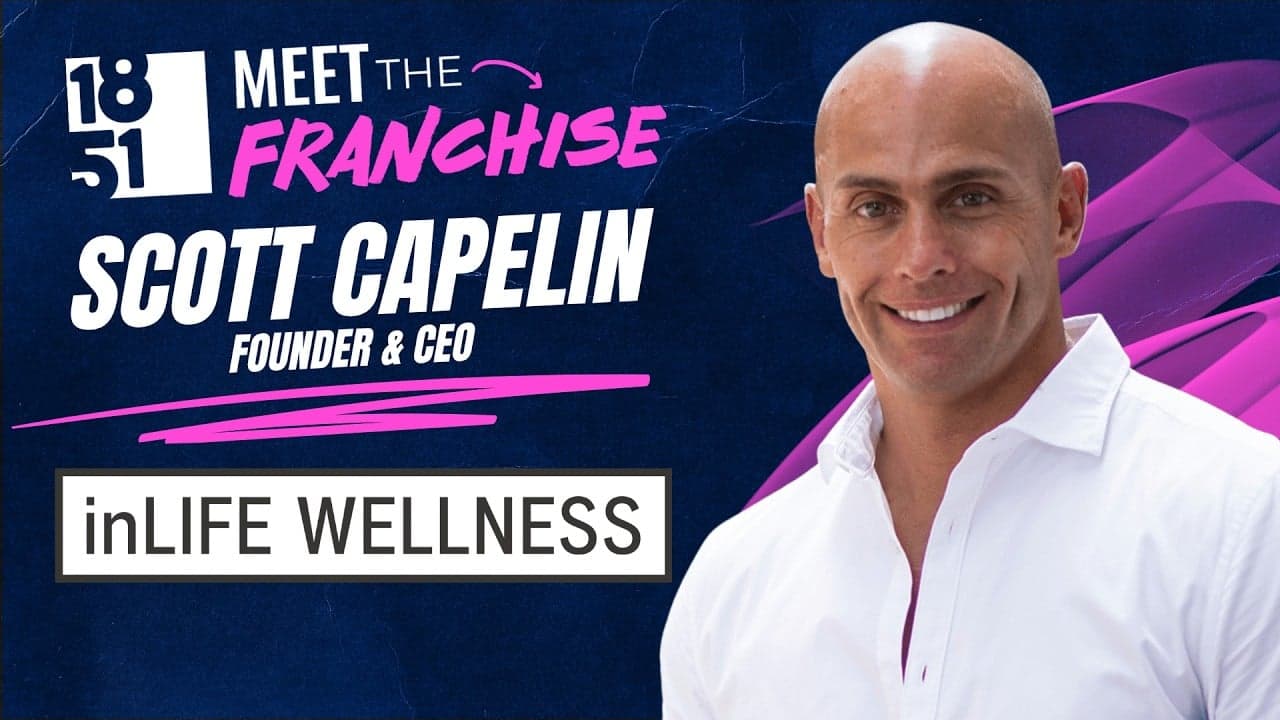
When Scott Capelin walked away from a corporate role in his 20s, he set out to build a career that would allow him growth and flexibility. After entering and getting his footing in the fitness industry, Capelin founded inLIFE Wellness, an accessible Pilates franchise. With a combination of his decades of fitness experience and deep commitment to franchisee success, Capelin was able to grow inLIFE Wellness to a footprint of 80 studios across three countries. He had no franchise marketing budget. He simply focused on franchisee profitability.
“Starting my career as a franchisee helped me understand what franchisees need, what support they need from head office, what makes a good franchisor and what makes a not-so-good franchisor,” Capelin said. “Most of our franchisees own more than one location, which speaks for itself.”
inLIFE Wellness is a community-driven Pilates franchise that offers relatively low startup costs, with initial investments starting at about half of what traditional competitors require, and protective business guardrails. For example, the franchisor has strict rent caps to prevent franchisees from overleveraging. This model places the primary emphasis on sustainable ROI and operational simplicity that appeals to members and owners alike. By focusing on what it does well and staying “in its lane,” inLIFE Wellness has ultimately built a model that keeps costs low, contributing to the financial success of each unit and creating a clear pathway for franchise success.
“We do not focus heavily on merchandise, supplements, or apparel because we know where our membership revenue comes from—it is a simple business model,” Capelin said. “Business decisions may be made emotionally, but they must be backed up logically by the numbers.”
With an accessible investment and continued growth driven in part by former members and staff, inLIFE Wellness is eyeing healthy growth across the U.S. market while maintaining unit economics and brand integrity as its guiding lights.
Capelin joined 1851 Franchise Publisher Nick Powills to discuss his journey from franchisee to franchisor, how guardrails protect the entire franchise system and inLIFE Wellness’s U.S. growth trajectory. A transcript of Capelin’s interview with Powills has been provided below. It has been edited for brevity, clarity and style.
Nick Powills: All right, Scott, I want to go way back, and we will catch up to current day. You started your franchise journey as a franchisee, is that correct?
Scott Capelin: That is correct.
Powills: How did you even fall into it, and what was the trigger that made you explore becoming a franchisee?
Capelin: My brief story is that I just turned 50 years old, but if you go back to 17 or 18 years old, I completed high school, went to university, completed a business degree, and worked in the corporate world in Sydney, Australia, for a few years. At the age of 23, you start to look at your seniors in the workplace — those men and women who were 20 or 30 years older than me — and it did not really feel aspirational.
In the meantime, my brother had become a personal trainer. He is a couple of years younger than me, and I thought, "I will give that a try." I had a bit of a history of sport and coaching. I loved it; it just fit with my values. I had great mentors, and I was fortunate to be part of a company that was preparing to franchise.
It took five and a half years to develop the franchise model, and I saw what went into that. The funny thing about the fitness industry is there is a very limited career path as a fitness professional. I have always felt very grateful that I had this opportunity to go from a personal trainer to a personal training studio manager to a personal training business owner. I ended up owning five of those franchises back in 2005.
People said to me at the time, "You are a really good personal trainer, Why would you go with a franchise?" I did not see it as a soft option; I saw it as a smart option because I had seen the systems, procedures, and processes that went into developing a proven model, plus the support I received as a franchisee. It really was the best way to start my business journey.
Powills: At that point, it is interesting because I was young when I started our company, too, and I try going back to those moments. I was an idiot in so many different ways, but it is almost like that is part of the magic.
You are sitting there at a corporate job, seeing all these people who are going to be stuck there. It is not like it is a bad thing to have a steady income and not have to worry about a business all the time; it takes a special person to get there. But if you think about that journey at a young age, you are seeing your future in a way that most people cannot. When you look back at that, is it like, "I was young and dumb, but it is pretty crazy that I did it?"
Capelin: Do you mean becoming a franchisee? You have just touched on so many points that really resonate with me.
First, regarding corporate work, there is nothing wrong with being in corporate or having a steady salary—unless, in my position, one of the triggers to move on was a performance review where I basically got a pay increase of $1,400 per year. Mind you, this was in the late 1990s when my pay went from $37,000 a year to $38,400, which represented a net gain of $20 a week. Then I asked for annual leave, which was denied, and you start thinking there must be a better way.
With business ownership, people talk about freedom. I call it the illusion of freedom. I saw a speaker the other day who is a business owner, and he said he is very free—and as it turns out, for the last 20 years, he has been free to work every weekend, which he did.
I would not say it was a crazy thing. One of my core values is personal and professional growth. I was an employee of that franchise group for five years before I opened my first franchise, and then I was a franchisee for seven years. After 12 years with that company—an amazing experience—I learned just about everything I thought I needed to know about leadership, management, marketing, sales, accounting, bookkeeping and recruitment.
To fuel my need for growth, it was time to move on. I opened a large gym with my brother that did really well, and then I went on to open another big gym. That is where I had a pretty harsh lesson. I realized with franchising how much accountability there is as a franchisee, and how the framework stops you from making silly decisions where you could go wrong.
It is a funny situation where I thought I knew a lot, and then I learned most lessons in my life the hard way. I learned that there are a few things I do not know, which really set me up for this current venture. I opened a Pilates studio in Sydney back in 2019. I never set out to create a franchise model at all. It was a funny time to open a new business in late 2019, especially in Australia, heading into two years of COVID-19.
Somehow through that period, we managed to do quite well. We had a couple of team members wanting to duplicate the business model and open their own inLIFE Wellness Studio. I used a lot of that COVID downtime to go through the legalities of getting a business ready for franchising. It is time-consuming, expensive, and very detailed, and you really do not know if anyone is ever going to open one of these. However, we have a few secret sauce elements that have seen us get to 80 locations in three countries with zero franchise marketing.
Powills: You said something that I have never heard before, and I am going to call it one of the smartest things I have heard in a long time. Every franchisor talks about support and infrastructure, but you mentioned putting guardrails around franchisees so they do not make stupid mistakes. If you think about small business in general, the ones that fail probably do so because they make dumb mistakes—whether they pick the wrong segment or want to open a flower shop without thinking about the supply chain. That line is interesting because it is a different approach to put guardrails around someone and prevent them from making dumb mistakes.
Capelin: I have quite a few philosophies and favorite sayings that I live by. One of those is, "Follow your heart, but take your brains with you." Another one is, "You do not know what you do not know." As a new business owner, there are things you are not aware that you do not know.
I will give you a good example of one of the guardrails. For an inLIFE Wellness franchisee, we do not let them sign a lease on commercial premises if the rent is over $90,000 per year, including triple nets. I talk to some business owners or franchisors and ask about their rent model, and they say, "We find that it affects profitability when the rent gets over $200,000 a year."
I think, "$200,000 a year? You should not let somebody sign for $200,000 a year. That is crippling; it is our largest fixed expense."
Learning over the last 27 years what matters, what does not matter, what is going to generate more business, and what the end customer cares about avoids overcapitalization. Starting my career as a franchisee helped me understand what franchisees need, what support they need from head office, what makes a good franchisor, and what makes a not-so-good franchisor. Most of our franchisees own more than one location, which speaks for itself. It has to be a true win-win relationship in the franchisee-franchisor model.
Powills: There is something about the lease that is interesting to me, too. When we do franchise assessments, a franchisor might say, "I want to sell or open X number of units." That is their definition of winning.
Then I start diving into whether I think it is viable or not. Nine out of 10 times, I look at Item 7 in an FDD and realize it is not a viable business. When I ask about their grand opening fee, customer acquisition cost, and the value of a customer, and they say they do not know, I know we have not engineered a good business model. That is why a franchisor might say franchisees are going to spend $200,000 a year on rent. Sure, if the volume is there, but we have to engineer a business that makes money for the franchisee so they can pay off their initial investment and scale.
You mentioned that most of your franchisees are opening additional locations, which means you gave them no-nonsense in the sales process, met their expectations, and built a model that can scale. So many franchisors focus on the bells and whistles without thinking about how it builds the business. Franchisors that eliminate bootstrapping from the process and over-expense it actually hurt the possibilities, because one franchisee owning two units pays much more in royalties than one who is barely getting by with one. What you said is simple, but so many people do not understand it.
Capelin: It seems obvious to me, but everybody looks at things through a different lens. I have always felt that business is a vehicle to have the life you want, not necessarily the end goal unto itself. Whether for myself or our franchisees, running a profitable business is great, but what can that business do for the rest of your life?
I had a conversation with a prospect who asked how much money they could make. I have to be careful answering that question, but hypothetically, at inLIFE Wellness, we have a pathway where people start as studio members, become Pilates instructors, and then become studio owners and multi-unit owners. People ask how many franchise locations I want, and I do not have a specific number. I am happy right now; life is great, and business is good.
Is my life going to be better at 300 locations? Maybe, or maybe it could be worse. It is funny how decisions change when you take money out of the equation. I am not afraid to say no to someone if I feel they are not the right person or might not have what it takes to run a successful business, because I know that will be problematic for all parties.
I do a lot of work in Australia and the U.S. In the U.S., franchising law is different, and publicly showing the performance of locations puts a much greater onus on the franchisor to ensure units are successful. The old argument that franchisors do not care if a franchisee is successful is not the case. If someone offered to buy out the franchise company, the first thing they would want to see is unit economics. It is a big responsibility to have someone put their money into a business, and from there, it is up to us to give them the tools they need for success.
Powills: You had that moment at 23 where you saw the corporate trajectory and wanted something different. Now that you are 50, do you have similar moments at this milestone regarding how you look at business? How are you addressing that internally now that you have accomplished so much?
Capelin: Fifty is a bit of a milestone, like 40. I do not feel old, and I still have lots of energy. Our U.S. enterprise is still in its infancy, so there is a lot of work ahead that I am excited about.
I am a big goal setter, but if you look back at setting annual goals, sometimes you look back and have achieved half of them. As the saying goes, "If you want to make God laugh, tell him your plans." I like to have intentions and direction without forcing outcomes.
When I was 23, I was single with no children; now I am married with four daughters. That changes how you look at things. I am starting to think about helping them enter the world as adults and maybe doing some fun things in business together. I almost have enough daughters to staff a whole studio.
I am a consistent, steady guy and do not chop and change too much or chase shiny objects. I have a few things happening in property, but business is my main passion. I love the fitness, people, and business sides of what I do.
Powills: You started inLIFE Wellness without thinking about franchising initially, and COVID-19 gave you time to put it into play. Now you are in three countries. At what point did you decide to enter the U.S. market, and how did that pivot happen?
Capelin: That seed was planted a long time ago. When I was a franchisee early in my career, there was a franchise advisory board. I did well as a franchisee and approached the franchisor with a strategy to launch that franchise in the U.S. under a master franchise arrangement, but he said no.
The U.S. has always called to me as an Australian. Our television and movies in Australia are all U.S. and Hollywood. Australia has 27 million people, whereas the U.S. has 350 to 380 million people. That does not mean it is easier, but while the population is 15 times greater, there is not 15 times more competition, which helps ratio-wise.
Going to the U.S. ticked my personal core value of growth. I have been doing this work for over 20 years and know what I am doing, but I am also a big fan of "ready, fire, aim." There is no ideal time to begin; things unfold from there. Three or four months after moving to the U.S. in mid-2024, I thought I had made a mistake after a rough start, but I believe all the good stuff happens on the other side of the comfort zone.
Powills: I pitched my former employer a few business ideas, including how social media would transform the agency world, and he said no. Smart businesspeople put chips on their shoulders. You got that chip when you received a small raise, were denied vacation, and were told no about the U.S. expansion. If you have a growth mindset, you do everything you can to prove people wrong.
Years ago, I wrote a column called "Catch the Entrepreneur Before They Catch You." The premise was that franchisors have the luxury of capturing entrepreneurial mindsets to join their vision, but many business owners shy away from growth mindsets. They want growth, but they dismiss it.
Capelin: Growth can be uncomfortable, and there is a reason the comfort zone is called the comfort zone—it is comfortable. But we are only on this planet for a limited time, so let us make the most of it.
Business ownership has been amazing to me. I have had ups and downs—mostly ups and one major down—and I want to help people share those ups.
To finish an earlier thought, someone told me they were making $150,000 a year in corporate and compared it to making $150,000 in franchisee profit. They asked what the point was if they were already making that amount. I asked how many hours a week they worked, and they said 50. In an inLIFE Wellness studio, the owner probably works five hours a week. You cannot sell your corporate job, but you can sell your franchise. One of the big advantages is flexibility—being able to do school drop-off and pickup. I am big on fitness, family, finances, flexibility and freedom.
Powills: How did you land on Pilates? The benefit to the body is tremendous, but how did you select it in a fragmented space?
Capelin: Pilates has been around for over 100 years and has become much more mainstream in the last decade. At a fitness conference in Los Angeles in 2015, major emerging trends included wearable technology, yoga, personal training, mindfulness, and Pilates.
My decision to choose Pilates complemented my personal fitness journey. I grew up playing rugby, running, and lifting weights. At 37 years old, I felt like I was 67. I took up Pilates, which solved about 90% of those issues. I had a bad back that is now fully recovered, and I avoided recommended shoulder reconstructions.
Our target market at the studio level is women in their mid-30s through late 60s. They are looking for a community and a place to call home. In fitness, member retention is described as "sticky," and this clientele is very sticky. They are ultimately the ones who go on to open studios. Everything has been curated intentionally.
Powills: Why have men historically stayed away from Pilates? Is it because it does not feel macho?
Capelin: Generally speaking, men still think it is a ladies' activity. It does not use heavy weights, but it makes you burn and shake in new ways. We are not trying to kill people with exercise, but it is good to feel the burn.
Additionally, many Pilates studios are aesthetically tailored to women, which can make men feel slightly uncomfortable. A few brands are doing a great job bringing men into Pilates by making workouts more physically challenging with heavier weights. Most of our male members are partners of female members who were encouraged to attend.
Powills: From a business perspective, that sounds like runway. If Pilates continues to increase its appeal to men, an entirely new customer base exists for an already profitable model.
Capelin: There is definitely potential there. I ended up in Pilates because I believe in it, saw the commercial drivers, and experienced how it helped me personally.
I am a big believer in staying in your lane. We do not focus heavily on merchandise, supplements, or apparel because we know where our membership revenue comes from. It is a simple business model. One of our competitive advantages is that it costs about $240,000 to open a studio, which is almost half that of our nearest competitor. I am very passionate about return on investment. Business decisions may be made emotionally, but they must be backed up logically by the numbers.
Powills: In closing, what is the state of the business across your 80 locations in three countries, and where are things heading?
Capelin: Only about 6% of franchise brands reach 100 units, so I would like to cross that milestone. inLIFE Wellness has been built on good people, and I want to keep it that way by focusing on values, culture and standards.
In Daniel Pink's book Drive, he notes that autonomy is the top driver of workplace engagement. In a franchise system, we provide a framework with flexibility so franchisees can make decisions within established guidelines.
I have big plans to grow in the U.S. and would love to reach 100 to 200 locations there. At the head office level, our main priority is ensuring studio owners are happy and receiving the support they need to be successful. When franchisees do well, they open more locations, make more money, and build a successful network.
Powills: I tell franchisors that you should not just celebrate signing a franchise agreement; you should celebrate the opening of a franchisee's second location. Growing successful franchisees increases royalty revenue and builds a stronger network. Focusing on finding the right people gives you a clear North Star.
Capelin: Choosing the right people is essential. Celebrating the second opening represents delayed gratification because selling and opening units takes time, but that is where true fulfillment comes from. Thank you for today.
Powills: This was wonderful. I love the story and what you are creating. For Scott Capelin, I am Nick Powills. This was another episode of Meet the Franchise.
Watch the full interview above or on YouTube.