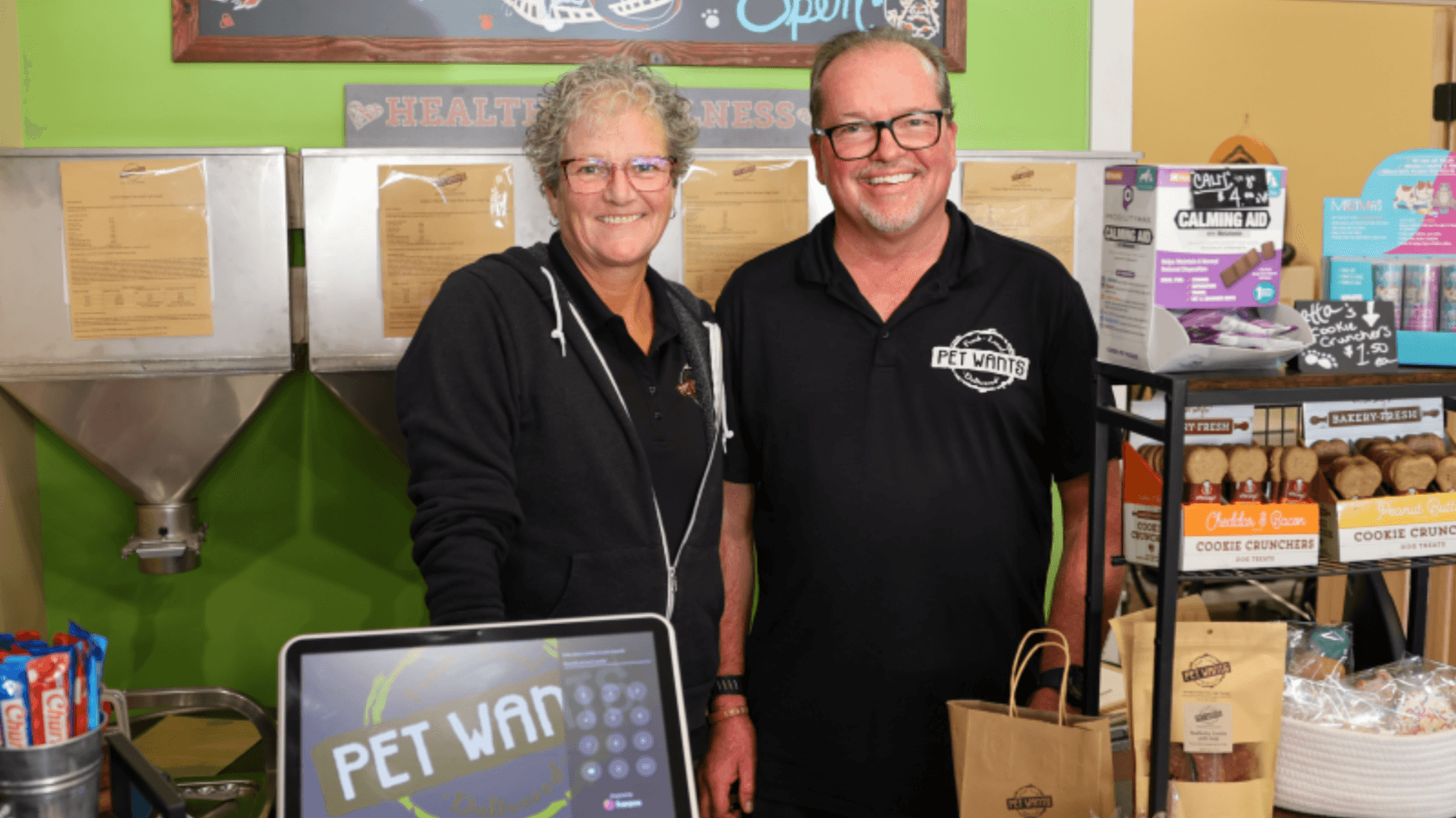
Gene and Jody Grant gave themselves about six months to decide whether Pet Wants was right for them. During that time, they dug into the business model and worked through what the investment would require. In May 2024, the husband-and-wife team launched Pet Wants of Miamisburg-Franklin in Ohio.
That preparation paid off. Since launching, the Grants have expanded from the mobile model into a brick-and-mortar store, added grooming and continued building their presence at farmers markets, festivals and community events. Today, Gene says the business is on pace to significantly outperform the growth target they initially set.
“We had targeted 20% growth, but I am thinking we are going to hit closer to 35%,” Gene said. “We launched the business in May of 2024, and in October we opened the store. We have continued to grow and expand.”
Still, some lessons can only be learned by running the business. Looking back, Gene says there are several things he wishes he had fully understood before opening, and they offer valuable insights for entrepreneurs considering a Pet Wants franchise of their own.
Don’t Underestimate the True Investment
The Grants entered the process with corporate experience and took their due diligence seriously. Before Pet Wants, Gene spent years working in the food, beverage and flavor industry, while Jody had stepped away from her corporate career to raise the couple’s five children.
As they approached the empty-nester stage of their lives, they wanted to build something together. Pet Wants appealed to them because it combined their entrepreneurial goals with their love of animals and desire to become more involved in their local community.
Even with that preparation, one of Gene’s biggest pieces of advice for prospective franchisees is to understand the full financial commitment required to launch a business properly.
“We did a pretty good job of doing our due diligence,” he said. “We took about six months to evaluate the opportunity so we wouldn’t have any surprises. One of the things that is out there for potential investors and franchise owners is: Don’t underestimate your investment.”
The initial franchise fee, Gene noted, is only one component of the capital required to get a business up and running. Owners should budget realistically rather than assuming they can cut costs throughout the startup process.
“A lot of people think that friends may build out the store, or they can pay the franchise fee up front and then you can do it on the cheap,” Gene said. “That’s not really how it works. Your investment is your fee, but it is also bigger than that. That wasn’t a negative for us. We had budgeted for that.”
Gene also encourages prospective owners to understand the franchise’s ongoing fee structure and account for those expenses when developing their financial projections. “I would caution folks when they invest to take a look at the fee structure, whether it is branding fees or anything else,” he said. “That is paid whether you are profitable or not, so that is one thing to keep in mind.”
For Gene, the lesson is not that franchise ownership comes with unexpected negatives, but that prospective owners should approach the opportunity with a complete understanding of the capital they will need and sufficient resources to execute the model properly.
Franchise Ownership Is Not Passive
Another reality Gene says prospective owners should understand is the time commitment. Pet Wants provides franchisees with an established model, training and ongoing support, but that does not mean the franchisor runs the business for them. Especially during the early growth stages, owners need to be prepared to take responsibility for everything from community engagement and staffing to customer service and day-to-day operations.
“It’s not a turnkey, passive-income operation,” Gene said. “We knew that, but the time commitment is there. Our store is open seven days a week, and it’s what every owner makes of it.”
In the Grants’ case, the workload has increased with the business's success. That is a positive problem to have, Gene says, but it still requires owners to build teams and systems that can support that growth.
“There is a big time commitment,” he said. “That has to be on your radar, and that is where a lot of folks get discouraged because of the workload. You are a business owner, so you are running it. It’s all you. It’s important to keep that in mind.”
Staffing, for example, has been one of the challenges the Grants have encountered as they have expanded into grooming. Their first groomer did not work out, but they found another who now works several days a week. Demand has been strong enough that the grooming schedule is already booked several months out.
“Everybody that comes in buys some retail products as well, whether it’s food or treats,” Gene said. “That’s been a great revenue stream, and we are looking to expand on that side as well.”
The experience reinforces one of the lessons Gene shared when he first became a franchisee: Owners need to think like entrepreneurs. “You have to remember that you are a business owner. You are an entrepreneur,” he said. “You have to make things happen for yourself, but that doesn’t mean you are completely alone.”
Pet Wants provides the model and resources, but the franchisees are responsible for putting them to work.
Know Your Market and Be Ready to Go After It
The Pet Wants model gives franchisees the ability to begin mobile, selling at farmers' markets, festivals and other community events before moving into a physical storefront. For the Grants, those events remain an important part of the business. Event season is now one of their busiest periods, allowing them to meet pet owners throughout their territory and introduce new customers to Pet Wants.
But Gene says prospective owners can't assume the same strategy will work the same way in every territory. “Know your market,” he said. “When you first start out, it’s a calculated risk, but you have to know your territory and what the potential is there and just get after it.”
That local focus was part of what attracted the Grants to Pet Wants in the first place. They wanted a business that would allow them to become part of the community rather than simply process transactions.
“We don’t view this as a transaction business; it’s a relationship business,” Gene said shortly after launching the franchise. “We want to focus on being there for our clients for a long, long time.”
A Storefront Can Change the Business
Perhaps the biggest surprise for Gene was just how much opening a brick-and-mortar store changed customers’ perception of the business. Pet Wants franchisees can use the mobile model to establish their presence through events, markets and local networking before taking on a storefront. The Grants launched in May 2024 and opened their physical location roughly five months later, in October.
“They tell you to do the mobile business for 12 months or so to get a feel of what the business is like,” Gene said. “I encourage folks to get into a store sooner rather than later, and I didn’t realize how much credibility that adds to you as an owner and as a business.”
The mobile model gave the Grants an opportunity to introduce themselves to the community, establish relationships and begin developing a customer base. But the store gave those customers a permanent place to return.
“The mobile side is great for community building, but we’ve had super success just because we now have a store,” Gene said. “There is a lot of enthusiasm. Once we opened the store, we were not disappointed. People came from events, networking, etc. I wish I had known what the impact would have been and how that capitalized into growth.”
The Grants discovered something else after opening their store: Their customers wanted an in-person experience more than they initially anticipated.
“I expected the online business, at least for us, to be even more significant than it is,” Gene said. “But people really love coming to the store and they love that face-to-face interaction, and I didn’t realize how important that would be. There is a craving for connection out there.”
That realization fits naturally with the approach the Grants have taken since day one. Pet Wants may sell pet food, treats and wellness products, but Gene believes the long-term value of the business comes from becoming a trusted resource for local pet parents.
The Model Provides a Foundation, but Owners Still Have to Learn
Even with months of research, Gene says there was no way to know everything before opening. Like any new business owner, he had to learn new systems, processes and responsibilities as he went.
“We went with the franchise business model because, with the economy and inflation the way it is today, starting a small business without support can be very challenging,” Gene said. “From the very beginning, I felt like Pet Wants really had a lot of things going in the right direction. We have not been disappointed.”
But support does not replace entrepreneurship. Gene’s experience demonstrates that franchisees still need to understand their finances, learn their market, put in the hours, build relationships and make decisions about how and when to grow.
“Use the resources from the franchise,” Gene said. “They have a lot more experience than you do. Stick to the model. You are a business owner, so you are running it. It’s what every owner makes of it.”
Ready to build a business rooted in purpose, passion and pet health and wellness? Visit https://1851franchise.com/petwants to learn more about franchising with Pet Wants.