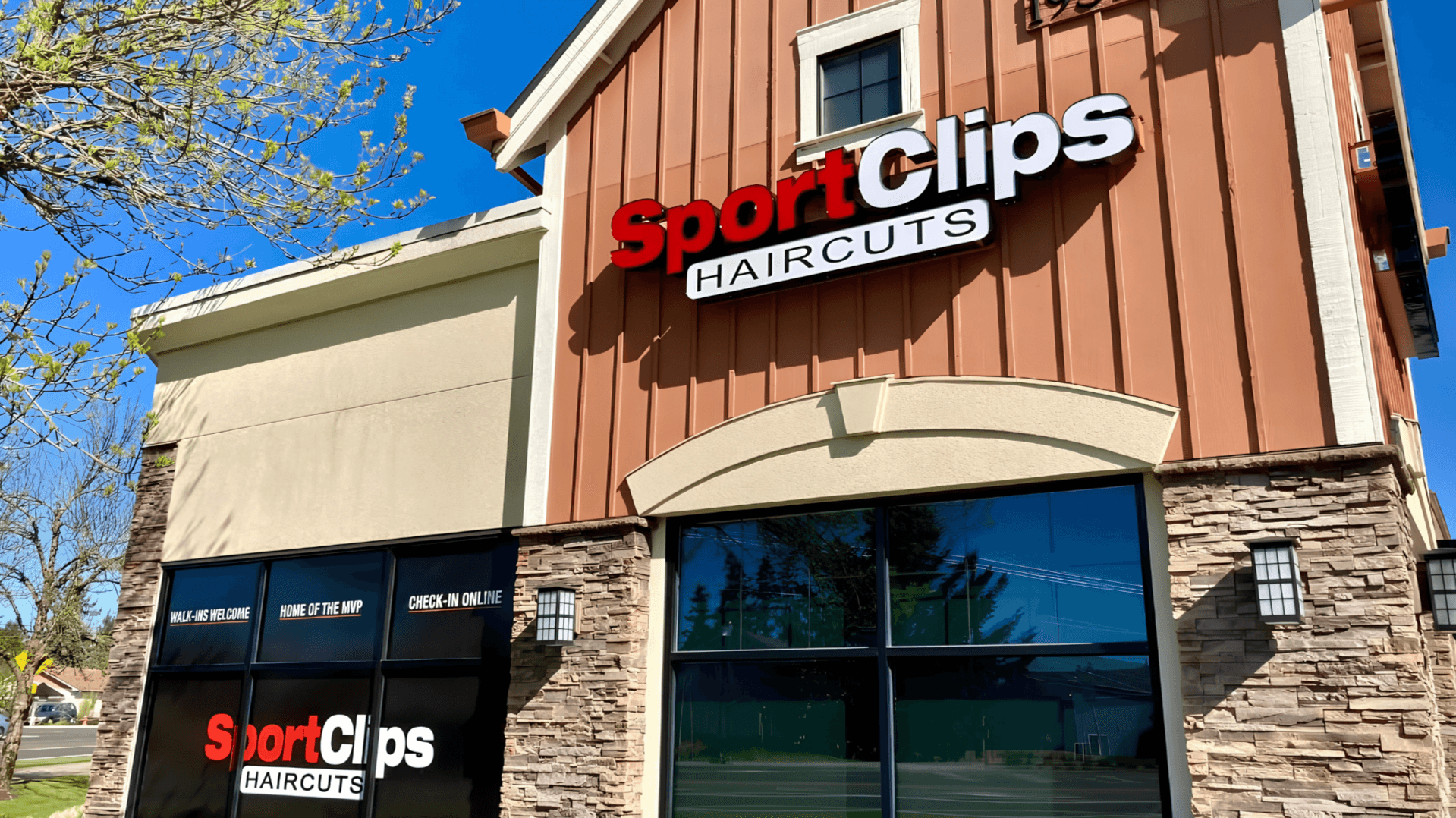
One obvious assumption someone might make when considering investing in a hair salon franchise is that you need to know something about cutting hair. At Sport Clips Haircuts, that is not the franchisee’s job.
The nearly 1,800-location brand has built its franchise model around a clear division of responsibilities. Licensed stylists provide the haircuts. Store managers oversee the daily operation. Franchisees, known as Team Leaders, handle something entirely different: building and leading the organization behind the store.
“You are spending time leading store managers, managing KPIs, recruiting and retaining stylists, a lot of the things that can be done outside of the four walls,” said Brent Greenwood, vice president of franchise development. “Building culture and the time spent in the store really helps with that, but at the end of the day, you don’t have to be in the four walls all day.”
That means the ideal Sport Clips Team Leader is not necessarily someone with experience in hair care. In fact, many successful Team Leaders have backgrounds that have nothing to do with salons.
What they do have is experience leading people.
Sport Clips Is Looking for Leaders, Not Stylists
When Greenwood looks across the Sport Clips system, he sees successful Team Leaders who arrived from a wide range of industries. “Team Leaders come from all walks of life, and we’ve had many successful ones who come from various backgrounds,” he said.
However, three profiles consistently stand out. “The three distinct categories that stand out are people who have built a successful career in corporate America leading other people, folks who come from employed, multi-unit leadership types of roles and then those who are already business owners who are looking to diversify and enter the industry that offers the recurring revenue we offer,” Greenwood said.
Those backgrounds make sense when considering what Sport Clips actually asks an owner to do.
Rather than standing behind the chair, Team Leaders work through managers. Their responsibilities include monitoring KPIs, recruiting and retaining employees, developing leadership bench strength, supporting local marketing and creating a culture that keeps teams engaged.
“We look at our entire organization through that lens,” Greenwood said. “From the executive team to in-store staff, everyone is a leader in their role. For Team Leaders, it’s someone who is people-centric, focused on delivering a great customer experience and building strong relationships with their team.”
Professionals in the stores can provide technical hair care knowledge. The Team Leader leads those professionals.
Manager-Led Doesn't Mean Absentee
The structure also explains why Sport Clips is careful about how it describes the ownership opportunity. While a Team Leader does not need to personally operate the store each day, Greenwood intentionally avoids calling the business “semi-absentee.” The phrase can suggest that an owner can provide the capital, hire someone else and largely disappear.
“We carefully select the manager-led model rather than using semi-absent, because so many investors consider that just absentee,” Greenwood said. “But this is not absentee ownership. It does require hands-on ownership, just not within the four walls of the store.”
The hands-on work simply looks different. A Team Leader might have a meeting with a store manager to review performance, stop by a location to connect with the staff, work on a local marketing partnership or interview a potential new hire.
“Once somebody has scaled, the day in the life is really just reaching out to the store manager, discussing KPIs, stopping in for an hour or so a week to connect with staff,” Greenwood said. “Maybe fix a television that was broken. You’re not in the day-to-day operations of the business.”
Recruiting remains particularly important.
“Recruiting and retention is another piece and is something we are always doing as owners,” Greenwood said. “Always find a place for a great new team member in the infrastructure, whether that is hiring a new stylist or creating new bench strength.”
That leadership responsibility becomes even more important as the business expands.
You Need to Know How to Work Through People and Data
Al Rodriguez offers one example of what the model can look like in practice. Before becoming a Sport Clips Team Leader, Rodriguez spent decades working in the office equipment industry and eventually became a national account manager. He wasn't a stylist, and when he began building his Sport Clips business, he wasn't even ready to leave his corporate career.
“I knew when I made the decision to invest in a franchise that I would end up having to work a day job for two years,” Rodriguez said. “I needed a concept that would allow me to work on it, instead of in it.”
That requirement became an advantage because Rodriguez couldn't make himself the center of his store's operation. “Having my day job forced me to work on it, not in it,” he said. “I had to work through people, and hiring a good store manager was a critical component of it.”
Rodriguez eventually grew to 36 Sport Clips locations. As his portfolio expanded, his leadership infrastructure expanded with it. “After I got to five or six locations, I promoted one of my managers to an area manager, who oversaw the stores,” he said. “And from there, we scaled.”
Leadership is central to the model, but Team Leaders also need to understand the performance of their stores. That doesn't necessarily mean being physically present every day. Technology and reporting systems let owners monitor what is happening across the business and use that information to guide their managers.
Multi-brand Team Leader Jesse Keyser has seen that firsthand. After operating across six different franchise systems, Keyser has grown his Sport Clips portfolio to more than 30 locations across five states.
“I manage these things remotely,” Keyser said. “There is no need to be there every day because I can see what is going on based on the data. The operation is pretty simple; inventory is pretty simple. I can see what time they took their first client, what time they took their last client and so on. At the end of the week, I can look at the productivity numbers and track that.”
The data doesn't replace leadership. It gives Team Leaders the information they need to lead more effectively. “After being in six different franchise systems, Sport Clips stands out because the model is so simple and easy to manage that I can focus on the big picture instead of the day-to-day,” he said.
You Need to Build Managers Who Can Build Stores
One of the clearest examples of the model comes from longtime Team Leaders Mark and Jan Mansfield. Mark was a petroleum engineer and Jan was an elementary school teacher before the couple signed with Sport Clips in 1999. Neither background prepared them to cut hair, but the business didn't require that.
After opening their first store, the Mansfields learned how important the manager position would be to their growth. “Once we found the right manager who was committed and really helped us get to where we needed to be, we signed a lease for a second store probably within six months,” Mark said.
They eventually fulfilled their original three-store commitment and continued expanding. Today, they own five Sport Clips stores and serve as Area Developers for a group encompassing 125 locations.
“Our job as Team Leaders is to support the manager and their team, and then help with marketing,” Mark said.
That creates a repeatable structure. Rather than building a business in which every important decision flows through the owner, the Team Leader puts capable people in charge of individual locations and gives them the tools and support to succeed.
“The ability to replicate is great,” Mark said. “It’s a proven model, and you are really putting someone in charge of each location.”
So, What Do You Actually Need?
A prospective Sport Clips Team Leader does not need a cosmetology license or years of salon experience. The brand is looking for people who can recruit talented employees, retain them, identify future managers, monitor performance, support local marketing, build culture and hold leaders accountable.
Sport Clips evaluates those qualities throughout its franchise discovery process, including thorough conversations, personality assessments and exposure to the actual store environment.
“You can’t just look at someone’s background and jump to conclusions,” Greenwood said. “You really have to spend the proper amount of time getting to know each individual person, what drives them, what made them express interest and what they bring to the table.”
The technical skill belongs behind the chair. The Team Leader's job is to build the business around it.
To find out more information on costs to buy this franchise, please visit: https://1851franchise.com/sport-clips.