Franchisor Stories
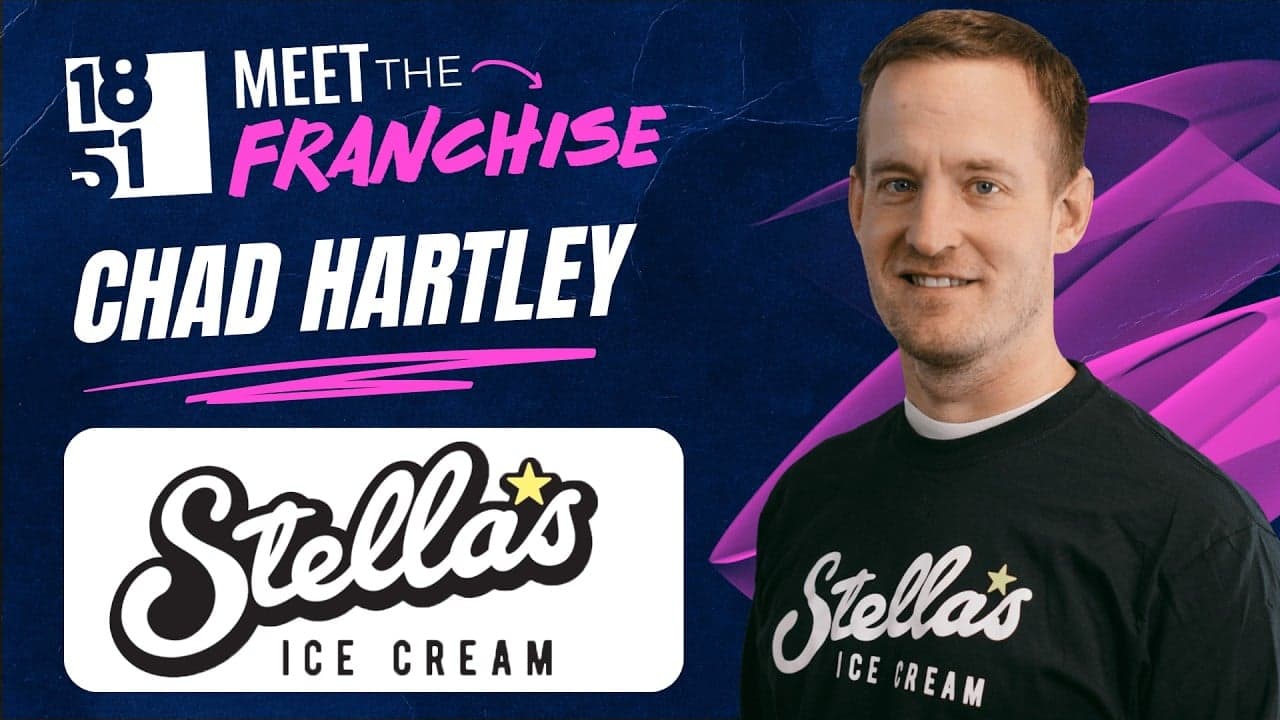
How Stella's Ice Cream Blends Small-Batch Quality With Scalable Franchise Systems
Stella's founder Chad Hartley shares how the Idaho ice cream shop grew into a 16-unit franchise system built on small-batch quality and community.
Franchisor Stories
Stella's founder Chad Hartley shares how the Idaho ice cream shop grew into a 16-unit franchise system built on small-batch quality and community.
Stella’s Ice Cream was born from a simple idea: What if work could feel more like joy?
For Chad Hartley, founder and CEO of Stella’s Ice Cream, that question came after a winding entrepreneurial journey. He started his career as a paramedic and firefighter, then built and sold a 13-location cell phone and computer repair business. After the sale, he spent time traveling with his wife and eventually found himself in Italy, thinking about what he wanted to build next.
“I just kind of said, ‘Man, wouldn’t it be nice to eat ice cream the rest of my life?’” Hartley said. “I came back and said, ‘I’m going to open up an ice cream shop.’ I didn’t know anything about ice cream or food service or any of that.”
That first shop quickly became a community favorite. Then came a second location, a third and a fourth. As the brand grew, Hartley began receiving questions from other aspiring ice cream operators who wanted to know how he was scaling successfully. That demand eventually led him to launch Ice Cream School, a consulting business that has helped hundreds of entrepreneurs open ice cream shops across the country.
But over time, Hartley realized that some operators did not just need guidance. They needed a system.
“There was one group of people that would come to me, and I would think, ‘You would be a perfect franchisee because you want to follow the rules. You want to do exactly what we say,’” Hartley said. “You may not be as gifted in the marketing or branding, but you can do operations really, really well.”
That realization led Stella’s into franchising. Since launching its franchise program in 2023, the brand has grown to 12 franchised units alongside four corporate locations.
The brand’s model combines small-batch ice cream made on-site, a community-centered retail experience and optional mobile ice cream trucks and carts that allow franchisees to capture additional sales at events, celebrations and local gatherings. For Hartley, the differentiation is clear: Stella’s is not trying to be another commodity dessert chain.
“People want homemade, locally sourced … I wouldn’t say healthier necessarily, but they want better products,” Hartley said. “There are thousands of ice cream shops out there that are making their ice cream on-site like we do at every single one of our franchises that are dang good ice cream shops.”
Hartley joined 1851 Franchise publisher Nick Powills on a recent episode of the “Meet the Franchise” podcast to discuss Stella’s Ice Cream, the transition from independent brand to franchise system and the lessons he learned from scaling too fast in his first business. A transcript of the interview — edited for brevity, clarity and style — has been provided below:
Nick Powills: How did you accidentally fall into franchising? What’s your franchise backstory?
Chad Hartley: It’s kind of a long story, how I even got into the business of ice cream and then finally into the franchising world.
I went to school to be a paramedic and firefighter out of college. I did that for about seven or eight years. I quickly found out that was probably not the best way to earn a living or build a lifestyle for a family. I saw a lot of gruesome and gory stuff, had a lot of late nights, nights and weekends, and it was not the ideal schedule. Quite frankly, it was not the greatest pay in the world either.
After that, I left and started another company in the cell phone and computer repair industry. I opened up 13 locations across three or four different states and got a glimpse into what scaling a business would look like. I had a lot of inquiries for franchising, but I didn’t want to go that route. I didn’t think it was for me at the time.
I also quickly learned that running 13 different stores across that many states was a lot of pressure on me personally. I got burned out really fast. Luckily for me, I got an offer from somebody that I couldn’t refuse to buy the whole business, and I took it and ran quite literally.
I went to Italy, [other parts of] Europe, Hawaii, Thailand and all these different places around the world because I was semi-retired for a year after the sale. When my wife and I were in Italy, I just kind of said, “Man, wouldn’t it be nice to eat ice cream the rest of my life?” I came back and said, “I’m going to open up an ice cream shop.”
I didn’t know anything about ice cream or food service. I took some classes, reached out to my commercial real estate agent and said, “What are we doing about this little spot downtown in my hometown? Let’s put an ice cream shop there.” He said, “Are you serious?” And I said, “Yeah, let’s do it.”
Next thing I knew, I signed a lease and was off and running into the ice cream world.
Quickly, that became popular in my hometown. We decided to open another one closer to where I was living. My wife didn’t like driving the kids across town, so we opened one closer. Then we kept snowballing and opened store number three and store number four in the following two years.
During that time, I got a lot of inquiries online, on Instagram, Facebook and social media. People were asking, “Chad, what are you doing? How are you opening all these shops and being successful?” For me, it really wasn’t that big of a deal because I had 13 cell phone stores, so four ice cream shops was pretty easy.
I started consulting during that time, and I still run a consulting business called Ice Cream School. I’ve helped hundreds of people open ice cream shops across the country. There is nowhere I can go in the U.S. without knowing a friend in the ice cream community. It is a tight-knit industry.
At one point, I thought, “Why am I not attaching my own name and my own brand to this?” There was a certain group of people I consulted for who fit the mold of someone who should not be a franchisee. They should go open their own ice cream shop, do their own branding and run it the way they want to.
There was another group of people who would come to me, and I would think, “You would be a perfect franchisee because you want to follow the rules. You want to do exactly what we say. You may not be as gifted in marketing or branding, but you can do operations really, really well.”
So we decided, if we wanted to expand our footprint, I did not want to open multiple stores across multiple states myself. I had done that before. We had gotten a lot of inquiries, and we finally decided to do it.
Now we are eight years into the business, about three and a half years into franchising, with 12 open and operational franchise locations and four corporate stores. We have four [franchises] opening in June alone, so we’ll be at 16.
Powills: You’re going to have 16 stores. How many franchise groups is that?
Hartley: We have three franchisees right now who have multiple stores. Several have multi-unit deals, but we have only been franchising for three years, so some of them are just getting into their second build. We don’t have any with three open yet, but I think we have about 18 franchise groups signed up currently.
Powills: Looking back at the cell phone business, what store number did you burn out on? Where could you have stopped and kept the joy?
Hartley: That’s a great question. Probably around six. Maybe about half that many.
Powills: That matters because you are now training franchisees on how to scale. You figured out how to scale a business, but you also figured out how you pushed yourself over the edge. How much of that lesson is now part of what you teach franchisees?
Hartley: When we go through training, and even with my consulting clients, one of the first things I ask them is, “How much money do you need to make?”
It’s open-ended, so they don’t know whether to respond with sales volume, revenue, net income or actual take-home pay. Because it’s so open-ended, it brings up some really interesting conversations.
I was consulting for a fairly young guy who had just opened an ice cream shop, and he started asking me about work-life balance, when enough is enough and how much money is enough. We got into this discussion about how it is not about the money anymore. It is about the game, what you consider successful, how much challenge you want to put into your life and whether that is in business or your personal life.
Entrepreneurs are notorious for wanting to push the limit and challenge themselves regardless of what the money is.
If I had known what I know now about scaling, putting the right people in place and building infrastructure, we could have easily grown the cell phone company to 50 stores. At the time, it was me being super controlling and micromanaging. I had to have my hands on every employee. I didn’t have the organizational structure I needed to grow.
I took the things I learned from that and asked, “How do I not burn out this time?”
When you’re going from one to two to three locations, there is a grind period where you probably are going to get close to burnout before you can afford to hire the right people. Now, I feel like I’ve achieved that with my team for our corporate stores. We have a fantastic team. Quite frankly, I don’t do a lot in my own corporate stores.
Then the grind became, “How do I get franchises open?” I spent a ton of time grinding in the franchise business. Now we are finally getting to a point where we have enough franchises to create the royalty income stream, and I am putting the same people in place so I don’t have to do everything anymore.
It was harder for me when I had five or six franchises than now that I am about to have 16 because I didn’t have any help. Now that I have a team underneath me, I’m like, “Let’s go to 50. Let’s keep scaling.”
For franchisees, those first one, two and three stores might be a bit of a grind. But when you get to four and five, all of a sudden you can afford to hire an operations manager. Then you can feel like you can go to 10 without the burden of those first three. There is a hump. You have to get over the hump.
Powills: Systems are greater than heroes. When the franchisee is the hero, they can get overwhelmed at two or three units because they have not reinvested in the business or built the systems. Is that part of what you’re trying to solve?
Hartley: For sure. If I had hopped right into ice cream, I probably would have made the same mistakes I made in the cell phone company.
I really think the sweet spot for our business is three stores. When you get three stores under your belt, that allows you the freedom to decide how much you want to hire out, how much you want to do yourself and whether you want to go another two, three, four or five stores.
Three stores can create a pretty decent income. You can decide, “I’m good. Let’s stop right there.” You can hire an ops manager or a regional manager, or whatever you want to do.
You’re not going to be a millionaire by any means, but for most people, it is a reasonable salary or income. It can replace most general people’s blue-collar wages. Would you rather own ice cream shops and let other people do your job, or would you rather work the 9-to-5? I would rather hang out in an ice cream shop on a Friday or Saturday night with my family and say, “I own this.”
Powills: There is something powerful about ice cream as a business. It naturally brings happiness.
Hartley: We used to say, in my previous businesses, that we met people on the worst day of their lives. If you have a broken cell phone or computer, you are extremely mad. That was very similar to how I greeted people on the ambulance. If you called the ambulance, it was probably the worst day of your life.
The cell phone industry was the same thing. The only reason you’re going into a cell phone repair store is because something is broken and you’re mad.
Ice cream is completely different. Most of the time, you are greeting people on a great day. They are getting ice cream. They are celebrating.
There is something about owning an ice cream shop that is very appealing to a lot of people. It is a sexy business to own. It is something you can show off. It is something you can be proud of.
Powills: You’ve helped so many people get into the ice cream category. Where do you see the differentiation in the concept?
Hartley: I consult for all types of ice cream shops, and the biggest thing I am seeing right now is that people want homemade, locally sourced, better products. I wouldn’t necessarily say healthier, but they want better products.
There are thousands of ice cream shops out there that are making their ice cream on-site, like we do at every single one of our franchises, and they are dang good ice cream shops.
When I visit a new city, I won’t go to a chain, but I will go to a local ice cream shop if I know they are making their own ice cream. If I know they are purchasing their ice cream, we are not going. The quality just isn’t there.
It’s kind of like a burger or pizza. I don’t want to go to a chain to get my pizza. I want to find the local community hangout where the best pizza is.
That is what people are looking for. The people struggling in the ice cream world are the ones who do not have any differentiation. They can’t make their own flavors. They can’t roll out seasonal products. They can’t source local products. They are just buying off the shelf from one of the major brands.
With ice cream, it is super easy to make your own ice cream, so that gives you some leeway against the competition.
Powills: Part of the magic in frozen yogurt was customer control. It was about letting the customer build what they wanted. Does that apply to Stella’s?
Hartley: In our ice cream model, we have set up our service counter to be similar to that.
Our tagline is “serving all kinds.” We want to be able to serve anybody who comes in the door something that will fit them. Whether that is gluten-free, dairy-free, vegan or whatever it is, we have something for you.
The idea, and the way we increase our average ticket, is that you start customers on things they didn’t know they needed when they walked in the door. Everything they came there for — the ice cream — is throughout the line.
It is no different than Chipotle asking, “Are you sure you want that guacamole?” In our store, it is, “Are you sure you don’t want some toppings, caramel sauce, an extra brownie, an extra cookie, a bottle of water or something to go?”
By the time they get to the end of the line, it is not just a little cup anymore. It can be $18 worth of ice cream. Setting up the line that way speaks to customization and being able to build your own product.
Powills: Ice cream is emotional. People are not just coming in because they are hungry. They are looking for happiness and memories.
Hartley: That can be applied to two different types of ice cream shops.
People always ask me, “Should you get a drive-thru?” I tell them they have to ask themselves what type of ice cream shop they want to be.
Do you want to be the experiential ice cream shop where people go in, sit down, hang out with friends, listen to music and make it a Saturday night date? Or do you want to be the drive-thru guy pumping out hundreds of soft-serve twist cones?
You can make money both ways, but you probably can’t do both well.
That is not the type of ice cream shop I am. I want to be community-centric. You come to celebrate. You come after football games, after graduation, after a piano recital. You come hang out, listen to music and enjoy the experience.
That is part of what you are selling. It is not just ice cream.
Powills: Your social media seems to tell that story well. How important has that been for franchise growth?
Hartley: Our customers are not coming through our website. They are going to our social media, Instagram and TikTok. We have things on Instagram that have 10 million or 50 million views.
A lot of our potential franchisees say, “I found you on LinkedIn.” I post on LinkedIn very rarely, and when I do, it is not even business-related. It is just, “Here’s me making some ice cream.” I get a lot of leads from that.
A lot of people are using AI to generate business content, but I don’t think they are getting any kind of return on their time or money there. Post something unique. That is what we have done through social media, and I think it is having a big payoff for us.
We have a full-time social media manager who sits right next to me in my office. I monitor her content, and she does a really great job of getting attention. That is the way we are selling franchise stores. That is what people are looking for.
Powills: Chad, great conversation. I’m excited for where the business is going. Thanks for sharing your story.
Hartley: Thank you so much.
Watch the full podcast here.
Sign up for the 1851 Franchise newsletter to get our biggest stories before everyone else
By signing up, you agree to our user agreement (including class action waiver and arbitration provisions), and acknowledge our privacy policy.