Franchisor Stories
Waterloo Turf Builds The First National Brand Owning The Growing Turf Sector
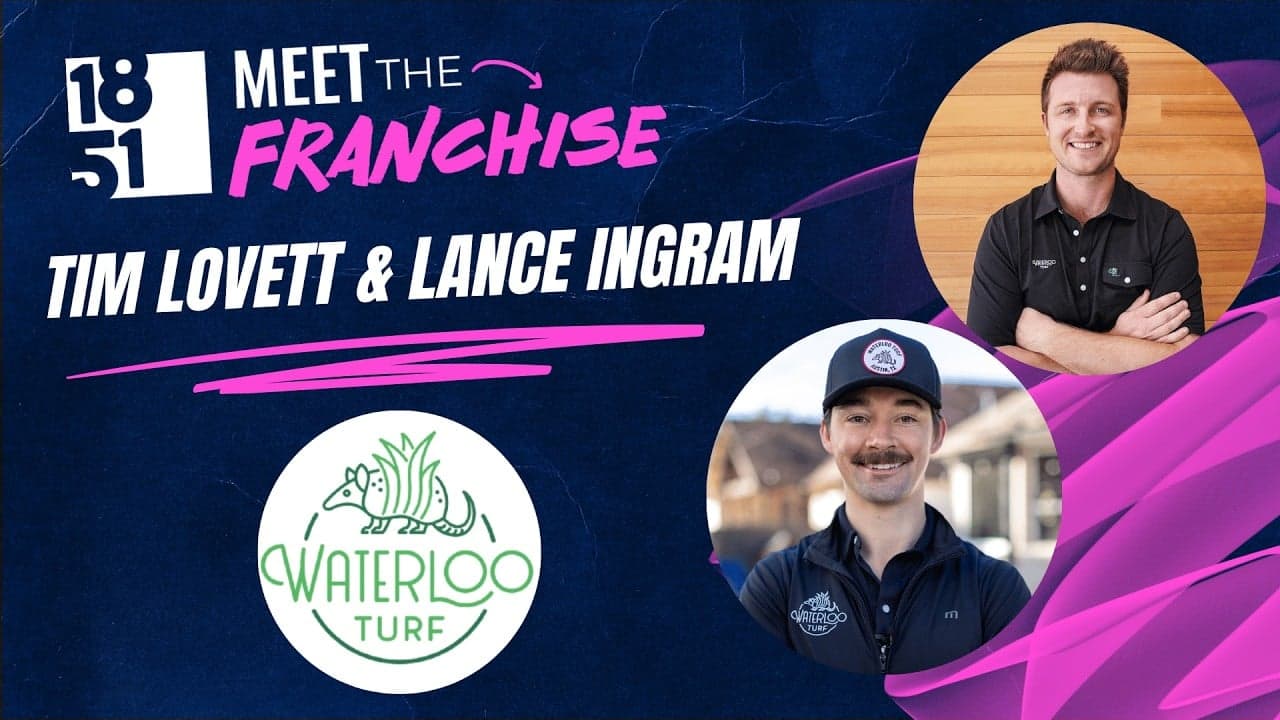
Waterloo Turf leaders Tim Lovett and Lance Ingram left corporate jobs to hone a model focused on creating local turf experts.
Franchisor Stories
Waterloo Turf leaders Tim Lovett and Lance Ingram left corporate jobs to hone a model focused on creating local turf experts.
When Lance Ingram graduated from college, he felt the pull of corporate employment, like most graduates. Although he felt an itch for entrepreneurship, the reality of making the leap felt far from what his fellow students and friends were doing with their time. While living with his parents in Austin, the decision on where to take his career was always on his mind.
“I am going to do what everybody else does,” Ingram said. “I am going to look into commercial real estate or insurance, because that is what you do.”
Following an unusual path, Ingram ended up taking that leap. Before creating Waterloo Turf in 2021, Ingram had already owned a turf company in his mid-20s, sold his shares in it, and had moved into and out of corporate medical device sales.
For Tim Lovett, entrepreneurship began with making waves at his own corporate job, where he worked with a small team to create a subscription product that netted $120 million in recurring revenue in just 15 months. After finding success and a bigger team, corporate restructuring driven by the product’s success led Lovett to a startling realization about the importance of equity.
“What I learned about that is I can put my heart and soul into building something, and at the end of the day, not own any of it,” Lovett said.
In his next role as an operations executive for Resi Brands, a home services franchise platform, Lovett came a lot closer to the ownership level he was looking for in his career. While researching the home services landscape for his next opportunity, Lovett made another discovery. In a crowded market, a single indicator of a franchisee's success was whether they were part of the first national brand in that trade.
“They were not competing against private equity that had just dumped a bunch of money into the space,” Lovett said. “They were able to compete against, for the most part, single mom-and-pop operators, but under a national brand and all the support that that brings.”
Ingram and Lovett were initially connected through church, but once they began discussing their professional circumstances and goals, it became clear there was an opportunity to work together. The two teamed up to accelerate Waterloo Turf's growth. With 95 units open, Waterloo Turf now represents the first national brand providing turf services in the B2B and B2C market, bringing the level of operational excellence normally seen in traditional home services brands that have cornered HVAC, plumbing, and roofing markets.
For Waterloo Turf, growth is a planned reality, but whom to grow with is a question Ingram, Lovett and their teams take seriously, sometimes checking back weekly to ensure everyone is aligned on what the perfect franchisee looks like. For Ingram, the perfect franchisee is a local operator who is deeply entrenched in the community and comfortable working diligently for years, earning the return that comes with expertly delivering a needed service.
“That is what we want from our turf owners: to be passionate about what they do and to truly care about the client they are working with.”
Ingram and Lovett joined 1851 Franchise Publisher Nick Powills on a recent episode of the “Meet the Franchise” podcast where they discussed the benefits of being the first national brand in a home service sector, and what they are focused on to continuously build on that advantage. A transcript of his interview with Powills has been provided below. It has been edited for brevity, clarity and style.
Nick Powills: What’s your guy’s backstory? It seems like both of you at some point got tired of corporate America and decided you were going to go do this instead.
Lance Ingram: I founded Waterloo in 2021, but I have actually been in the turf space for a little greater than 10 years. I graduated college in 2016. I had no idea what I wanted to do with my life. I had no job.
At that time, I thought, "I am going to do what everybody else does. I am going to look to getting into commercial real estate or insurance," because that is what you do. I moved back home, and a friend reached out and said, "Hey man, do you want to help start a turf company with me?" At first, I told him, "No, I’m good. I don’t want any part of that." It reminded me of my youth, which was every Saturday doing yard work until I could hang out with my friends.
I went down the path of looking into insurance and looking into real estate, realized I do not like either of those things either, and I have always kind of had an entrepreneurial edge to me. I decided to say yes to starting up that other turf company because I figured I am already living at home.
I helped co-start a separate turf company in 2016, ran that for about three years, and it went really well. About three years in, for whatever reason, I got lured into the corporate world. I was young, I was dumb, and unfortunately, I am the type of person that you could tell me the stove is hot, and I have to figure it out for myself.
I sold off my ownership, I went into medical devices, and very quickly found out that the stove was hot. About two years into medical devices, I remember one day in particular that really shifted me back to wanting to be on this side of the table.
I was driving to my territory, which was about three hours outside of Austin. It was in December. I am coming down a road, and there was a little bit of an ice storm that morning. I slid off the road, through a fence, into a field.
I get a call from the doctor's office and they are asking me, "Where are you at?" They said, "Why aren't you here? We are getting scrubbed up." I told them, "I just slid off the road. I am in a field. I am trying to get my car out." It was not, "Are you okay? How can we help?" It was just, "Well, how soon can you be here?"
On that drive home that evening from that car wreck, it was 10:00 PM or 11:00 PM when I am getting back home, and I am thinking the whole way if I could start another turf company and run it at somewhat of the same pace I was running this last one, that would be great.
The same month that my wife and I got married back in 2021, I quit medical devices and I started Waterloo Turf. I ran it solo for about three years, and then about three years into the journey, a buddy of mine who I had known for a bit reached out and said, "Hey man, I have been following what you have been doing with Waterloo. It looks really interesting. If you ever wanted to expand, I would love to talk about the opportunity of expanding to San Antonio to be the next location."
I knew from the beginning that expansion is something I wanted to do. It just had to be the right person, right place, and right time, and all those boxes were checked. Ted, who started as my general manager but is now my business partner, opened up San Antonio. Within three months of opening up San Antonio, I have not gone back to San Antonio. That has been over two years now and I am again left in this kind of spot with free time to figure out how I want to continue to expand Waterloo.
At this point in time, my wife and I joined a small group through our church. Tim and his wife were actually leading that small group. We met at the Lovetts' house for a couple months, and just did not really talk about much other than what was on the curriculum for that evening. Then we went on a double date one evening with our wives and started talking about what we do for work. I told him I own a turf company, I am looking to expand it, and I am thinking about franchising.
He said, "That is interesting, because I am in franchising.” The main catalyst of choosing franchising over going the corporate route and planting Waterloos like San Antonio and Austin was really that Waterloo has been a massive blessing to my life. It really came down to what vehicle could be used to get this blessing out to as many people as possible, hopefully as quickly as possible, with franchisee profitability being at the forefront of everything that we are doing. That is ultimately the story of how Waterloo and Waterloo franchising came to be.
Powills: All right, Tim, you are in a corporate job. You are in another franchise brand at that point. Obviously, now you have to go through the same mental process. What is that trigger that made you say, "Okay, I am willing to take a risk here, too"?
Tim Lovett: Frankly, it came before then. I was a part of a different multinational corporation. It was a big company. When I was there, I helped start up a subscription product with one other guy. We ended up building a team around it, had a couple of other people join that team, and we went from zero to $120 million on that subscription product in recurring revenue in 15 months.
At that company, it was great. But once you start doing $120 million of revenue at ridiculous gross margins, they say, "Hey, you are actually a real part of this business. We do not want you to report to the investors anymore; we want you to report into the actual system and company."
I decided to leave that company. It was a really great experience for me, no regrets. But what I learned about that is I can put my heart and soul into building something, and at the end of the day, not own any of it.
After that experience, I decided that if I am going to go and do something, I want to make sure that I actually own equity in it. I got involved in a franchise platform and was the operations executive there across a home services brand. One of the things that I quickly started to look for and find patterns in was: across home service franchising, who are the franchisees who just have exceptional outcomes and are super successful?
What I found was typically the number one indicator of a franchisee having a lot of success was whether they were a part of the first national brand for that given trade. They were not competing against private equity that had just dumped a bunch of money into the space. They were able to compete against, for the most part, single mom-and-pop operators, but under a national brand and all the support that that brings.
I felt like there was a bunch of opportunity in the artificial turf space. It is also a growing industry. It is B2C, it is B2B, and it is a high-project ticket. There is recurring revenue on the back end. There are legislative tailwinds through water conservation. Nobody wants to mow their lawn anymore. I just liked everything about it.
I started to look for companies to franchise for about a year and a half, and that is when I met Ingram. What really clicked was a couple of things. As I started to go to Ingram's job sites for Waterloo Turf in Austin and San Antonio, you just found a higher level of quality, not just in the branding, but also the customer experience and the level of install. As Ingram and I continued to talk, I found that we were extremely values-aligned. We thought: if we are going to do a brand, we want this thing to be about franchise owner success.
Powills: For clarity, you left the old franchisor and now do this full time, right?
Lovett: Correct.
Powills: That is a big decision, too. I wrote a column after I quit the agency that I left where I pitched business concepts, got rejected, and then I wrote this column that said, "Catch the entrepreneur before they catch you." I actually think that is the biggest mistake that corporate America misses, and it is probably built on greed.
How do you catch these entrepreneurs so that they stay in your company?
Lovett: The beautiful thing about business is that there are just so many ways to do really well. What we found was: we can be extremely focused on a space that nobody else is focusing on. There is no other national brand in artificial turf. You look at other trades where there are national brands in home services; those brands have done exceptionally well, especially if they were the first to market.
For us, it was, "Let us develop a thesis here that we can become a national name brand in artificial turf." We can do that through franchising because we believe that homeowners will get a better quality product at the end of the day if it comes from a local business owner who is in that area, goes to the church that their customer goes to, and sees them at the coffee shop, versus just sales representative number 500, who might just be cashing a check and might not even be a full-time employee. We just think it is a better way to go about becoming a national name brand by keeping quality at the top.
Powills: How many units do you guys have open right now?
Lovett: We have 95 units open.
Powills: Both of your stories are built on faith and built on culture, so how are you balancing that? How are you doing that in a world where, to the franchise broker, it is all about closing the deal, but to the franchisee, it is about changing their life, building wealth, building trust, and transparency? What are some of the challenges and bumps that you have had to battle through?
Lovett: When we launched the brand, we started by just looking at who is doing really well in Waterloo Turf in Austin and San Antonio. At the time, 75% of Waterloo Turf salespeople had a fly-fishing background. We figured that was probably too small of a pool to draw from.
What did that mean? They had a very high bar for what client experience looked like. They had a little bit more of that hospitality-type touch, and they were really hungry. They wanted to go and make more money than what they were doing, and so that is how we started.
What I have found is we have had a great experience working with franchise consultants out there. Part of that is we have actually gotten extremely clear on who is a good fit for Waterloo Turf. We are looking for somebody who wants to be all in on the business.
What does that tactically mean? They are going to leave their job before they come to in-person training, and they are going to build the Waterloo Turf business full time. We are looking for somebody who actually lives in their territory. That community and local business owner model is really, really important to us. They do not need to have sales experience, but what we have found works really well is when somebody has organizational experience. At this point, close to 25% of our owners are from the military, and many of them are former SEALs. They are coming from law enforcement, larger sales organizations, or as a former NCAA athlete or straight out of an MBA program, something where they have had organizational structure while having the latitude to perform like an athlete would.
If somebody does not match this, we are going to let you know very early if you are a franchise consultant that they are just not a fit for us. We have been able to do a good job with franchise consultants because we are not leading bad candidates along and stringing them along on a three-month process while they talk to us, only to turn them away at the end.
Powills: You said, "We put in the pre-work to say very clearly who we want." If most brands do not create that clarity, their clarity is: do they have the money and can they buy a franchise? What you unlocked is saying, "Let us put a guardrail in front of this so that the brokers can actually be beneficial to our business." If they understand this, candidates do not just get through level one to get to you, whereas every other brand treats a territory check like a win.
The other thing that you said that unlocks greatness is that you are very franchise-intelligent in talking about the success of the franchisee. Most franchisors are confused; they think the sale is the win, not the gross sales which turn to royalty. That is part of the magic, whether you recognize it or not. That is why it is working for you, because you have those two guardrails in place before candidates are even able to enter your system.
Lovett: I agree. For us, we have developed it over time, and for any franchise brands out there, this is continuous. It is figuring out who is a good fit for your system, because even as you grow, your system evolves as far as who is a good fit. It is something we actually look at weekly in our leadership meeting: who is the ideal franchise owner in Waterloo Turf? It evolves every single week.
Powills: Generally speaking, even when I am looking at resumes today, there is a lot of bounciness in everybody. Even in people that do not become business owners, they are bouncy.
How do you guys keep that lockstep, ensuring there is enough variety and change for your franchisees who are probably coming in with some bounciness too, to say, "Look, you are going to have to stick this out"? How do you build that culture that this is going to be a ride to build something up? What is that bounciness that can exist when being a franchisee?
Lovett: Have you ever seen the movie Groundhog Day? That is what we like to talk about: a good Waterloo Turf owner is living Groundhog Day every single day.
We would actually discourage having variety. We think that you should be doing the same thing every single day. If you spend every single day working on a new thing, you never give it time to compound and actually pay your business back.
If you are just chasing shiny objects or putting out fires all the time, you probably have not built a system that eliminates those fires in the first place. We think that everybody should come in, have a lot of consistency, and give it a lot of patience.
What is different is that you are stepping into this as a business owner, so it is a little bit more of an ownership versus an employee mindset. When I was working for other companies, I bounced around because ultimately I was a salesperson. I did the same thing every single day for six years; it was just for three different companies because they paid me more. But when you are an owner, you are actually building an asset for yourself, so you are able to stick with one opportunity vehicle for longer.
Powills: My final takeaway question and statement is this: I love your story and every bit of it. If I go to your franchise website, it says "franchising." The "get your Saturdays back" line is interesting, but it says "franchising." Why have you not put your story, or the stories of the police officers or the military members, front and center? It is there, but it is not front and center. Is that just default, or is it that you have so much to get done that you cannot go back and think about that? I actually think organic lead generation for you guys is completely possible because of your story.
Ingram: That is a great point. Something to make note of, because I do think it is a great idea, is that a lot of these stories coming about from our franchise partners are starting to blossom right now, and that is part of it, too. We are hearing amazing things on a daily basis, and we probably could run something like that.
To be the turf guy—or turf gal, as we have got some gals in the system in your area—that was kind of my original goal when I came back to the turf space. I never thought I would come back to turf when I left it. But what you will learn is that when you get in it, it is a really fun place to be. If you leave, you are going to miss it and you are going to want to be back.
It just means being passionate about what you do, being knowledgeable, and being the turf expert that someone is going to talk to if they have Waterloo Turf or any synthetic grass come out to give them a quote on their backyard. Through Trainual, which is our onboarding, we have 60-plus hours of turf content, turf literature, and turf knowledge that you go through before you ever go live with your business.
Something we reiterate to all these owners is: you have put the money in and you have put the time in to learn all of this information. You would really only be doing your business and yourself a disservice if you do not go and flex it on anybody and everybody that you meet.
I could be talking to somebody and they could be super passionate about beekeeping. I do not care about beekeeping at all, but if you are passionate about it, I will stand there, listen to you, and be engaged as well. That is what we want from our turf owners: to be passionate about what they do and to truly care about the client they are working with.
Being in the turf space for 10-plus years at this point, the coolest part of the business, still to this day, is seeing the family come out after you transform their backyard. It is hands down the best part of the job, because you get to see the yard before and you get to dream with them.
Our slogan, like you said, is "Get your Saturdays back." We like to ask every client, "For you, what would it look like to get your Saturdays back?" We want to dream with them. They might say, "We want to entertain more, but we do not entertain because we have to take care of our yard first," or, "We have got three young kids, but they hate playing outside because our yard is a mess, and we want to get them off the screens and be outside more." You get to see the before, and then you literally get to transform and see the after with them. The kids come running out, the dogs come running out, and you get to hear these success stories after.
Countless times I have heard from clients, "That was the best thing we have ever done with our house. The best money we have ever spent was using you guys to come in and transform our backyard, because it completely changed the rhythm of our house."
It changes so many things—more than you would even imagine. It is the passion of getting to transform lives through synthetic grass that a lot of our franchise partners get really passionate about.
Watch the full episode above or on YouTube.
Sign up for the 1851 Franchise newsletter to get our biggest stories before everyone else
By signing up, you agree to our user agreement (including class action waiver and arbitration provisions), and acknowledge our privacy policy.