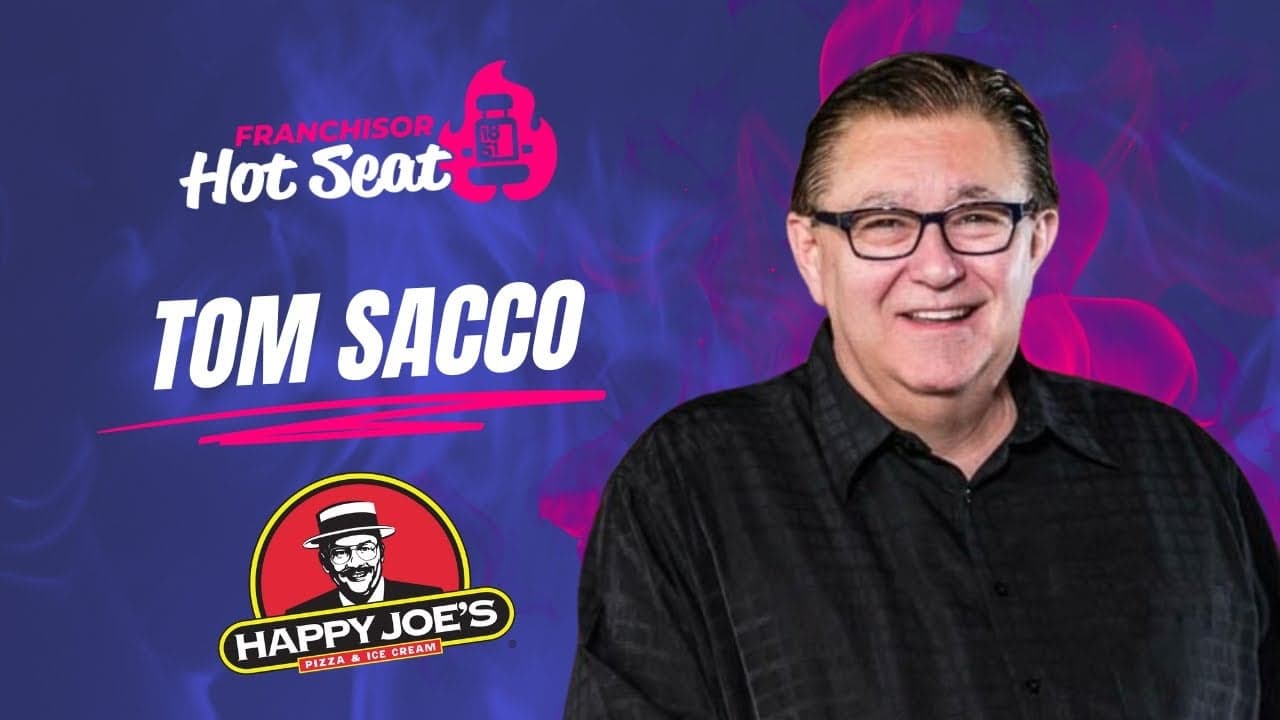
Happy Joe’s President and CEO Tom Sacco recently joined 1851 Founder and Chief Growth Officer Nick Powills on his “Franchisor Hot Seat" podcast to discuss his leadership journey, the challenges of reviving a legacy brand and his passion for creating a sustainable future for the family-friendly pizza and ice cream restaurant brand.
Drawing on decades of experience in the restaurant industry, Sacco shares how he built trust with franchisees, focused on operational excellence and developed a vision that blends family connections, strong unit economics and franchisee success. With 75 locations and plans for national and international expansion, Sacco is ensuring Happy Joe’s remains a beloved brand for generations to come.
A transcript of Powills’ interview with Sacco has been provided below. It has been edited for brevity, clarity and style.
Nick Powills: All right, Tom I know your story, but for our audience may not. It's such an easy question, but you're going to have a good answer to it. How did you accidentally fall into franchising? What's your franchise backstory?
Tom Sacco: I got into franchising kind of by default. Back in the early 1980s, I went to work for — at that time — a little itty-bitty restaurant brand called Red Robin. We had five restaurants only in Seattle. My background had been in corporate stores, and at that time, that's all they had — corporate stores — but they wanted to franchise and that became my introduction. From then on, I just got better and better at it because it’s really relationship building. My job over the years has been helping other people make a lot of money and grow the same brand that I happen to love. One thing led to another, and I ended up here at Happy Joe’s many years later, starting all the way back in the early 1980s.
Powills: Obviously, franchise growth is a component, but you're not just franchise growth. You are a leader over the entire organization. If you had to weigh the importance of areas — if we broke it into operations, customer experience, marketing and then put franchise sales over here — how do you weigh the importance? When you get involved with a Happy Joe's, do you say, "Okay, first I gotta fix these before we can start being a good opportunity for a franchise buyer"?
Sacco: Yeah, that's exactly how the process goes. When we finally came to the conclusion that I was going to take the job and Happy Joe's was going to take me on to lead the company, the first year and a half really was a lot of resuscitation and analysis. It was about identifying strengths, weaknesses, opportunities and threats — like a SWOT [strengths, weaknesses, opportunities and threats] analysis — by discipline: marketing, purchasing, operations and all those elements. Then you just take it one hill at a time. Over time, you develop the people around you so they can climb the hill with you. You don’t have to manage everything alone.
After about 18 months, we were really ready to roll. Around that time, I hired Kat [Davidson] to head up franchising because I don’t have the time to sell. I’m fine coming in to close or massage a deal, but because I’m engaged in so many areas — purchasing contracts, marketing, new product development — I drove a lot of that myself initially. I had to say, "Okay, go make me this." Then we’d talk about it and I’d explain the "why" behind it. Over time, it builds from there.
The other part is truly relationships. You have to get the franchisees to buy in. In the old days, we’d say, "We have to get them to drink the Kool-Aid." They have to share the same vision I have for the company. When I joined, it was a challenging time. The company was drifting without a rudder. The owner had passed away five or six years before, the company had been sold and the franchisees didn’t have confidence in the brand for the long term.
Part of my job wasn’t to sell them but to let them see into my soul and understand why I was there — that I was there for the same reason they were. Together, we’d be better off linking arms and going to battle hand in hand instead of me battling them, the competition, the economy and, as it turned out, COVID. We faced all those challenges, but building that mutual trust was critical.
Powills: One thing you shared with me is that during your own due diligence, you flew to Iowa and started asking customers at the grocery store if they knew Happy Joe's. Obviously, you were doing that to assess the viability of the brand. When you were doing your due diligence before taking this on, it’s a two-part question: First, were you looking at it through the lens of a franchisee? And second, if you were and came to the conclusion that there was a lot of work to do, you then spent 18 months trying to make this brand franchisable again to be a good opportunity for the buyer. Were you looking at it through that lens? And how do you have the patience to wait long enough to put the machine back in order?
Sacco: So to answer the first question, no, I wasn’t looking at it from a franchising perspective. I was strictly assessing if it was a viable business. We’ve all been in this business long enough to know both sides of the selling point, and Happy Joe’s needed a leader. Everyone was telling me great things about the brand, but they weren’t the ones buying the product — the guests were. I needed to know what people in the backyard of this 50-year-old brand really thought, unfiltered.
In my own unsophisticated way, I created focus groups — one guest at a time. I have to say I was delightfully surprised, and that’s an understatement. I’ve been in this business a long time and worked for some great brands, but I’ve never seen a brand where guests had such an emotional connection — not just with the product, but with the concept of who we were. Guests would bring up Happy Joe’s and share family memories created around it, whether at home, the restaurant or even a football field. The stories varied by generation and gender, but the theme was the same.
I often had to ask, “How’s the pizza?” because their focus was on the emotional impact of the brand. Then they’d say, “Oh, the pizza is unbelievable — the best around,” and rave about things like the Taco Joe pizza. But the product wasn’t what drove their connection, and that fascinated me. Based on all this goodwill, I knew I could figure it out.
When I came back from Iowa, I told my wife, “I think I’m going to accept the job.” She wasn’t thrilled since I had already retired, but it felt right. The hours are long, but when you’re passionate about something, the time doesn’t matter. Sometimes the days aren’t long enough to get everything done. I tell my kids to find a job they love, not just the one that pays the most, because that passion keeps you engaged and makes you successful.
Now, five years later, we’re growing the brand nationally and internationally. We still have challenges, like POS [point-of-sale] functionality, but those are small compared to where we started. Early on, if the cash register worked, I was fine because I had bigger issues to solve. The brand was dated, and after the founder passed, the vision faded.
This isn’t just about growing restaurants — it’s about impacting lives. Part of my strategy is succession planning. Many franchisees have been with Happy Joe’s for decades and I don’t want to lose stores because of aging owners. We help franchisees transition ownership to maintain the brand’s legacy.
When the franchisees saw my dedication and the effort I put in to gain their trust, they knew I was all in. After about a year, their concerns eased and we locked arms to move forward. That timing was critical because it coincided with the darkest days of COVID. We needed each other to get through it, and we did.
Powills: You’re doing this due diligence and now that you’ve gone through it, when you look back, do you feel disappointed as a restaurant operator? Here you have a brand that’s beloved by customers, but it stopped being beloved by the brand itself. If the team had stayed true to creating these memories, upgrading and innovating, the franchisees could have remained happy, the brand could have continued scaling and sales volumes could have stayed high. When you look at this, do you feel like the brand stopped loving itself? Is that disappointing to you as a leader?
Sacco: Well, it’s not disappointing because I’ve seen this happen many times throughout my career. What’s sad is that it didn’t have to happen. I don’t put myself on a pedestal and say it’s because I’m so much smarter than everyone else — far from it. The question is, why did they choose the path they did? Sometimes it’s because the path I choose is tougher. It doesn’t give you that quick reward where sales jump and you can flip the business.
But I wasn’t brought on to flip the business. I was brought on to stabilize it and then grow it. My predecessors often came in with two-, three-, or four-year plans to cut costs, improve margins and flip it for profit. That strategy wasn’t working, which is why the bigger investors made the decision to take a long-term approach. They weren’t convinced this was a short-term game.
They were looking for someone who had done this multiple times — not someone who had been part of a team that did it once. Sure, someone younger could theoretically have more stamina than me, but it’s not about working harder; it’s about working smarter. I know where the landmines are and can avoid them, which allows me to move faster than someone without that experience.
I don’t have any ill will toward the people who came before me. I do feel bad for the brand because, emotionally, I’m connected to it now. When I see how much people love what we do, it’s hard not to think about the tough years. Those years of mediocrity didn’t need to happen. It wasn’t just when I joined or when Joe passed away and the family sold the business — it was a period when the brand was rudderless.
Today, we don’t have those issues. The guests love the brand but I can see how that period of mediocrity might have confused them. Thankfully, we’ve moved past that but it’s a shame the brand had to go through it at all.
Powills: It carried over to the franchisees. Ultimately, when you’re getting involved, you’re rebuilding relationships with them. If you let mediocrity hit the franchisees and they let it trickle down to their staff, it eventually reaches the customers. So while I might have amazing memories built at Happy Joe’s, my current-day experience could feel worn and tired — worn and tired by the staff, by the franchisees and by the franchisor.
When you came in and started to turn this around, it must have made a big difference. You’ve said before that you’ve done this kind of work before and you’ve got a blueprint for turning things around. You’ve also mentioned how much you want things done yesterday. I imagine you’re proud of the work you’ve done so far, but you know how much is left to accomplish. What’s the current vision now that you’ve established this foundation?
Sacco: Well, just because of how I’m built, I can’t go fast enough. If I had an endless timeframe, I could see us having 500 or 1,000 restaurants — probably 500 to 700 across the U.S. and another 200 or 300 internationally. But I don’t know what I don’t know, so I can only move as fast as I can. Based on the reception so far, I can see how we could really light things up in an incredibly successful way, creating magical memories for families across the U.S. and the globe. At the same time, we’d be building strong net worth for our franchisees and providing a great return on investment for Happy Joe’s shareholders.
The question for me is, how much of that game am I going to be a part of? I’m focused on two things: moving the ball down the field and growing the bench. You don’t know what the future holds, and I’ve learned that firsthand.
When COVID hit, I got really sick in Iowa — so sick I couldn’t get out of bed for two weeks. With everything on the news about people dying, I wouldn’t even let my family come see me. I didn’t want to risk contaminating them or have them drive 15-20 hours from Central Texas. I certainly didn’t want them flying because I thought I caught it while traveling.
That experience gave me a reality check. It reminded me to do the best I can every day — to focus on building up the team for the future while growing the brand in today’s world. You have to balance those two priorities because you just never know what’s around the corner.
Powills: It sounds like you’re pushing reset, not just for today, but for the next 20 years. Previous leaders may have pushed reset just to get through the day only to have to come back and do it all over again because they weren’t laying a proper foundation. They carried things forward but without true sustainability.
With your experience, you could have gone in and said, "Forget it, Happy Joe’s is gone. We’re building Tom’s Pizza tomorrow and that’s the new concept." But the survival of the brand affinity must have been so high that you chose to build on it instead. That meant fixing the franchisees, ensuring succession planning for new blood, giving them a brand they can believe in with proven profitability through strong unit-level economics and building an internal staff that can eventually carry forward the roadmap. You’ve essentially pushed an ultimate reset for ultimate growth, handing off something sustainable for the future.
Sacco: Yeah, that’s exactly right. That’s spot on. If you had to sum it up in an elevator pitch, that would be it. But unfortunately, it’s not that simple. Every day, there’s a different battle to fight. Just when you think you’ve got everything where you want it, life throws something new at you. We had a franchisee pass away unexpectedly two months ago, and an employee had to leave to care for family in Florida.
The reality is, it’s never a perfect world. You have to multitask constantly. Franchisees appreciate my compassion, but at the end of the day, they’re paying royalties and expect results. On the flip side, shareholders are saying, “We’ve invested millions in the brand. Your job is to deliver ROI.” I don’t disagree with either perspective, which is why juggling all these responsibilities is critical.
Many of the issues I deal with never reach the franchisees or investors because it would be counterproductive to their focus. I know the path we have to take to deliver what both groups need. That’s the challenge in today’s complicated restaurant industry. Costs have skyrocketed. When I joined Happy Joe’s, they hadn’t raised prices in two and a half years. We had to take three price increases in one year because of inflation.
This industry throws curveballs constantly. Without experience and the ability to draw on past challenges, it would be incredibly difficult. Every day, you hear about big brands filing for bankruptcy, and we’ve faced financial challenges too. When the family sold all the real estate, it created issues with landlords that we had to resolve.
That situation took four or five months of my full focus. I’m someone who’s "all gas, no brakes," but I had to ease off the accelerator to address those external issues. It wasn’t derailing — it was just another challenge that required attention. Ultimately, navigating these complexities is what it takes to position the brand for long-term success.
Powills: A turnaround specialist has to juggle a lot. You have the investment group saying, “Get us a return,” but then you’re saying, “Okay, we need capital to get that return,” and they push back with, “We’ve already put in enough.” Franchisees hear, “We need to make your units look pretty,” and they respond, “That takes money.” Then there’s the staff saying, “This is how we’ve always done it,” and customers noticing, “This isn’t the Happy Joe’s I used to know.”
A turnaround leader almost has to approach the task with blinders, focused only on going up. That’s the hard reset — making the tough decisions to ensure this brand survives not just for today, but for the next 10, 20 or 50 years. It’s about reinventing the business to emerge stronger and ready for the future.
Sacco: Exactly. That’s spot on, but the key is doing it without losing the DNA that’s been built over the first 45 to 48 years. When we come out of this turnaround, it still has to feel like Happy Joe’s. Grandparents brought their kids here, and now those kids are bringing their own children. When you’re serving three or even four generations of families, there’s a certain level of expectation.
We can’t suddenly decide to become MOD Pizza or Papa John’s. If we did, we’d lose the essence of what has sustained this brand through all the challenges — COVID, the founder’s passing, the family selling the company and leadership changes. I’m the fourth CEO since the founder passed away, and I’ve been here almost five years. The others came and went quickly because it wasn’t the right fit. They may have been great restaurant people, but this role requires a unique style and approach.
Many of our franchisees are older, and I think it’s an advantage that I’m older too. We relate to each other as peers, which builds trust. If I were a younger CEO trying to tell them how to run their businesses, they might push back. But because I’m a peer, they’re more willing to listen. Meanwhile, the newer franchisees are younger — around my kids’ ages — and they look up to me for guidance.
I see this business as a three-headed dragon. I have to take care of the consumer, the franchisees and the shareholders. All three are invested in the brand. The consumers are emotionally invested — they spend their money and build memories here. The franchisees pay royalties and depend on us for support. The investors have bought into the company and expect a return.
Employees are critical too, but they’re paid and can leave for another job tomorrow. The other three groups are deeply invested in ways that go beyond a paycheck. To me, these are the three legs of a stool. If one leg isn’t strong enough to support the others, the stool tips over. That’s what happened to my predecessors — they didn’t know how to balance those three legs.
My job is to keep that balance, making sure the brand meets the expectations of all three groups while staying true to what makes Happy Joe’s special. That’s how we ensure the brand’s longevity and success.
Powills: I’ll say this in closing: You’ve clearly built a career as a turnaround specialist. Retirement might sound appealing, but you have your blueprint. It’s like riding a bike: You get back on, have some fun and make a difference.
In the pizza category, you see examples of hard resets paying off. Domino’s came out and admitted their pizza wasn’t good, fixed it and thrived. Taco Bell said their brand was old and tired, found a way to reconnect with customers and turned things around. Popeyes did something similar. It’s a common story for legacy brands.
What stands out in your case is your ability to connect with franchisees on a personal level. You’ve built that relatability through shared life experiences. Mission one is building trust and then, with your blueprint, you’re laying the foundation for the next 20 years. New franchisees aren’t just investing in the current state of Happy Joe’s; they’re buying into the future you’re setting up based on your life and business experience. That’s an incredible legacy to build, and I think it’s awesome that you’re sharing that story with us today.
Sacco: Well, I’m honored that you were inquisitive enough to ask and want to hear some of it. But I’ll tell you — what I’m doing now is a lot more fun than being retired. Sure, there are days when I want to pull my hair out or when my wife suggests I pack up and head back to Iowa, but if I look at it over 365 days, there are maybe five tough days a year. The other 360 are incredible. Sitting in this chair, I couldn’t have drawn up a better script for myself.
I grew up in a family of restaurant operators — Italian, so pizza is in my blood. Small-town operators, just like Happy Joe’s. It’s not just luck — it’s in my DNA. It feels like everything lined up perfectly with what Happy Joe’s needed, and that’s why this run has been so rewarding. Every week, I thank the good Lord for blessing me with this opportunity.
When my wife asked, “Why do you need to do this?” I told her, “I don’t need to, but I want to.” I want my grandkids to experience the magic we’re creating at Happy Joe’s. We don’t have any restaurants here in Texas, so that became my driving force: fix the brand, open restaurants in Texas and let my grandkids grow up with the same kind of memories my kids had.
My kids grew up with BJ’s and Red Robin, and even though I was long gone from those brands by the time they were older, they were there during the formative years. They were part of the VIP parties and test runs — guinea pigs for burgers and pizzas. Now, wherever they go, they’ll call me and say, “Hey Pops, I saw a BJ’s in Charleston — was that one of yours?”
That connection means the world to me, not just as a restaurant executive but as a dad. That’s why I get up every day excited to make an impact. It’s personal, and that’s what I love about it.
Powills: I think people retire because they’re done having fun, but you’ve found fun again. What you’re really talking about is legacy, and that’s what you’re building here. I look forward to seeing how the story turns out.
Watch the full interview above or on YouTube.
For more interviews with those influencing the franchise industry, check out these stories on 1851 Franchise: