Franchisor Stories
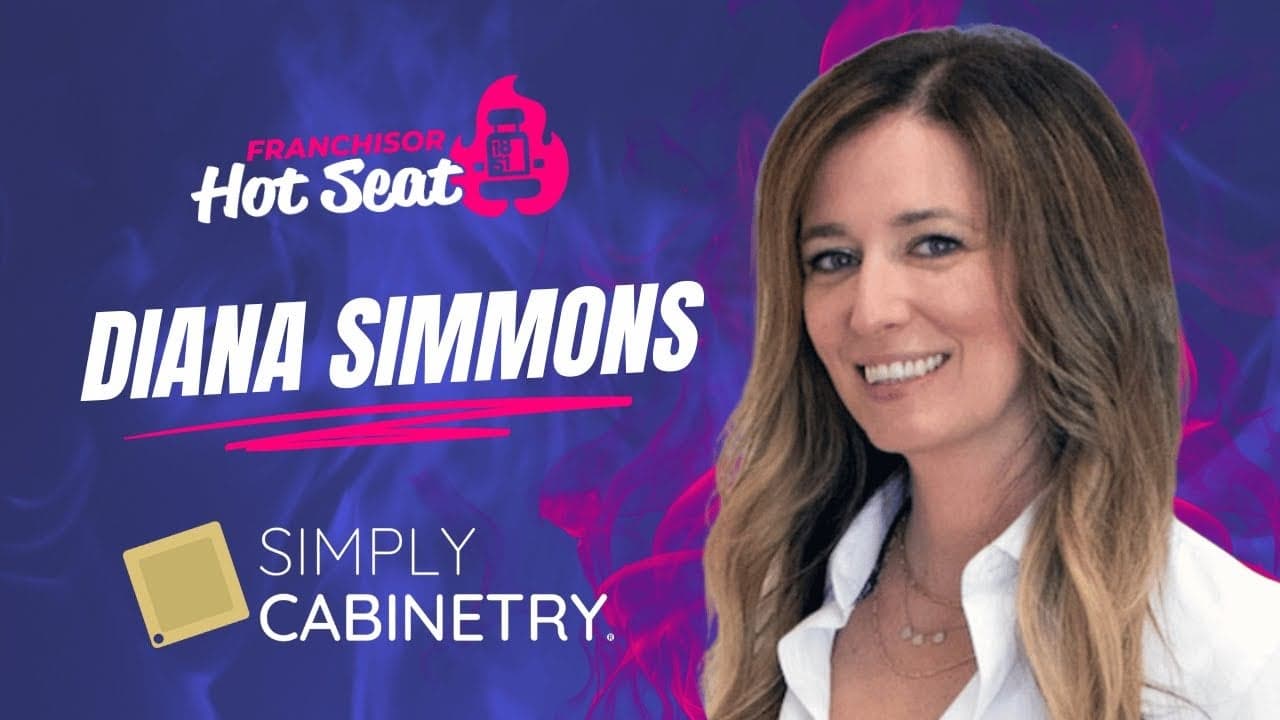
Building Simply Cabinetry: Derrick and Diana Simmons Share Their Franchising Journey
The Simmonses discuss 15 years of success, their transition to franchising and how their carpentry business is empowering entrepreneurs.
Franchisor Stories
The Simmonses discuss 15 years of success, their transition to franchising and how their carpentry business is empowering entrepreneurs.
Derrick and Diana Simmons, owners of Simply Cabinetry, joined Nick Powills’ “Franchisor Hot Seat" podcast to share the story of how they built their cabinetry business from the ground up. Over the past 15 years, the Simmonses have transformed Simply Cabinetry from a small operation in their garage to a well-established business with three corporate locations. Now, they’re taking the next step by franchising their model, offering aspiring business owners a chance to tap into their proven systems and extensive industry knowledge.
During the interview, Derrick and Diana emphasize the simplicity of their business model and the unique advantages it offers. They explain how small showrooms allow franchisees to operate efficiently with minimal staff while maintaining a personal touch with customers. By avoiding construction liabilities, they can focus on delivering tailored cabinetry solutions that meet a wide range of needs. The Simmonses also highlight their dedication to franchisee success, from offering comprehensive training and tools to fostering a culture that ensures a strong fit for every owner. Building community relationships remains central to their approach, reinforcing the brand’s commitment to scalability and local connections.
A transcript of Powills’ interview with the Simmonses has been provided below. It has been edited for brevity, clarity and style.
Nick Powills: I've talked to you guys so much over the last few weeks, so I feel like this is repetitive, but I promise once we get past the scripting question, everything else will be good. Thanks for joining us. Question one — whoever wants to take it: how did you guys accidentally fall into franchising? What's your franchise story?
Diana Simmons: We’ve always wanted to do it over the years but never had the resources to make it happen. Having a system that’s repetitive and duplicable, along with the ability to ship nationwide, allowed us to become a brand that could gain national recognition and compete with larger brands. With that buying power and the ability to share what we’re doing with others, we decided it was time to figure out how to go bigger.
Derrick Simmons: To hit the nail on the head, it’s really about simplicity. It was about simplifying the model. In our industry, there’s a vortex of shiny objects, and it’s up to us to clear the path and trailblaze a successful journey for entrepreneurs.
Powills: So the business is 15 years old?
Diana: Yep, we've been doing this for 15 years. We started out of our garage and grew it to this point. We were trying to decide how we wanted to move forward.
Derrick: And this is where we're at now. We kind of hit a ceiling. We have three kids and three units, and it got to a point where that made sense for us that was enough to handle. But we knew we had more gas in the tank and wanted to figure out how we could empower other people to do what we do.
Diana: We have a great team that takes care of our three corporate locations. We're on top of the business now, and we just want to start elevating, going to the next level, and helping others achieve what we've done.
Powills: Just for clarity, you're not planning to keep the same pace of kids to units as you grow, right?
Diana: No, no, no. I'm done with kids — three boys is enough.
Derrick: That door is closed.
Powills: Okay, so 15 years of doing this, and you're obviously building as you go. At what point in that journey did you start thinking about franchising seriously? You mentioned always thinking about it, but when did it become logistical to start?
Diana: It really came to the point where we started gaining brand awareness in our industry. People were coming to us, asking about becoming a national brand. With that, we were able to secure buying power, vendor agreements and the ability to ship nationwide. It just made sense.
Opening up a showroom on your own wouldn’t give you the buying power or the simplicity we can offer.
Derrick: It’s about taking those 15 years of experience and applying them moving forward. There are so many lookalike markets like ours. Our business model isn’t unique to just our territory. Everyone in the U.S. — I’d hope — has a kitchen or needs one. It’s a necessity. So applying what we’ve built to different markets is really the next step for us.
Powills: I feel like every time I talk to you, I have another comment on what you guys need to do from a positioning standpoint. You just talked about the national infrastructure you’ve built — how you now have access to all these different lines of service and products. In my opinion, while you're saying that, it opens up your website as a showcase of power and success through ownership.
If the trigger for franchising was people saying, "Oh, I want to start tapping into the network you’ve built," then that needs to be part of your positioning. You’re selling the fact that you’ve built the infrastructure and resources people need to localize it at their level. If I were you, I’d play back what you just said in your own words because there’s a real insight there for how you should position this from a franchise standpoint.
Diana: There are just so many advantages to what we do because we’re unique in the space we’re in. In the franchise space, our model is designed for one to two people to run a whole territory with just a small showroom. You don’t have to manage subcontractors or deal with construction liability — it’s really about the showroom and building connections. It’s a very different approach.
Derrick: One of the questions we get from potential franchisees is, "What do I get out of this?" And there are so many benefits, it’s hard to pinpoint just one. You mentioned the networking aspect and how empowering that is, but there’s more — like the lessons we’ve learned over 15 years and the mistakes we’ve fixed so others don’t repeat them.
Then there’s the simplicity of the model, or even small things like our CRM system, which captures data and gives us actionable insights to market better. There are just so many benefits — it’s overwhelming how much value we’ve built into this.
Diana: Honestly, if this opportunity existed 15 years ago, I would’ve bought it.
Derrick: Looking back, it would’ve been a no-brainer — having someone pave the way for us would’ve made all the difference.
Powills: Maybe that’s the insight: a 15-year overnight success story. If you show the bumps and bruises you took to build this infrastructure, it really highlights the value. You’ve built a culture that not only reflects your vision as business operators but also gives franchisees a pathway to wealth and success. When you say, "If this was available 15 years ago, I would’ve bought in," that’s your North Star. That’s what you’re striving to create — something even better for the next person.
There’s always something that keeps business owners up at night, but it’s all noise as long as the doors are open. Now that you’ve made the decision to franchise your business, what keeps you up at night when it comes to growing or franchising it?
Diana: It’s making sure we have every tool possible to make a franchisee successful. We’ve been really honing in on our training and are building this huge LMS system with countless lessons and courses. We’re even creating our own custom chatbot for staff members to quickly and efficiently address any problems or questions they might have.
It’s all about building efficiencies and simplifying the model — ensuring that everything aligns with our mission, vision and culture. Over the past year and a half, we’ve invested heavily in making sure those efficiencies are in place for our franchisees.
Derrick: I’d take that from a different angle. For me, it’s really about partnering with the right people. We’ve talked about this before — we want to find like-minded individuals with energy, passion for the industry and a willingness to invest in themselves.
We’ve even turned away some people because they weren’t the right fit. If someone approaches this business with the wrong mindset, it’s not going to work and that’s what keeps me up at night — making sure we’re aligning with the right franchisees.
Diana: Exactly — finding the right people so they can be successful. We want to ensure we’re giving them everything they need because it’s a big decision for them. They’re putting their lives on the line, taking out loans on their homes. It’s a huge responsibility for us to provide as much as possible for them.
It’s funny because we’re on the same wavelength, but he’s looking at it from a different perspective. He’s more on the operations side while I’m more focused on the culture. You’d think it would be the opposite!
Powills: No, that makes sense. My wife is the operator, and I’m more about the culture — it just works that way sometimes.
What I’m hearing, though, is that what keeps you up at night isn’t so much about selling or awarding the first franchise. It’s more about whether you’ve done enough to make this a viable and successful opportunity for them. Am I getting that right?
Diana: That’s exactly it. Obviously, finding the right franchisees is part of it, but at these franchise events, the emphasis is always on finding the right fits for your business. It might take longer to find the right franchisees, but in the long run, it’s worth it. If it makes our lives easier and leads to more success stories later, it’s far more important to start with the right people.
Powills: Yeah, I love that statement. The reality is, in a franchise world dominated by consultants and brokers, the focus often shifts to selling franchises rather than finding the right fit. For buyers, cutting through the clutter and finding your business organically can be challenging. Your drumbeat has to be loud enough to guide those organic candidates to you.
But if they find you and hear what you just said, that value becomes the scaffolding they need as business operators to achieve the success they’re striving for.
Diana: Exactly.
Derrick: Nick, I’m big on analogies. Like Diana said, we can create the toolbox and fill it with the most powerful tools. But the flip side is that the person using those tools needs to understand what they are, take full advantage of them and know how to use them effectively. That’s where we are — balancing those two sides.
Powills: It’s tough. If you think about business operators, whether it’s you guys or me, on day one, we have to be experts in HR, labor relations, supply chain management, marketing, websites — you name it.
For a franchisee, those foundational elements are at least established, so they can come in and start learning and selling. They focus on developing relationships in the local market. But finding someone willing to roll up their sleeves, especially in a world where absentee operators are celebrated, feels like finding a needle in a haystack. You need someone who’s ready to get their hands dirty, work hard and understand that success won’t happen overnight.
Diana: Exactly — you get out what you put in. If you’re putting enough in, you’ll get enough out.
Powills: Let’s shift to the brand. I like establishing the culture side, which gets addressed in question one. Now, for question two: Once someone says, “Okay, I’m bought into who you guys are as humans,” the next question is, what do you do?
Diana: We design and sell cabinetry. Think of it like the Sherwin-Williams model — we partner with builders, contractors and developers. It’s a B2B2C model.
We build relationships with industry professionals like flippers and real estate investors, becoming a key part of their business. They refer their clients to us, and we work with them to design and sell cabinetry. The product goes factory-direct from the manufacturer to the end consumer.
It’s all about building those relationships, designing spaces and focusing on spatial planning. While we work with interior designers, our emphasis is more on spatial planning and fostering strong connections in our showrooms.
Derrick: It’s not just about creating the culture within the organization — it’s also about building that culture within the community. We’re partners with other businesses, and they rely on us just as much as we rely on them.
Whether it’s our partner networks like painters, appliance companies or countertop fabricators, we’re creating a collaborative culture that supports other business models as well.
Diana: Exactly. It’s all about making those connections. For example, if a painter is talking to a client about a project, they might say, “Oh, Simply Cabinetry is a great option.” That referral business is key for us.
What we offer are showrooms and design studios, which range from 1,200 to 1,500 square feet. Two to three people can run a showroom, and that’s the territory. In these showrooms and design studios, we have what we call Simple, Premium and Luxury options, which include stock, semi-custom and custom cabinetry.
This setup helps divide products based on budget, availability and customization needs. Each space is designed and curated so customers know exactly what they’re looking at and can almost self-shop. Of course, we have staff available to guide them, but the storytelling aspect of the showroom helps make everything clear.
One of the biggest challenges is when a client comes in and treats the showroom like a candy store, picking out all the most expensive items only to realize they can’t afford them. By labeling everything correctly, clients can see exactly what they’re looking at, which makes conversations about budget much easier because they’ve already made informed choices.
Then there’s the design studio, which you can see behind us. This is where we break down cabinetry into door styles, wood species, paint colors and more. It’s designed to cater to how different people learn and shop.
Some clients love exploring the design studio, seeing the product broken down and building their vision themselves. Others prefer the showroom, where everything is already put together so they can better visualize the final result.
Powills: Do you want your franchisees to be the face of the community? Are you helping with the design aspect, or what does a day in the life of a franchisee look like?
Diana: Essentially, the franchisee will be an owner-operator, handling the day-to-day operations of the showroom. They’ll have a lead management associate who handles incoming leads, gives tours of the showroom and schedules appointments with the franchisee. From there, the franchisee designs spaces and puts projects together.
The franchisee will do some spatial planning and should know enough to confidently talk to clients, but we also offer internal design services. Showrooms can get busy. For example, our Warrington, Pennsylvania, showroom is in a shopping center with Home Depot and Avalon Carpet. With a high volume of leads, we want franchisees — what we call managing designers — to focus on being the face of the business and making connections, rather than being stuck in the back designing.
We also offer options for design assistance. Franchisees can use internal design services or hire a design assistant, depending on their needs and abilities.
Powills: Okay, let’s talk about the investment. Every franchise buyer asks this: What does it cost to get started, and what do you report in Item 19?
Diana: The investment ranges from $295,000 to $376,000. That includes three months of operating costs, the franchise fee and related expenses.
Powills: And are you making an earnings claim in Item 19?
Diana: Not currently. All of our locations were previously under one roof, but we recently separated them to better define individual performance for franchisees in the future. At this time, we don’t have an earnings claim.
Powills: Has that been a stumbling block for potential franchisees?
Diana: Honestly, no one has really asked about it. We’ve been in business for 15 years, so the proof is there. We’re franchising for a reason.
Powills: I have strong opinions on Item 19. It frustrates me when someone asks, “What’s the average?” — as if they’re asking to be average. Why would I say yes to that? It doesn’t show the full picture because so much depends on the marketplace and building inventory. But you’re providing a blueprint for an industry that’s clearly attractive and you’re focused on finding the right cultural fit.
Diana: Exactly. We started this in 2007-08 during a market downturn, so we’ve already proven the model through a recession. It’s recession-proof because it’s a B2B model. We work with builders and other businesses, so we rely on repeat and referral business to stay strong.
Referral business is so much easier than selling to someone walking in off the street. When you’re in a business-to-business model where referrals are coming to you, it’s a smoother process.
Powills: I think it’s important to highlight your growth strategy, which focuses on concentric circles. If you find the right franchisee, they’ll be close enough to tap into your existing networks. That proximity should help them get off the ground quickly.
Diana: To be honest, our locations have grown organically so far. Someone lives in an area and we open a location there. We’re actually very tight right now in terms of territory. A new franchisee would have almost our entire territory for our three stores. So even without an Item 19, those locations should theoretically perform similarly to what our three stores are doing combined.
Derrick: Exactly. And even with that, we still have a small market share in our current territory. There’s a lot of untapped opportunity out there.
Diana: Especially when you think about being an extension of other businesses. Instead of competing with a thousand contractors in your area for bids on installations, why not partner with those contractors and become an extension of their business model?
Powills: Let’s talk about your vision. Obviously, you’ve built a successful business. Franchising aside, you’ve accomplished something tremendous. Where do you see things going in the next year or so?
Derrick: I’d say we need to get a couple of franchisees signed up, a few in the pipeline and some actively searching for locations.
Diana: Right. We want to grow, whether organically or through franchising, but we want to do it the right way. We’re not rushing to bring on franchisees. For now, we’re focusing on growing territorially in the Northeast.
Derrick: And like you said earlier, it’s about sharing connections. We don’t need to reinvent the wheel; we can spread our existing network of connections to support new franchisees.
Diana: Exactly. But within the next couple of years, we’d like to start expanding more nationwide. Once we have a few franchisees under our belt and can confirm we’ve put everything in place for their success, we’ll look at broader growth opportunities.
Powills: Out of curiosity, are there specific professions or business owners that would make ideal franchisees? For example, would a real estate agent with a built-in pipeline be a good fit? Or are there other categories of people you think this business would be perfect for?
Derrick: I think a lot of it comes down to sales experience. We’ve seen interest from people in pharmaceutical sales and real estate sales — sales is definitely high up there.
Diana: Especially with real estate, there’s usually some passion for it. It’s about putting your feet on the ground and making those connections, which is exactly what real estate agents or pharmaceutical sales professionals know how to do.
It’s that background, that drive and the ability to get out there, make connections, attend events — that’s what really sets people apart for us. That’s much harder to teach than design. I can teach someone spatial planning easily, but teaching them how to network and connect is a different story.
Derrick: Exactly. It’s about teaching the ability to sell, network and build those connections — to get your foot in the door and make it happen.
Diana: Business isn’t for the faint of heart, but we make it easier. You have to put in the effort; there’s no magic bullet where you just blow up because you’ve opened a business. That said, we show you how to put in the right effort to be efficient and successful.
Powills: Out of curiosity, what’s the breakdown between new construction and home upgrades? Do you have a sense of the mix?
Derrick: In our market, our bread and butter is remodeling or additions — things like finishing basements or updating kitchens. The majority of our traffic comes from those types of projects.
In our community, there are a lot of general contractors handling roofing, siding, windows, doors, decks and basements. When they get to the kitchen portion, they hand the lead over to us, saying, “Hey, Mrs. Jones wants to redo her kitchen. Can you walk her through the process?”
We work hand-in-hand with contractors to excite clients about their kitchen remodels. By doing that, the contractor has a much higher probability of closing the overall package.
Diana: So I’d say new construction makes up about 10-15% of our business.
Powills: Out of curiosity, have you expanded into outdoor kitchens as well?
Diana: We get requests for outdoor kitchens here and there, but it’s not a huge market for us. The same goes for garage cabinets — we’ve done them occasionally, but the cabinetry costs the same whether it’s for a kitchen or a garage. And garage cabinetry often requires a more specific type of product, so it’s a bit different at the moment.
Derrick: Let me add to that. One of the things we’ve built into our system is what we call Boutique Brands. In each market, we adapt to local needs. For example, if we open a unit in Lancaster, where Amish-built cabinets are highly valued, we’ve created a category to cater to that market.
While the core of our business is educating clients on cabinetry in general, we can adjust to local preferences. For instance, Miami might favor sleek, frameless, modern cabinetry, which isn’t as popular here in Philadelphia.
Diana: Exactly. Having that outlet allows us to adapt to trends in different areas. We have access to all the data and information we need to understand those trends and respond accordingly.
Powills: That circles back to what we talked about earlier — the infrastructure you’ve built allows you to adapt your product to fit any market in the U.S. That flexibility is a huge asset and will pay dividends down the road. This is awesome. I love the category. You’ve kept the costs down to enter the retail market, and it’s clear you’ve put an exhaustive amount of effort into preparing for your first franchisee. The groundwork is solid. Now it’s just about finding franchisee number one.
Derrick: If I can piggyback on that, one of the things to consider is that this is a fragmented industry — there’s no real leader in the space. Our goal is to take what we’ve learned over the last 15 years, apply those principles and share that knowledge with franchisees. If we can work as a group, share best practices and create a community all moving in the same direction, that’s what excites us.
Diana: It’s a significant but manageable investment for a retail location. And the initial investment is really the main one, aside from rent and staff. You’re only purchasing what you’ve already sold, so there’s no need to inventory products.
Powills: That’s great. I love what you’ve built here and look forward to seeing where the story goes. There’s so much good stuff happening — thank you for sharing it all.
Derrick: Thanks for having us on.
Diana: Yeah, thank you!
Watch the full interview above or on YouTube.
For more interviews with those influencing the franchise industry, check out these stories on 1851 Franchise:
Sign up for the 1851 Franchise newsletter to get our biggest stories before everyone else
By signing up, you agree to our user agreement (including class action waiver and arbitration provisions), and acknowledge our privacy policy.