Franchisor Stories
Inside FSC Franchise Co.’s Training and Support for New Franchise Owners
The company begins supporting franchisees well before opening, with help choosing a site, understanding the financials and preparing for the grand opening.
Franchisor Stories
The company begins supporting franchisees well before opening, with help choosing a site, understanding the financials and preparing for the grand opening.
For aspiring restaurant franchise owners, signing a franchise agreement is often the moment excitement meets uncertainty. While entrepreneurs may understand the opportunity ahead, many have never navigated commercial real estate, hired a restaurant management team or managed the countless moving pieces required to open a successful business.
According to leaders at FSC Franchise Co., that's exactly where a franchisor should deliver its greatest value.
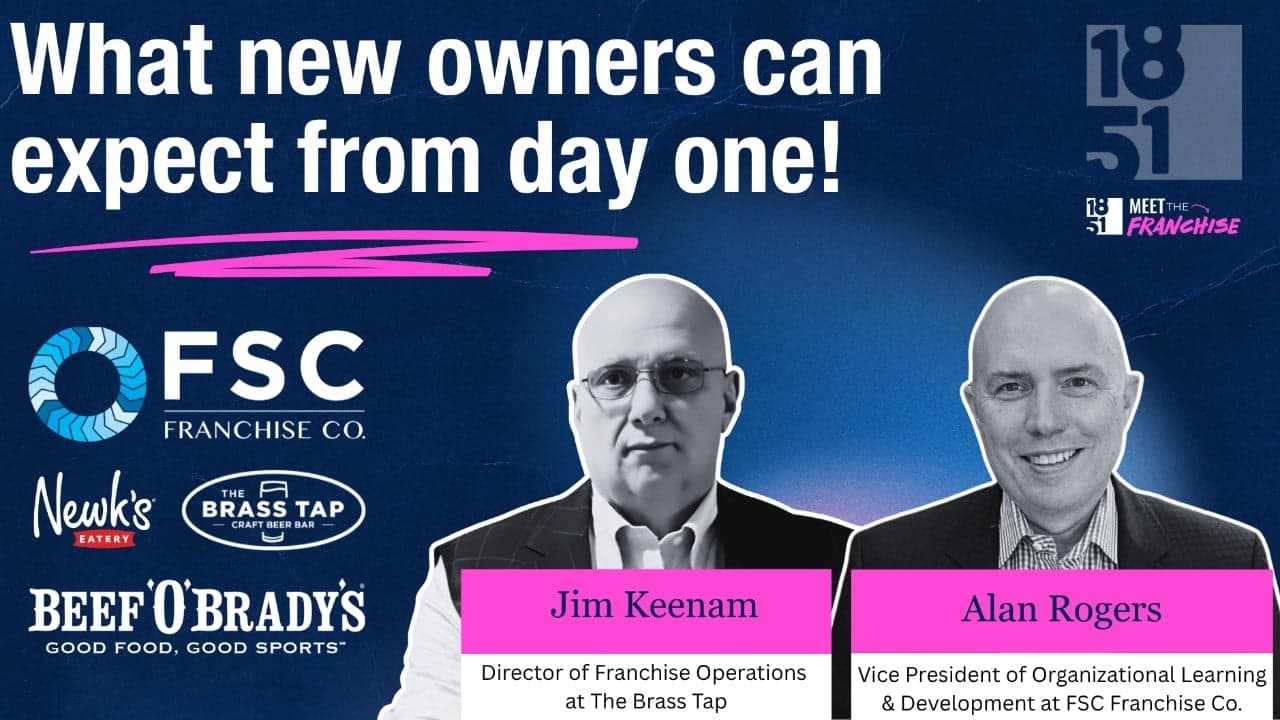
FSC Vice President of Organizational Learning and Development Alan Rogers and The Brass Tap Director of Franchise Operations Jim Keenan recently appeared on an episode of the “Meet the Franchise” podcast, where they were interviewed by 1851 Franchise Publisher Nick Powills. The conversation explored what franchisees can expect after signing with one of FSC’s restaurant brands, with a focus on the support provided across Beef ‘O’ Brady’s, The Brass Tap and Newk’s Eatery.
"So our department at FSC, training isn't just about creating courses," Rogers said. "Our mantra for FSC is 100% franchisee success. Everything that we create, whether it's a course, workbook, guide or on-floor tool, is designed around making franchisees and operators successful."
That philosophy shapes every stage of onboarding. Depending on an owner's background, FSC provides financial management education, operational guidance, webinars, new partner training and personalized coaching throughout development. The goal is not simply teaching restaurant operations but giving owners confidence before they ever serve their first guest.
"We really tailor that support to the level of the franchisee's experience," Rogers said. "If it's your first restaurant or your first business, we'll spend more time helping with financial management, development and all of those things."
One of FSC's biggest differentiators is that the people providing support have personally operated restaurants themselves.
Keenan has spent 15 years with The Brass Tap, beginning on the operations side before moving into franchise support. Rogers similarly built his career managing restaurants before transitioning into training and organizational development. Across FSC, many members of the leadership team have firsthand operational experience.
"I used to work for Fridays back in the day," Keenan said. "Almost every person you're going to come in contact with — from our CEO down to the person in our tech department — has been an operator. We understand it 100%."
Opening a restaurant inevitably brings moments of uncertainty, whether it's finding a general manager, building a leadership team or making critical operational decisions. Rather than expecting franchisees to navigate those situations independently, FSC views each concern as an opportunity to provide another layer of support.
"We had a franchisee this morning opening a new location whose biggest fear was finding a general manager," Keenan said. "I can't hire your manager, but I can direct you where to go. Alan is going to help with hiring resources, and we're going to lead you through the process."
Rogers and Keenan agreed, emphasizing that FSC's success is inseparable from the success of its franchisees. "We're not successful if franchisees aren't successful," Rogers said.
A transcript of Rogers and Keenan’s interview with Powills has been provided below. It has been edited for clarity, brevity and style.
Nick Powills: Welcome, everyone. I'm excited for today's conversation. Jim, let's start with you, then Alan. Tell us about your franchising backstory. How did you end up here?
Jim Keenan: I've been with our franchise system for about 15 years. I was actually the first employee at The Brass Tap when FSC acquired the brand. I started on the operations side, and today I serve as director of franchise operations.
Alan Rogers: My path is similar. I started in restaurant operations while I was still in high school, working for a McDonald's franchisee. I eventually became a store manager while I was in college, then moved into franchise consulting, company operations and franchise operations. About 15 years ago, I transitioned into learning and development, which is where I've focused my career ever since.
Powills: I think training and franchise support are some of the most valuable — and most underappreciated — parts of franchising. Every brand says they support franchisees, but very few explain what that actually looks like. When I look at FSC, I see shared resources across multiple brands, operational knowledge from corporate-owned restaurants and an incredible support infrastructure. So, how important are your departments to franchisee success? And what separates great franchisees from average ones?
Rogers: At FSC, training isn't simply about creating courses or manuals. Our guiding principle is 100% franchisee success. Everything we build — whether it's a workbook, online course, operations guide or in-store tool — is designed to answer one question: Will this help franchisees become more successful?
We think about whether it improves guest engagement, profitability or sales. That's the lens we use for every piece of training.
Support actually begins long before opening day. Once a franchisee signs, we begin working with them during development. Depending on their experience, we may provide financial management education, webinars, one-on-one coaching, new partner training and opening support. Then, once the restaurant opens, the coaching continues throughout the life of the business.
Powills: That's really about building scaffolding around someone who's entering probably the most uncertain period of business ownership. They sign the agreement, they're excited — and then suddenly they're dealing with site selection, construction and spending money before they've earned their first dollar.
You're almost acting as both teacher and therapist.
Rogers: That's a fair way to describe it.
What's great about FSC is that this support philosophy extends across every department — not just operations or training.
We help with site selection, restaurant design, construction, operational planning and everything else required to open successfully.
We tailor our support based on the owner's experience. Someone opening their first restaurant will naturally receive more guidance than an experienced multiunit operator, but everyone receives the resources they need to succeed.
Powills: Let's talk about what separates good franchisees from great franchisees.
Rogers: Coachability is a huge factor. When someone buys into a franchise system, they're investing in a proven business model. The operators who embrace that system tend to perform best.
At the same time, you still need entrepreneurial drive. You have to own your community and your local market. The most successful owners balance both — they bring initiative while operating within the framework that's already been proven.
Keenan: I completely agree.
Our strongest franchisees embrace the system, ask for help and, just as importantly, accept help. We can provide an incredible amount of information and support, but franchisees have to take advantage of it. One thing that's unique about FSC is that almost everyone you'll interact with — from our CEO all the way to members of our technology department — has operational experience. We've been in restaurants. We've run shifts. We understand exactly what franchisees are dealing with because we've lived it ourselves.
Powills: One misconception people have is that they buy a franchise, turn on the lights and the business simply works. The reality is that owning a restaurant means suddenly wearing every hat imaginable — operations, marketing, labor, supply chain, finance, hiring, community involvement. A good franchise system helps carry some of those responsibilities, but accountability still belongs to the owner. The best franchisees seem to approach the business by saying, "Teach me."
Keenan: Absolutely. Our best franchisees actively seek guidance. They understand they don't have to know everything themselves. The support is here — they simply have to use it. We have experts throughout the company who can step in and help with virtually every aspect of running the business.
Powills: Every new franchisee experiences fear at some point. Maybe it's hiring managers. Maybe it's staffing. Maybe it's construction. How do you help restore confidence?
Keenan: We had an example this morning. One franchisee who's preparing to open was worried about finding a general manager and building a management team. I can't hire that manager for them, but I can absolutely guide them through the process.
Alan can connect them with recruiting resources. Together we can help them identify strong candidates and build a leadership team. That's what we tell every franchisee: if something worries you, tell us. Someone in this building has almost certainly dealt with that exact situation before. We genuinely enjoy helping franchisees overcome those challenges because their success is our success.
Rogers: That's exactly right. We've all experienced those same fears ourselves. At one point, we were all hiring our first general manager. Because we've done it repeatedly, we've developed practical tools to help owners succeed — interview guides, hiring frameworks, evaluation techniques and coaching around what to listen for during interviews. When franchisees encounter uncertainty, chances are we've already developed a resource that addresses it.
Powills: One advantage franchise systems have is the network itself. New owners aren't just learning from corporate — they're learning from operators who have already been through the same challenges.
Keenan: Exactly. We have outstanding Franchise Advisory Councils across all three of our brands, and they're incredibly supportive. When we onboard a new franchisee, we literally provide them with phone numbers for other operators. We tell them, "These are people who've been in your shoes. Call them. Ask questions. They'll talk with you. They'll share their experiences." That's one of the biggest strengths of franchising — you have peers who genuinely want to help.
Powills: Even with all the systems you've built, are there still things that keep you up at night? What are you constantly trying to improve?
Keenan: Absolutely. Just recently, a franchisee wanted to hire a dedicated marketing manager and event coordinator. I walked through what I thought that position should look like and shared my notes with Alan.
Alan turned that into a complete hiring package — a job description, interview guide and even an Excel scorecard to measure success. That's how we operate. Whenever franchisees encounter something new, we build better tools that everyone else can use going forward.
Rogers: I agree. The moment you think you've figured everything out, something changes. We're always asking ourselves how we can build a better system. Our goal isn't necessarily to make training shorter; it's to make learning faster. The restaurant industry constantly evolves, and our support has to evolve alongside it.
Powills: Listening to both of you makes me think we should stop calling franchise royalties "royalties." They're really a support fee. When franchisees pay that percentage every month, they're gaining access to people who spend every day thinking about how to help them become more successful. Hiring this level of expertise independently would be impossible.
Rogers: You're also buying into a proven concept. If you opened your own independent restaurant, you'd spend enormous amounts of money developing menus, operating systems, training, marketing and everything else — and you'd still be gambling on whether the concept would work.
With franchising, you're joining a concept that's already proven itself and a support organization that's dedicated to helping you succeed.
Keenan: And internally, we're constantly collaborating. Alan and I meet every week. We also meet regularly with every department to discuss what's happening now and what's coming three months down the road so we're always thinking proactively about franchisee success.
Powills: Do franchisees fully understand the amount of work happening behind the scenes on their behalf?
Keenan: The strongest ones do. The franchisees who embrace the partnership understand how much support exists. Others sometimes assume they'll simply open the doors and everything will happen automatically. Eventually they realize asking for help actually makes running the business easier. That's what we encourage every day. Call us. Ask questions. We don't have egos. We're here because we want you to succeed.
Rogers: It's a true partnership. We're not successful unless our franchisees are successful. We're not here to police anyone. We're here to help build stronger businesses. The franchisees who understand that relationship are usually the ones who thrive the most.
Powills: I'll close with one final analogy. Imagine being a quarterback without an offensive line. You'd get hit on every single play. That's what many independent business owners experience — they're trying to do everything themselves. In franchising, you still have to execute as the quarterback, but on day one you already have an offensive line helping protect you from avoidable mistakes. That's really what a strong franchise support system provides.
How does that analogy land?
Keenan: I think that's exactly right.
Rogers: It's a great analogy. We're here to make the entire team stronger. Success isn't about one person — it's about everyone working together.
Powills: I appreciate both of you sharing your perspective today. I hope current franchisees watching this feel encouraged to reach out when they need help, and I hope prospective franchisees see what a true support partnership looks like.
Ultimately, that's why people choose franchising. They choose a team that's invested in helping them succeed.
Thank you both for joining me today.
Keenan: Thanks for having us.
Rogers: Thank you.
Watch the full interview above or on YouTube.
Sign up for the 1851 Franchise newsletter to get our biggest stories before everyone else
By signing up, you agree to our user agreement (including class action waiver and arbitration provisions), and acknowledge our privacy policy.