Franchise Your Business
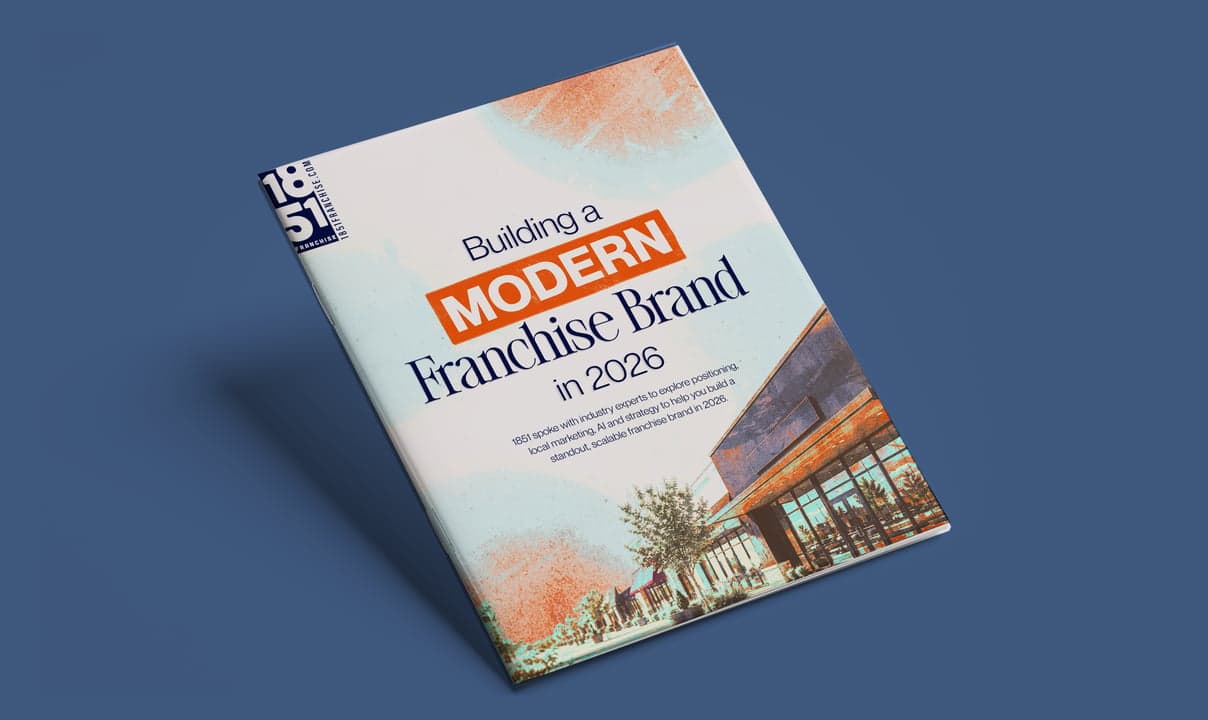
Building a Modern Franchise Brand in 2026: The Complete Guide
This 1851 Franchise guide features experts exploring positioning, local marketing, AI and strategy to help you build a standout, scalable franchise brand in 2026.
Franchise Your Business
This 1851 Franchise guide features experts exploring positioning, local marketing, AI and strategy to help you build a standout, scalable franchise brand in 2026.
Building a franchise brand used to be easier to define. Create a recognizable logo. Establish brand standards. Develop national marketing campaigns. Give franchisees a library of approved assets. Maintain consistency as the system grows.
Those fundamentals still matter, but the number of places where a franchise brand now has to perform has multiplied.
Customers can discover a business through Google, TikTok, Reddit, streaming television, online reviews, creators, AI-generated answers or a recommendation from someone in their community. Prospective franchisees may research the brand extensively before ever submitting a lead. Employees experience the brand from the inside. Franchisees have to translate a national identity into something relevant to their individual markets.
Meanwhile, every location, review, social post and customer interaction has the potential to strengthen or weaken the larger brand.
Across this guide, 1851 Franchise examines the systems behind modern brand-building, from defining the promise and understanding different audiences to equipping franchisees for local marketing, measuring performance, protecting reputation and deciding where emerging technology actually creates value.
Here is what we'll cover.
Before a franchise can communicate consistently, leadership needs a clear understanding of what the brand promises, what makes it different, how it should feel to the people who interact with it, and, perhaps most importantly, who it is looking for in franchise partners.
"So much of your success is going to depend on the quality of the operator," said Jeremy Vitaro, chief development officer of QDOBA. "I think that operator difference matters more than people give it credit for."
A franchise brand is rarely speaking to only one audience. Customers, franchisees and employees have different priorities, but the brand shouldn't develop a different identity for each of them.
"It's equally important for franchisees, employees and customers to all understand why we are different as a brand," said Kevin Dugan, vice president of marketing for Pet Wants.
Strong messaging gives a franchise system a hierarchy for communicating what makes the brand relevant, differentiated and worth paying attention to, whether the audience is a customer, employee or prospective owner.
“It’s important to clearly explain, through both words and imagery, what your brand represents and where it fits in the marketplace,” said Scott Capelin, founder of inLIFE Wellness. “That applies to both the customer and the prospective franchise owner. They need to understand what the brand is about and where it fits within the industry.”
A logo is only one part of a franchise identity. Modern visual systems need to work across storefronts, menus, uniforms, social media, mobile apps, video, digital advertising and emerging interactive formats.
"We really have a responsibility to our franchisees," said Peter Wiley, co-founder and director of marketing for Hot Head Burritos. "You have to create materials that at least appeal a little bit to all of our franchisees. You deal with one opinion. I have 50 opinions."
Franchise systems often underestimate the importance of narrative consistency across national, local and operator-facing communications.
"Learning how to balance the brand message while giving franchisees the autonomy to add their local flair, while staying within brand guidelines, is a constant balancing act," said Ashley Mitchell, vice president of marketing for East Coast Wings + Grill. "Franchises are local businesses and need to be able to showcase that. People buy from people, not brands, but they also need the power of the brand behind them, which is why franchisees bought in to begin with."
Franchise brands need to move beyond superficial differentiators and build distinctions into everything from product and service to hospitality and operations so customers actually experience what makes the concept different.
"In a crowded category, the product gets you noticed, but the total experience is what makes you memorable," said Wing Snob President Brian Shunia.
Offers and pricing shouldn't be based solely on instinct. Modern franchise brands need ways to test ideas, measure customer response and determine whether a successful experiment can translate across markets without sacrificing franchisee economics.
"We run A/B tests on email and digital ads to see what specific messaging is generating a stronger click-through rate and higher conversions," said Sal Longo, founder of Busy Bee Jumpers. "By making minor adjustments to some ads, we are able to see a big increase in conversion value."
Knowing the competition doesn't mean copying it. Competitive teardowns can help franchisors understand category conventions, identify genuine competitive advantages and find white space.
"Research, research, research," said BooXKeeping CEO Max Emma. "We took our time to see what other brands were doing and answer hundreds of questions, challenging ourselves by asking, 'What else are we missing?'"
National recognition doesn't guarantee that a customer will choose an individual franchise location. The franchisor's role is to determine which tasks should be centralized and where local owners have an advantage.
"Working closely with franchisees early in my career taught me the importance of listening and understanding their local-level challenges," said Jennifer LoBianco, chief marketing officer of Best Life Brands. "I prioritize creating marketing that resonates with franchisees before engaging other audiences."
A folder full of logos and social templates isn't necessarily a marketing system. The best toolkit is the one that removes enough friction that franchisees actually use it.
"We manage the website internally, both from a content and SEO standpoint," said Emma Fee, vice president of marketing for Escapology. "We help them structure the website to be localized and show up for local searches in their market."
AI may be changing how consumers search, but the fundamentals of digital discovery haven't disappeared. Corporate can establish the infrastructure and national strategy while franchisees contribute the local information, community involvement and customer relationships.
"Getting the basics right is essential for franchise brands because everything else you do in digital marketing, such as paid ads, builds on them," said Maria Boyle, head of marketing at Best Life Brands.
Search, social media, streaming, outdoor advertising and other channels increasingly work together in today's world. Choosing the right media mix means understanding how different touchpoints contribute to demand.
"Every marketing dollar needs a job," said Brian Gross, president of Bach to Rock. "Before choosing channels, a franchise brand should understand what each market needs: greater awareness, more leads or better conversion of existing interest into customers."
More marketing data doesn't automatically produce better marketing decisions. Metrics such as lead quality, lead volume and appointment generation can tell franchise systems more about business performance than traffic and impressions alone.
"Ultimately, the future of franchise marketing is not about finding a single channel that wins," said Laura Vodvarka, chief marketing officer at HorsePower Brands. "It is about understanding how all marketing efforts work together to create demand, build trust and generate qualified opportunities."
Getting customers to enroll is only the beginning. Modern loyalty programs need to make rewards attainable, redemption worthwhile and customer data useful.
"Loyalty helps guests feel they get more value and personalized content, which is more important than ever," said Jenna Law, senior director of marketing and communications for Keke's Breakfast Cafe. "But it has to mean more than discounts and coupons. Those can put brands in a downward discount spiral."
Creators can give franchise brands something traditional advertising often struggles to replicate: local credibility and content that feels native to the platforms where customers spend their time.
"I feel like there's a gray area around this: What is an influencer? How is this impactful? How are we measuring it?" said Natalie Hurley, vice president of marketing at Layne's Chicken Fingers. "It's such a tactic now that's being used across so many brands, but I don't think it's done necessarily well. It's just kind of white noise now."
Franchisees experience the brand from the inside. That makes training, communication, leadership, support and trust brand issues, not simply operational ones.
"So our department at FSC, training isn't just about creating courses," said Alan Rogers, vice president of organizational learning and development for FSC. "Our mantra for FSC is 100% franchisee success. Everything that we create, whether it's a course, workbook, guide or on-floor tool, is designed around making franchisees and operators successful."
Employees deliver the brand promise customers actually experience. Recruiting, onboarding, culture and retention therefore belong inside the brand conversation from day one.
"We're investing in people before their roles even exist," said Rob Emery, founder and CEO of DOGPerfect. "We're training employees before they're serving franchisees."
Marketing campaigns only work when operations can execute them. Building an annual calendar that connects promotions, product launches, staffing, training, technology and franchisee communication can help prevent marketing ambition from creating operational problems at the unit level.
"Our marketing calendar is a collaborative process because marketing doesn't operate in a vacuum," said Kyle Kosco, vice president of marketing for Caring Transitions and CTBids. "The goal is to ensure we're balancing brand-building efforts with what's actually happening in the field."
Innovation can generate traffic, create new occasions and keep a franchise relevant, but every new product or service also introduces operational complexity. Modern brands need a process for deciding what deserves to become part of the system and what should remain an experiment.
"You got to work out all the distribution. You got to work out the point-of-purchase material. You've got to work out the training aspect side of it," said Brandon Gawthorp, co-founder of Urban Bird Hot Chicken. "It takes a lot of time."
A franchise system's reputation can change with one viral customer complaint, franchisee incident or piece of misinformation. Franchisors need escalation procedures in place before trouble arrives.
"We got in a lawsuit with Crumbl that gave us national attention," said Bennett Maxwell, chairman of Dirty Dough. "They sued us before we had our first franchise open."
The franchise brands best positioned for the future won't necessarily be those using the most AI. They'll be the ones that know where technology actually creates value.
"With Griswold, we are using AI, but not to replace Caregivers," said Steve Turner, chief operating officer for Griswold. "It's about helping us to do what we do best. It doesn't replace the core of the business of helping people stay safe in their home. The second way we can leverage AI technology is to help us behind the scenes operationally. We can use technology in the back end to make ourselves more efficient and more effective."
Global consistency doesn't mean copy-and-pasting the same business into every country. The objective is to identify what can't change, then build enough flexibility around those elements.
"We're taking a 20-year tradition of culinary excellence and giving it institutional-grade infrastructure," said Blas Escarcega, chief development officer for Bonchon. "It's rare to find a brand that has this much organic soul while being so ready for healthy growth."
Taken together, these chapters point to a broader change in what franchise brand-building means. It's the promise a prospective franchisee encounters during research and the experience an owner has after signing. It's what an employee understands they're supposed to deliver. It's whether a customer can find a local location online, whether that location lives up to its reviews and whether the loyalty program gives that customer a reason to return.
The franchise systems that get it right are building alignment between what the brand says, what franchisees can execute and what customers ultimately experience.
That's what makes a franchise brand scalable. And in 2026, that's the brand-building standard that matters.
Stay tuned throughout the rest of the month as 1851 Franchise rolls out our guide to "Building a Modern Franchise Brand in 2026." Each section of this guide will be explored in greater depth with insights from industry experts and real-world examples.
Sign up for the 1851 Franchise newsletter to get our biggest stories before everyone else
By signing up, you agree to our user agreement (including class action waiver and arbitration provisions), and acknowledge our privacy policy.